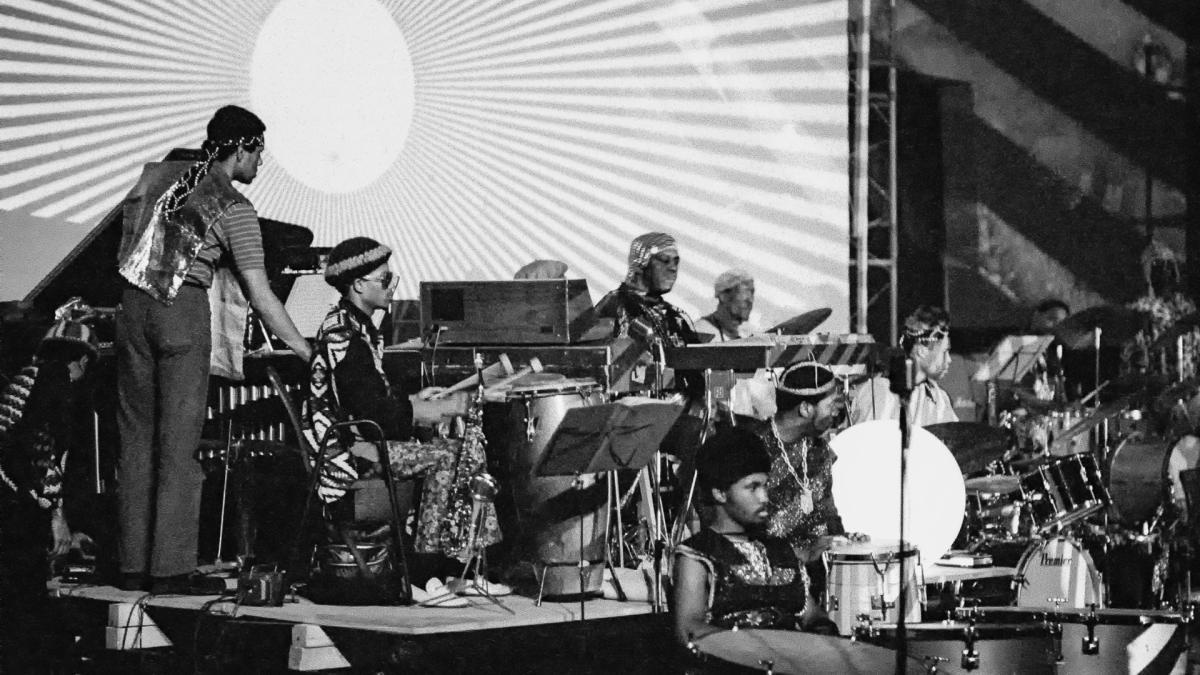
There are two plausible readings. One is that the prototype loan began in 1969, and later sessions at the factory took place the following summer. The other is that sources have conflated two visits. The Moog Foundation also says the “Moog Experiment” recording came from the 1969 visit and was released in 1992 on Volume 2, which sits uneasily with the summer 1970 claim. This article does not choose between them.
What the records show
The same foundation article lists a set of recordings. My Brother the Wind, Vol. 1 on Saturn in 1970 includes “The Code of Interdependence,” an extended Minimoog solo, though the foundation cautions that the credit for two Minimoogs may be inaccurate, since the November 2, 1969 Philadelphia session may have used only one.
The Night of the Purple Moon, also 1970, has Sun Ra on Minimoog and Rocksichord. A live set recorded on August 5, 1970 at Saint Paul de Vence, France, released in 1971 as Nuits de la Fondation Maeght, contains “The Cosmic Explorer,” a nearly twenty-minute Minimoog solo.
Space Probe, released on Saturn in 1974, was recorded November 2, 1969 in Philadelphia, which the foundation describes as one of the earliest commercial recordings to use a Minimoog. Sorry State is more cautious, saying the track “Space Probe” is a solo Moog piece recorded around the same time, possibly on a Minimoog. It also notes that a typewritten card on one release claimed the track was recorded in Chicago in the 1960s, which the label dismisses as fanciful at best.
A further detail from Holmes: the track “Space Probe” mixes keyboard playing with knob turning and modulation, and he says its scales sound almost microtonal.
Why he wanted the machine
The reissue notes include Sun Ra’s own account of his intentions. He did not want to use the Moog to reproduce existing music. He saw electronic instruments as futuristic tools, and talked about a Black Space Program powered by sound instead of gasoline. According to the notes, he thought future technology could use sound to power ships, cars and homes, and that the Moog would help him achieve lift-off.
That attitude stands out against the commercial mood of the period. The notes contrast his approach with the trend of using the synthesizer to play familiar melodies. Whatever one thinks of the cosmology, the practical result is clear: a bandleader treated a brand-new instrument as a vehicle for unfamiliar sounds, not as a novelty for old tunes.
Sun Ra’s keyboard family
The Minimoog was one instrument among many in a large keyboard collection. Equipboard lists fourteen keyboards and synthesizers, from two Minimoog entries to Farfisa organs, a Hohner Clavinet and later Yamaha instruments. It also points to the film Space Is the Place, where it says a Model B can be seen in the background about 35 minutes in. That claim is the site’s own inference from a background shot, so it should be taken as a suggestion.
The same list notes that the Model C entry is described in its text as a Model B, which shows how easily the details blur. The safest statement is the one in the foundation’s account: Sun Ra received a prototype, bought a second instrument later, and used them on many recordings.
Final perspective
The documented history of the Sun Ra Minimoog is more interesting for what it fails to settle than for the legend it supports. Dates conflict, credits are imprecise, and the prototype itself went where Moog could not follow. What remains reliable is the pattern. Sun Ra reached for each new electronic keyboard as soon as it existed, and he used it to make sounds that no one else was making.
For the synthesizer’s own story, the lesson is about who defines an instrument. Bob Moog designed the Minimoog as a compact tool for performing musicians. One of the first performers to take it seriously used it as a way out of the ordinary, and the results are still being reissued.
Related stories
Sources