Home›Articles›Roland JP-8000: How seven detuned sawtooth waves became…
Articles

Roland JP-8000: How seven detuned sawtooth waves became the sound of trance

JP-8000: One waveform option on a late-1990s Roland keyboard ended up as a genre signature. The Roland JP-8000 offered a “Super Saw,” a stack of seven…

Bernardo de Azevedo
Bernardo de Azevedo
· Updated
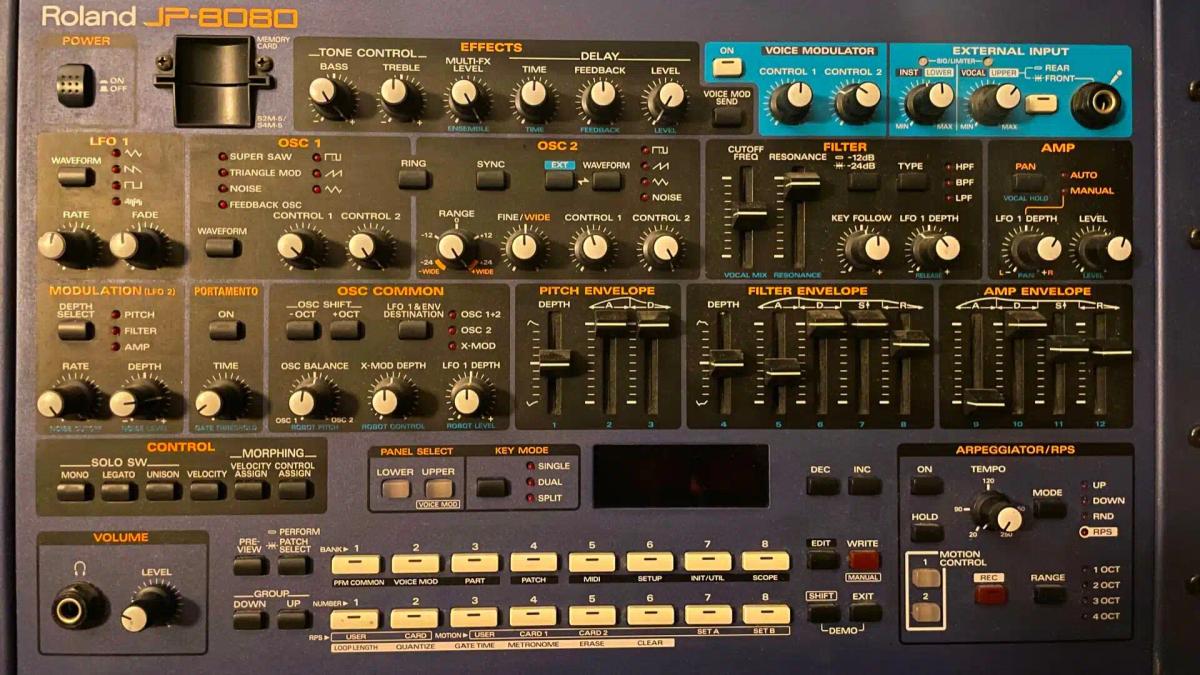
Roland JP-8000 - historic photo

One waveform option on a late-1990s Roland keyboard ended up as a genre signature. The Roland JP-8000 offered a “Super Saw,” a stack of seven sawtooth waves slightly out of tune with one another, and dance producers heard in it a lead sound that could fill a festival field.

The strange part of the story is what happened next. The machine itself drifted out of fashion, while its signature sound became so widely imitated that most people who use a supersaw today have never touched the instrument that introduced it. Where does a sound live once its hardware stops mattering?

Table of Contents

  • Roland JP-8000: a modern Jupiter in a digital body
  • Seven sawtooth waves in one oscillator
  • What the first reviewers heard
  • Anthem trance and the lead that carried it
  • Sandstorm and the startup patch
  • The synth that fell out of fashion
  • The supersaw without the synthesizer
  • Final perspective

Roland JP-8000: a modern Jupiter in a digital body

The Roland JP-8000 was a virtual analog synthesizer, a machine that imitated the architecture of analog subtractive synthesis with digital processing. Wikipedia places it in 1996 in one paragraph and early 1997 in another, and lists production from 1996 to 2001, so the exact launch date is best left as roughly that turn of the year. The US price given there is $2,295.

It was seen as the modern digital incarnation of the classic Jupiter-8, with programming and tone that also recall the Jupiter-6. It had eight voices, two oscillators per voice, two LFOs, two ADSR envelopes and a resonant filter that could be set to low-pass, high-pass or band-pass. The keyboard had 49 keys with velocity sensitivity. Roland used sliders instead of knobs for editing, and added a ribbon controller, an arpeggiator and a phrase-sequencing function called RPS.

It arrived in a crowded moment. Wikipedia lists the Clavia Nord Lead, the Korg Prophecy, the Access Virus and the Yamaha AN1x as contemporaries, and the Perfect Circuit history notes that virtual analogs were spreading in a climate where some people expected them to replace the real thing.

Seven sawtooth waves in one oscillator

The feature that mattered was the first oscillator’s Super Saw waveform. Roland itself described it as the sound of seven simultaneous sawtooth waveforms. Perfect Circuit explains how it was controlled: a Detune fader spread six extra saws slightly around one accurately tuned primary saw, and a Mix fader set the level of the detuned voices against the central one.

Wikipedia adds that it was a free-running oscillator, so that the shape drifted over time as the waves moved against each other. Because the Super Saw was simply a selectable waveform, it did not cost any polyphony. The rack-mounted JP-8080, released in 1998 with a vocoder, extra patches and distortion, offered the same oscillator. Perfect Circuit also suggests that internal high-pass filtering in the JP-8000 contributed to the sound’s character, though the page frames this as a likely factor, not a confirmed detail.

None of the sources consulted names the engineer behind the supersaw. In the material read here, the credit goes to Roland as a company.

What the first reviewers heard

Sound on Sound previewed the instrument in February 1997, in a piece by Brett Mitchell. He described the Super Saw as a waveform made of seven sawtooth waves detuned against each other, and called the overall sound bright and forward. He thought it sounded closer to real analog instruments than Roland’s sample-based JD range, and he called it the finest-sounding machine the company had made in quite some time.

The preview also expected the JP-8000 to appeal to analog fans and in particular to electronic and dance producers. The preview is only the opening of a longer review, and it says nothing about a genre to come. That is a useful reminder. What looked like a good new synth with a thick waveform became a cultural landmark once players found what the waveform was for.

Anthem trance and the lead that carried it

Wikipedia credits the JP-8000 with helping to define trance and hardcore, mainly through the Super Saw. It was a main keyboard sound in dance music, alongside the Access Virus, and it shaped what the article calls anthem trance, a style in which a powerful lead carries the melody and hook. Wikipedia compares this to the role of the TB-303 in acid house.

The Perfect Circuit history says the sound became so closely associated with the genre that many people simply call it the trance sound. It was used from the late 1990s onward for melodic anthems and dance floors in warehouses, festivals and other venues. A Dance Music NW anniversary piece from December 2016 says the style of anthem trance followed shortly after the JP-8000’s release, and names Above and Beyond, Armin van Buuren and Myon and Shane 54 among artists who used supersaw-style sounds.

It does not claim these artists used a hardware JP-8000.

Sandstorm and the startup patch

The best-known single connected to the machine is Darude’s “Sandstorm,” although it involves the rack version. Wikipedia’s article on the track says the title comes from the Roland JP-8080, which displays “sand storm” when it starts up. The Supersaw article describes it a bit differently, saying the track is named after the pad patch loaded when the synth boots. Either way, the origin is a factory default, not a studio decision.

“Sandstorm” was released in Finland on October 26, 1999, and recorded the same autumn in September and October at JS16’s studio. The track was ready after about a week of work, at 136 BPM in E minor. The listed gear also includes an Ensoniq ASR-10 sampler, a Nord Lead 2 and a Roland JV-2080, so it would be wrong to credit the whole sound to a single machine. It reached number one in Canada and Norway, number three in the UK, and was certified platinum in the United States.

The synth that fell out of fashion

Here the story takes a turn. In November 2014, Attack Magazine included the JP-8000 in a feature on affordable first vintage synths. It called the machine one of the classic synths of the 1990s, said it had been priced at £1,499 on release in 1996 and suggested that a buyer could find one for under £150. It also warned that the synth had fallen out of fashion hard and that anyone hoping for a future collector’s item would probably be disappointed.

That price advice was contested at once. Readers’ comments reported listings above £500 and called the article’s figures off. The disagreement shows how thin the market data is, so both figures deserve caution. The point stands either way: unlike the Jupiter-8 it was compared to, the JP-8000 did not become a revered object, and a very influential instrument can still be a cheap one.

The supersaw without the synthesizer

The oscillator outlived the box. Wikipedia lists later supersaw designs that include Roland’s own SH-201, SH-01 Gaia, V-Synth and Gaia 2, Access’s Hypersaw in the TI line from 2005, and software such as SUPERWAVE P8 and Supersaw Plus. Perfect Circuit adds modern hardware including the ASM Hydrasynth, the Modal Cobalt8 and the Roland SH-4d.

The Dance Music NW piece makes a quieter observation. Modern supersaws, it says, are usually handcrafted layers of oscillators in a DAW, not the original technology. Its suggested method splits the sound into four frequency groups: sub lows, low-mid bass, mid lead and top end, with a mono sine for the sub and wide, filtered layers for the lead. Producers built their own approximation of what one Roland oscillator had once done in a single step.

Final perspective

The Roland JP-8000 is a case of an instrument defined by one feature, and a feature that became larger than the instrument. Sound on Sound heard a fine, bright synth. The dance floor heard something else, and eventually the genre was named after the lead.

What the history suggests is that a sound can detach from hardware completely. A waveform that cost no extra polyphony, controlled by two faders, set a template that later makers, software authors and DAW users kept rebuilding. The JP-8000 may be remembered mostly as an inexpensive used keyboard, but its seven saws are still, in effect, playing.

Related stories

Sources

Bernardo de Azevedo
Written by
Bernardo de AzevedoFounder & Editor

His connection with music began at age 6, in the 1980s, when his father introduced him to Jean-Michel Jarre's Rendez-Vous on vinyl. He works professionally in the legal field, while synthesizers became his space for abstraction and creative exploration. Founder of The Synth Source.