

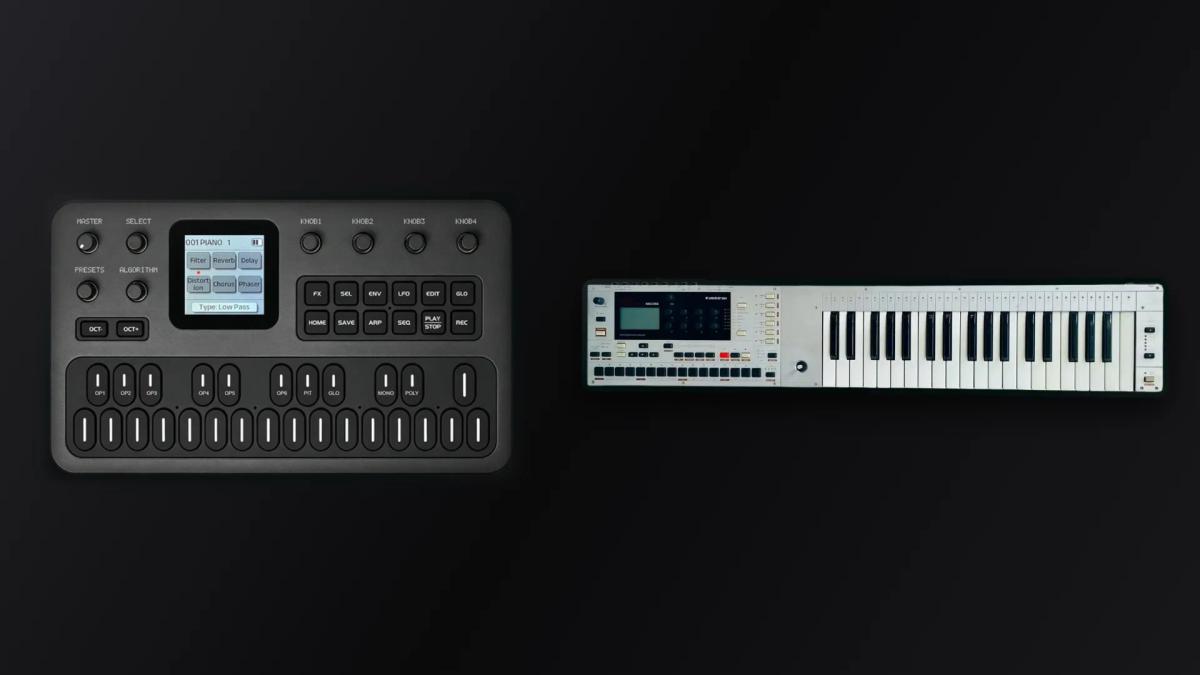
MONO2K is a custom firmware for the M-VAVE FM-1 that borrows the working method of Elektron’s Monomachine: six tracks, one synthesis machine per track, a sequencer with parameter locks and a deliberately dirty output stage. It is published by a developer who works under the name Sequencist and whose GitHub account is InigoHernandez. The MONO2K firmware raises a pointed question, namely how closely a pocket synth can follow a 2004 design when, by the author’s account, every machine is written from scratch and checked against the original with measurements.
Table of Contents
What the MONO2K firmware is
The project describes itself as a Monomachine-style firmware with a 1-bit, 240 by 240 screen, dithered type and machine icons. The Elektron Monomachine was produced from 2004 to 2016, offered six tracks and stored a snapshot of track parameters on each sequencer step. MONO2K reproduces that workflow on the FM-1 rather than the DX7-style voice the device ships with, which is covered in the M-VAVE FM-1 profile.
The MONO2K firmware code is GPL-3.0-only according to the README, which says it is built on open FM-1 work including Felucca and carries that project’s update loader. The project’s pages state that it is not affiliated with Elektron or M-VAVE.
The interface follows from that borrowed logic. Each knob value is drawn as a small picture (dials, sliders, curves, wave shapes) in the manner of Elektron’s parameter pages, and machine icons move in time with the pattern. The screen can be set to a light or dark scheme. It is an unusual choice of identity for a firmware that could have settled for text lists, and it will not suit everyone.
The same core also runs in a browser through WebAssembly, so the project page doubles as an emulator, with a patch editor and a manual beside it. That is a practical way to judge the interface of the MONO2K firmware before owning the hardware.
Six tracks, nineteen machines
The tagline mentions six mono machines, which is slightly misleading. According to the manual, each of the six tracks hosts one machine, and the player chooses from nineteen. They are grouped in families: sine and noise tones, three SuperWave-style variants (saw, pulse, ensemble), a digital wave machine, a formant voice, a SID-6581 chip voice, three FM machines, four drum voices and three effect machines.
The effect machines make no sound of their own. They process the track before them, so a source on track 3 can be followed by a chorus, ring modulator or dynamics stage on track 4. The drum voices are described as modelled on the voices of Erica Synths’ LXR, with the page stating that none of that instrument’s code or samples are used.
Each track also has its own chain. The amplifier section covers attack, hold, decay, release, distortion and portamento. The filter combines high-pass and low-pass in one band described by a base and a width. Further pages add EQ, sample-rate reduction, an 8-bit mu-law delay, bit crushing, wavefolding and an XOR mangler, plus three LFOs per track and an arpeggiator.
Sequencer and lofi bus
The sequencer has 64 steps per track and supports parameter locks, according to the project page and README. Each step can trigger the amplifier, the filter envelope and the LFOs independently, giving eight trig states from ALL to NONE. The README describes a trigless lock among them, which is the kind of detail that Monomachine owners will recognise.
Conditions include chance steps, A:B loops, first and previous-step tests and fill logic, and a step can ratchet one to four times. Tracks can run their own length and speed, so polymeter is built in. A drum pattern generator ported from Mutable Instruments’ Grids is also included under the same licence.
The signature of the firmware is the bus. A feedback-delay reverb with a tail from 0.3 to 24 seconds, a 4-bit ADPCM crunch and a drive into a soft clip sit on the master. A PERFORM mode, reached by holding FX, then turns the black keys into bus effects such as repeats, reverse, stutter, freeze, scatter and shimmer. Read in sequence, the manual suggests an instrument meant to be played and broken live rather than programmed and left alone.
The factory content points the same way. According to the README, bank A of the demo project holds four parts named CIRCUIT, TIDE, SUSPEND and LANTERN, and the README adds that their sounds were drawn at random and picked by ear. The manual says the sound library has 128 slots, of which 96 are factory sounds, twelve in each of eight categories.
Calibrating against the original
The most distinctive part of MONO2K is its documented testing. The project page says the machines were measured against a Monomachine running in a community emulator, by playing identical notes and knob settings on both and recording levels, spectra, times and stereo behaviour. It reports 944 cases, grouped by topic, and 2,605 measured numbers kept, and it calls the reference “measurements only, no code or data”, the same line the README applies to the emulator.