Home›Reviews›Korg Mono/Poly vs Behringer Monopoly: Does the clone ca…
Reviews

Korg Mono/Poly vs Behringer Monopoly: Does the clone capture the grit of the originals?

Mono Poly vs Monopoly: how do they really differ? We break down sound, controls and value from Kebu’s hands-on video test to help you choose.

Bernardo de Azevedo
Bernardo de Azevedo
· Updated
Korg Mono/Poly vs Behringer Monopoly comparison

Choosing between the Mono Poly and the Monopoly? This Mono Poly vs Monopoly comparison summarizes what Kebu found when testing both instruments, so you can see how they differ in sound, controls and value before you buy.

For Kebu, the Korg Mono/Poly is one of his favorite synthesizers. He has owned his since 2009 and used it so much on his first two albums that at some point he decided he had to stop using it. He describes its sound as aggressive and biting yet still warm, a sound that belongs to early-1980s recordings. So the arrival of Behringer’s Monopoly raises the big question: how does it compare with the original?

He is unusually well placed to answer, because he owns two original Mono/Polys, a “studio” unit and a “live” unit that sound surprisingly different from each other.

Source video: Korg Mono/Poly vs. Behringer Monopoly (Kebu, YouTube)

Table of Contents

  • Same panel, different details
  • Listening: studio unit, live unit and clone
  • Key assign modes and the arpeggiator
  • What he would change
  • Which one makes more sense?

Same panel, different details

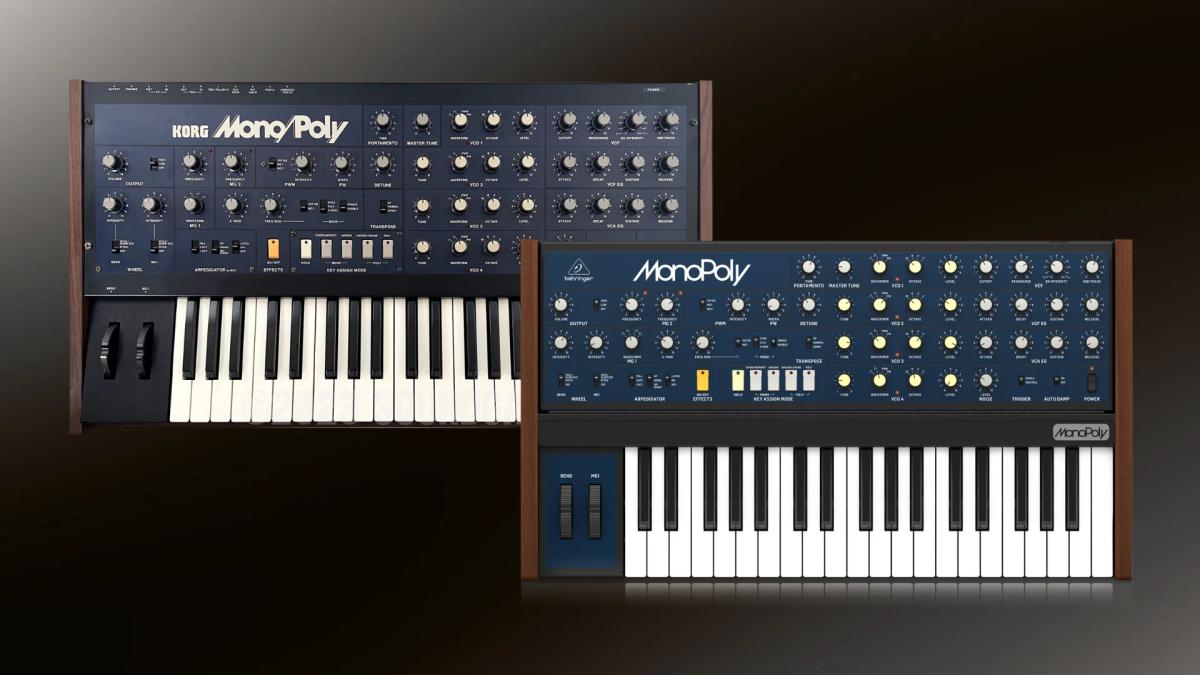
The panel is essentially identical: four oscillators feeding a filter and amplifier, separate envelopes, portamento, one-knob detune, pulse width modulation, sync and cross modulation, an arpeggiator and two wheels. It is a paraphonic design: you can play polyphonically, but everything shares one VCA envelope and one VCF envelope.

On the back, the Behringer’s trigger input accepts only voltage pulses, which he finds more flexible for syncing with other gear, and it adds MIDI and USB. The MIDI only controls the keyboard, not the knobs, which is a pity, but the original did not offer that either. The Monopoly can be tilted for programming, and, in his view the best addition, it gives easy access to the internal trimmers for tuning, whereas on the original you need to open the panel and consult a service manual.

It is heavy, around 10 kg versus 12 kg for the original, thanks to a steel frame on both.

However the Mono Poly vs Monopoly debate plays out for you, the best test is still playing both instruments side by side.

Listening: studio unit, live unit and clone

Playing the sawtooth, pulse, pulse width modulation and triangle waveforms, he finds the Behringer very similar to his studio Mono/Poly. His live unit has more bass and is temperamental: in the upper register notes sound slurred, as if portamento were on, so it needs servicing, though it adds charm. The difference between his two originals is bigger than the difference between the Behringer and his studio unit, which he finds fascinating, since two units from the same years sound this different as components age.

The envelopes are another point: the Behringer’s are so clean that you can hardly hear them with the oscillators turned down, whereas the older units have more grit, and the live one has an audible click or pop that adds a lot to its sound. In a musical context with several oscillators, those small nuances add up, and he finds the live Mono/Poly benefits from the pops in the attack. Overall, he was positively surprised how close the Behringer sounds to his studio unit.

In the Mono Poly vs Monopoly comparison, price and playability matter as much as raw sound.

Key assign modes and the arpeggiator

He walks through the unison, poly, unison-share and chord memory modes, and the fun of the arpeggiator in polyphonic mode, where it cycles through the oscillators, each of which can have different octaves and waveforms. Clocked from an external step sequencer, it produces rhythmic patterns, and that is how he made the main riff of one of his tracks.

The Mono Poly vs Monopoly question rarely has a single right answer, because it depends on how you actually work.

What he would change

His complaints are few: the external power adapter instead of an internal one, no aftertouch, and the way the clock input works. With external clock selected through software over USB, removing the trigger stops the arpeggiator entirely, whereas on the original the internal LFO takes over.

If you are still undecided in the Mono Poly vs Monopoly matchup, think about which controls you would reach for every day.

Mono Poly vs Monopoly: which one makes more sense?

He is really impressed. The Behringer sounds like a new Mono/Poly rather than his old ones, but really close, and it feels and sounds like a Mono/Poly. If you want the personality of a vintage unit with its quirks, the original is irreplaceable, and each unit has its own. If you want that sound reliably, with MIDI, easy tuning and a build that can take the road, the Behringer is a strong, affordable way to get it.

That is the Mono Poly vs Monopoly decision in short: match the instrument to the sound and workflow you actually want, and weigh the price difference before you commit.

Related comparisons

Sources

Bernardo de Azevedo
Written by
Bernardo de AzevedoFounder & Editor

His connection with music began at age 6, in the 1980s, when his father introduced him to Jean-Michel Jarre's Rendez-Vous on vinyl. He works professionally in the legal field, while synthesizers became his space for abstraction and creative exploration. Founder of The Synth Source.