Home›Reviews›Matriarch vs Prophet-6: Paraphonic funnel or six parall…
Reviews

Matriarch vs Prophet-6: Paraphonic funnel or six parallel synths?

Matriarch vs Prophet-6: how do they really differ? We break down sound, controls and value from Jameson Nathan Jones’s hands-on video test to help you choose.

Bernardo de Azevedo
Bernardo de Azevedo
· Updated
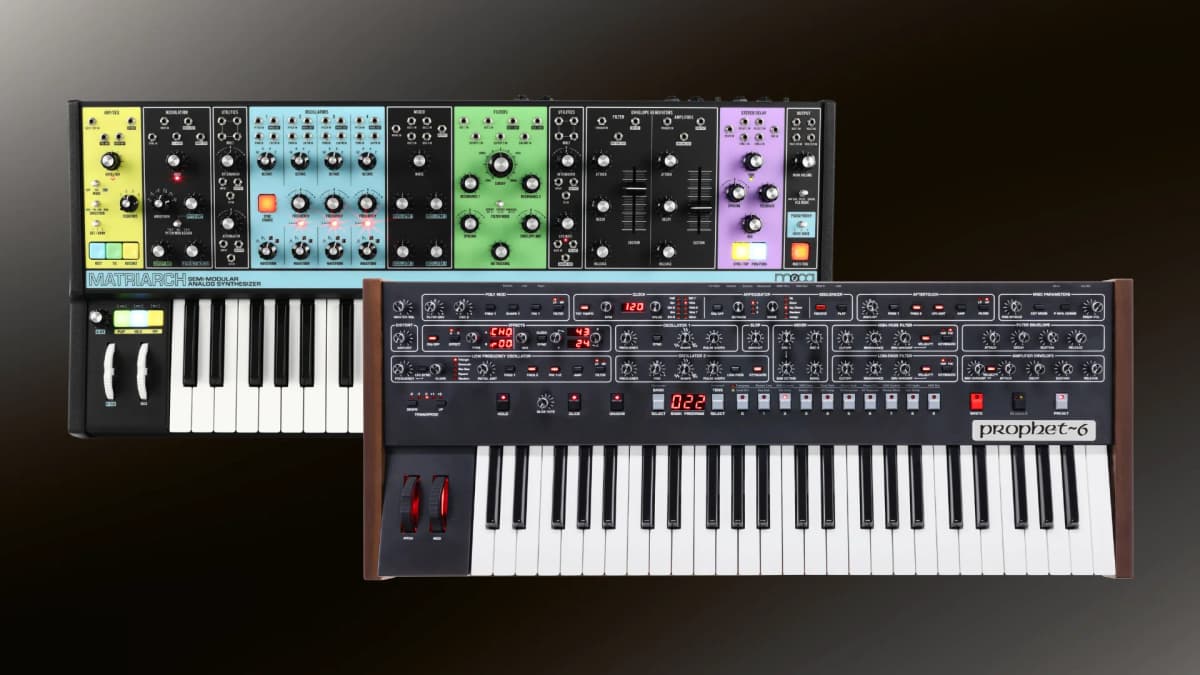
Moog Matriarch vs Sequential Prophet-6 comparison

Choosing between the Matriarch and the Prophet-6? This Matriarch vs Prophet-6 comparison summarizes what Jameson Nathan Jones found when testing both instruments, so you can see how they differ in sound, controls and value before you buy.

On a spec sheet, the Moog Matriarch and the Sequential Prophet-6 have almost nothing to argue about. Both are analog, both are keyboard-friendly instruments with serious sonic reputations, and both can play more than one note at a time. But the comparison that matters is not about sound quality. It is about what “more than one note” actually means inside each machine, and that difference changes how you play, how you program and what you can expect from an arpeggiator.

That is the useful lens Jameson Nathan Jones brings to this pairing: before arguing over which one sounds better, understand the difference between polyphony and paraphony. Once that distinction is clear, the two instruments stop looking like rivals and start looking like two different answers to two different musical questions.

Source video: Moog Matriarch vs Sequential Prophet 6 [paraphonic or polyphonic] (Jameson Nathan Jones, YouTube)

Table of Contents

  • Six synths in parallel versus one signal path
  • Re-triggering: the clearest audible difference
  • Where paraphony pulls ahead: arpeggiators and oscillator tricks
  • Which one makes more sense?

Six synths in parallel versus one signal path

The Prophet-6 is a true polyphonic instrument. According to the reviewer, each of its six voices carries its own oscillators, noise source, filter, envelopes, LFO and VCA, and each voice runs in parallel and independently of the others. In practical terms, playing a six-note chord means playing six separate analog synthesizers at once. That is also the reason he gives for why instruments like this tend to cost more: the manufacturer has to build an analog synth for every voice.

The Matriarch is built on a different idea. It has four oscillators that can all be played at the same time, but all of them feed the same mixer, the same stereo filters and the same filter and VCA envelopes. The reviewer describes it as a funnel: every oscillator enters one signal path and leaves through a shared VCA and shared filters. That architecture is what makes the Matriarch paraphonic rather than polyphonic.

There is an upside to the funnel, and it is a very Moog one. Because everything runs through the same analog path, pushing the oscillators hard into the shared mixer produces a pleasant overdrive. The reviewer treats that as part of the character of the Moog sound, a by-product of the architecture rather than a flaw to be engineered away.

However the Matriarch vs Prophet-6 debate plays out for you, the best test is still playing both instruments side by side.

Re-triggering: the clearest audible difference

The most instructive part of the comparison is a simple demonstration. Using MIDI to drive the Prophet-6 from the Matriarch’s keyboard, the reviewer holds the top notes of a chord and re-triggers the lower ones. On the Prophet-6, each voice’s filter envelope fires independently, so the held notes keep evolving while the new ones start fresh.

On the Matriarch the result is different. With only one filter envelope, every new note re-triggers the shared envelope, and that affects the notes that were already sounding. With multi-trig switched on, the envelope fires every time. With it off, the instrument waits for the last voice to finish its release before re-triggering the VCA, which lets you play without re-triggering until everything has been released.

He is direct about what this means. It is a limitation if you want a polyphonic instrument, and the Matriarch is not one. But he is just as direct that this does not make polyphony “better”. It makes it different.

In the Matriarch vs Prophet-6 comparison, price and playability matter as much as raw sound.

Where paraphony pulls ahead: arpeggiators and oscillator tricks

The reviewer’s strongest argument for the Matriarch is the arpeggiator. Because each oscillator can be set independently, a paraphonic synth can do things in an arpeggio that neither a polyphonic nor a monophonic instrument can do in the same way. He demonstrates this with oscillator sync, and notes that the round-robin behavior can be adjusted on the Matriarch by holding one button along with the sync enable button while holding down keys. The result is a different kind of movement, with each oscillator contributing its own timbre to the pattern.

In short, the Prophet-6 gives you the reliability and independence of six complete voices. The Matriarch gives you a single, shared path that can be pushed into overdrive and exploited rhythmically by its arpeggiator.

The Matriarch vs Prophet-6 question rarely has a single right answer, because it depends on how you actually work.

Matriarch vs Prophet-6: which one makes more sense?

If your priority is playing chords, pads and parts where every note should behave independently, the Prophet-6 is the more natural tool. Its architecture gives each note its own envelope and its own place in the sound.

If you are drawn to the Moog character, to overdriven shared signal paths and to arpeggios where each oscillator can do something different, the Matriarch makes the stronger case, as long as you accept the limits that come with paraphony. The reviewer leaves the deeper Prophet-6 discussion to a separate video, but the core message of this one is clear: these are not two answers to the same question, and the best choice depends on which question you are asking.

That is the Matriarch vs Prophet-6 decision in short: match the instrument to the sound and workflow you actually want, and weigh the price difference before you commit.

If you are still undecided in the Matriarch vs Prophet-6 matchup, think about which controls you would reach for every day.

Related comparisons

Keep your own music in mind when weighing the Matriarch vs Prophet-6 choice, since a spec sheet only tells part of the story.

Sources

Bernardo de Azevedo
Written by
Bernardo de AzevedoFounder & Editor

His connection with music began at age 6, in the 1980s, when his father introduced him to Jean-Michel Jarre's Rendez-Vous on vinyl. He works professionally in the legal field, while synthesizers became his space for abstraction and creative exploration. Founder of The Synth Source.