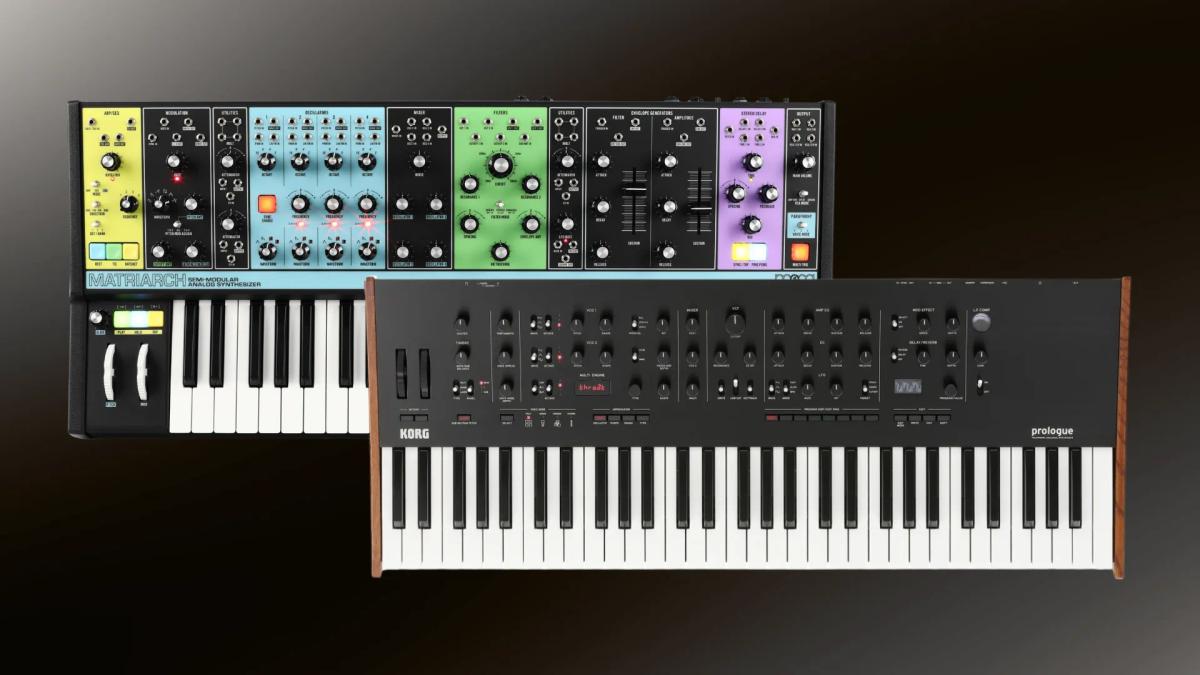
Matriarch vs Prologue: Moog brass and bass against polyphonic tricks
Matriarch vs Prologue: how do they really differ? We break down sound, controls and value from Devin Belanger’s hands-on video test to help you choose.
Choosing between the Matriarch and the Prologue? This Matriarch vs Prologue comparison summarizes what Devin Belanger found when testing both instruments, so you can see how they differ in sound, controls and value before you buy.
Devin Belanger (Miles Away) follows an earlier Prologue versus Summit video with another match-up of two of his absolute favourite synths: the Moog Matriarch and the Korg Prologue. He stresses it is in no way a scientific comparison. To bring the Prologue closer to the Moog’s beefy oscillator character, he uses its low-frequency compressor throughout.
Source video: Moog Matriarch vs. Korg Prologue: Analog Sound Design Shootout (Devin Belanger, YouTube)
On basic sawtooth patches, the Moog is a little darker and the Prologue a little brighter. The Matriarch’s oscillators are tuned independently and have to be tuned each time you use it, while the Prologue’s are, he believes, tuned digitally by the software at start-up, so they are quite stable. He thinks the Prologue’s oscillators are underrated: among the warmest yet punchiest he has heard.
The filter is where he calls a clear winner. The Prologue’s filter is nice, but the Matriarch’s is “really something special”, with a brassiness he finds unbelievable, and he hasn’t even touched its stereo capabilities. The Prologue’s filter is less thick, which makes it easier to mix for light pads, whereas the Matriarch takes up a lot of room because of how fat it sounds.
With resonance, the Moog’s ladder filter loses low end, as expected, while the Prologue has a distorted, MS-20-style growl and loses gain, though you can compensate through the mixer. The Matriarch has a 24 dB filter and the Prologue a 12 dB one, and both self-oscillate. Because the Moog filter is stereo, you get two resonant peaks that you have to tune together.
However the Matriarch vs Prologue debate plays out for you, the best test is still playing both instruments side by side.
Square waves, basses and richness
For pulse width modulation and big square basses, he picks the Moog: the Prologue’s square is smooshier and less punchy, and the Moog’s is unbeatable. For a plucky bass he says there’s “no contest”, with unbelievable low-end punch. In a richer patch with a sub square and two detuned saws, the Moog richness is incredible, and the 24 dB filter gives a brassy tone as it cuts everything above a certain frequency, whereas the Prologue lets much of the high end through.
The Prologue, in turn, has a trick: it can layer sub frequencies underneath, which the Matriarch cannot do. “Pick your poison,” he says, as both sound awesome.
In the Matriarch vs Prologue comparison, price and playability matter as much as raw sound.
Dreamy plucks and polyphony
For a chill pluck on a triangle wave with a slow pitch LFO and delay, the Matriarch makes one of his favourite sounds. But on the Prologue he finds the triangle wave bell-like and arguably nicer than the Moog’s, and the 12 dB filter matters less when there is less harmonic content to remove.
The Prologue is also fully polyphonic, so it doesn’t retrigger the filter on every note, and turning off LFO sync gives each voice its own LFO, which adds a dreamy quality and something he says is miles more advanced than the Matriarch.
The Matriarch vs Prologue question rarely has a single right answer, because it depends on how you actually work.
Matriarch vs Prologue: which one makes more sense?
His personal verdict is a Moog lover’s: the Prologue is a fantastic synth, but nothing will ever beat that Moog sound. The honest practical summary: choose the Matriarch for the fat, brassy ladder filter, square waves and bass, and choose the Prologue for polyphony, per-voice modulation, layering tricks and a cleaner, easier-to-mix sound.
That is the Matriarch vs Prologue decision in short: match the instrument to the sound and workflow you actually want, and weigh the price difference before you commit.
His connection with music began at age 6, in the 1980s, when his father introduced him to Jean-Michel Jarre's Rendez-Vous on vinyl. He works professionally in the legal field, while synthesizers became his space for abstraction and creative exploration. Founder of The Synth Source.