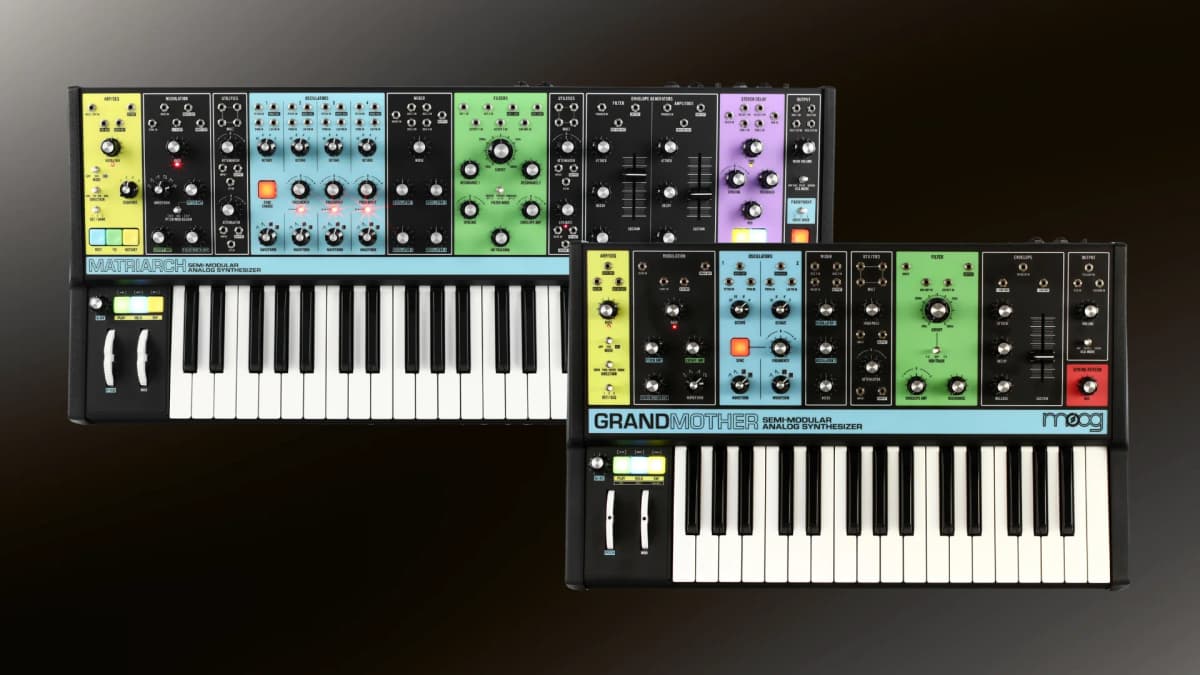
In the Matriarch vs Grandmother comparison, price and playability matter as much as raw sound.
Oscillators, modulation and the Matriarch’s extra structure
The Matriarch has twice the oscillators, built-in paraphonic modes, a stereo signal chain with dual filters, dual VCAs and dual delays, and a more elaborate sequencer. The sequencer is polyphonic and has 12 slots versus three, and the arpeggiator can turn off the repeated first and last notes in up-and-down mode. The LFO has two extra shapes, stepped triangle and smooth random, and can be assigned to different oscillator pairs for sync and FM.
The two utility modules matter too. On the Matriarch the attenuators are voltage-controlled, which means they can act as bipolar VCAs or ring modulators. There are two ADSR envelopes instead of one, with a dedicated filter envelope and separate VCA control, and the envelopes can loop. The effects include a stereo dual delay that can sync to the sequencer and has a ping-pong mode.
He is careful to add that the Matriarch is not fully polyphonic. All four oscillators share the same filter and amplifier envelopes, though it has tricks such as paraphonic unison and round-robin mode.
The Matriarch vs Grandmother question rarely has a single right answer, because it depends on how you actually work.
Matriarch vs Grandmother: which one makes more sense?
His conclusion is the one that gives the video its value. They are two quite different things despite the similar look. The Grandmother is a bass and lead machine with a lot of character, a nice Eurorack sidekick and starting point, like a bundle of classic Moog modules with a keyboard, arpeggiator and sequencer. The Matriarch is more of its own thing, with quirky paraphonic modes, round-robin chord inversions, stereo filters, VCAs and delays, and a stepped LFO that keeps surprising him.
He adds a practical warning for beginners: neither synth can save presets, so patches must be photographed. These are instruments designed for analog exploration.
That is the Matriarch vs Grandmother decision in short: match the instrument to the sound and workflow you actually want, and weigh the price difference before you commit.
Related comparisons
Sources