Home›Reviews›Jupiter-X vs Juno-X: Flagship presence or medium-sized …
Reviews

Jupiter-X vs Juno-X: Flagship presence or medium-sized sensibility?

Jupiter-X vs Juno-X: how do they really differ? We break down sound, controls and value from MR TUNA Music’s hands-on video test to help you choose.

Bernardo de Azevedo
Bernardo de Azevedo
· Updated
Roland Jupiter-X vs Roland Juno-X comparison

Choosing between the Jupiter-X and the Juno-X? This Jupiter-X vs Juno-X comparison summarizes what MR TUNA Music found when testing both instruments, so you can see how they differ in sound, controls and value before you buy.

Roland’s Jupiter-X and Juno-X share so much that choosing between them can feel like a question about furniture rather than sound. A player who owns both, and who confesses he sometimes wonders why he keeps both, argues that the two are “extremely similar” synthesizers separated by size, scope and a few design choices.

That makes the comparison useful for a different reason than most. The question is not which synth has more features. It is which interface, which footprint and which price fit the way you actually work.

Source video: Jupiter X vs Juno X… Which is best for you? Pros & Cons SYNTH TALK (MR TUNA Music, YouTube)

Table of Contents

  • Almost the same synth, in different packaging
  • Controls, screens and layering
  • Sound: smoothness versus depth
  • Which one makes more sense?

Almost the same synth, in different packaging

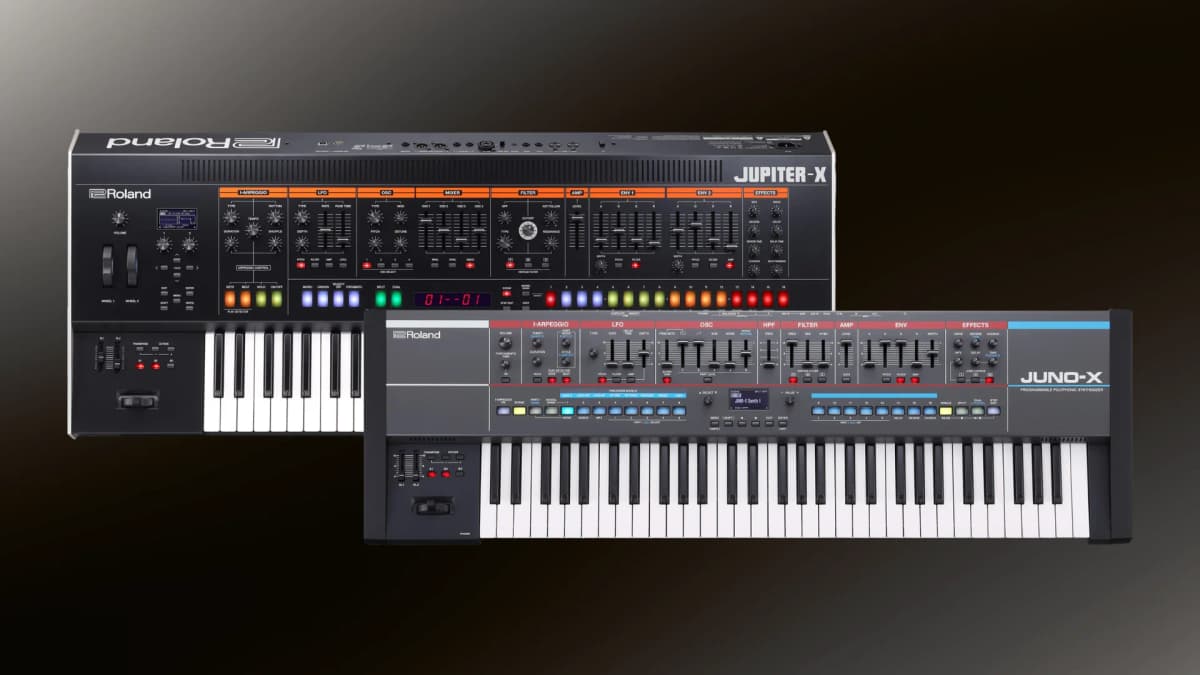
The Jupiter-X is the original and the flagship. It is larger, heavier and more imposing, with aluminum side panels and a largely metal body. The Juno-X sits in a more medium-sized package with, in the reviewer’s words, an almost entirely identical feature set, down to the sounds, the built-in speakers and the Bluetooth connectivity. Both have 61 keys with aftertouch, five parts and a long list of connectivity options including USB MIDI, Bluetooth audio and MIDI, mic inputs and full MIDI in and out.

The compromises on the Juno-X are build and keybed. It has more plastic, and he understands that its keybed is lighter-duty, particularly for aftertouch. He says he can feel the difference when comparing them directly, while not feeling it as a deal-breaker.

However the Jupiter-X vs Juno-X debate plays out for you, the best test is still playing both instruments side by side.

Controls, screens and layering

The two synths approach control differently. The Jupiter-X has a classic knob-laden layout for the arpeggiator, oscillators, filter and effects. The Juno-X takes its design heritage from the Juno-106 and uses faders. For filter sweeps he prefers the range of a rotary control, though he does not consider it a deciding factor.

The screens are also positioned differently. On the Jupiter-X the display sits off to the side, supplemented by a retro digit display. On the Juno-X it is front and center, which he prefers. He also finds the Juno-X’s part layout easier to understand when stacking and layering, since parts are separated rather than lined up side by side. The Jupiter-X offers eight effect controls without secondary functions, while the Juno-X relies more on shifted functions and also places mono, unison, split and master effects behind secondary controls.

In the Jupiter-X vs Juno-X comparison, price and playability matter as much as raw sound.

Sound: smoothness versus depth

Both synths offer multiple engines. The Juno-X focuses on the Juno family, including Juno-106 and Juno-60 models, as well as XV and RD sounds. The Jupiter-X adds the Jupiter-8 and the Jupiter-X engine itself, which he describes as seriously capable, with four oscillators and four envelopes.

His impression is that the Juno-X has a beautiful smoothness that the Jupiter-X lacks, while the Jupiter-X engine has real power and depth, especially in the low end. He also mentions that the chorus sound is something the Juno-X excels at, and that he dislikes the drive setting on both.

The Jupiter-X vs Juno-X question rarely has a single right answer, because it depends on how you actually work.

Jupiter-X vs Juno-X: which one makes more sense?

For his money, the Jupiter-X offers more presence, more tactile control and a sturdier build, but it takes up a lot of space and weighs a lot. The Juno-X offers a more portable package, an interface he finds clearer and, he notes, saves more than a thousand dollars.

His recommendation is relaxed: you will not be disappointed and you will not be making a sacrifice either way, so pick the one that speaks to you or that you can get. The real insight is in the closing line: what matters most is the sound that comes out when you put your hands on the keys.

That is the Jupiter-X vs Juno-X decision in short: match the instrument to the sound and workflow you actually want, and weigh the price difference before you commit.

Related comparisons

Sources

Bernardo de Azevedo
Written by
Bernardo de AzevedoFounder & Editor

His connection with music began at age 6, in the 1980s, when his father introduced him to Jean-Michel Jarre's Rendez-Vous on vinyl. He works professionally in the legal field, while synthesizers became his space for abstraction and creative exploration. Founder of The Synth Source.