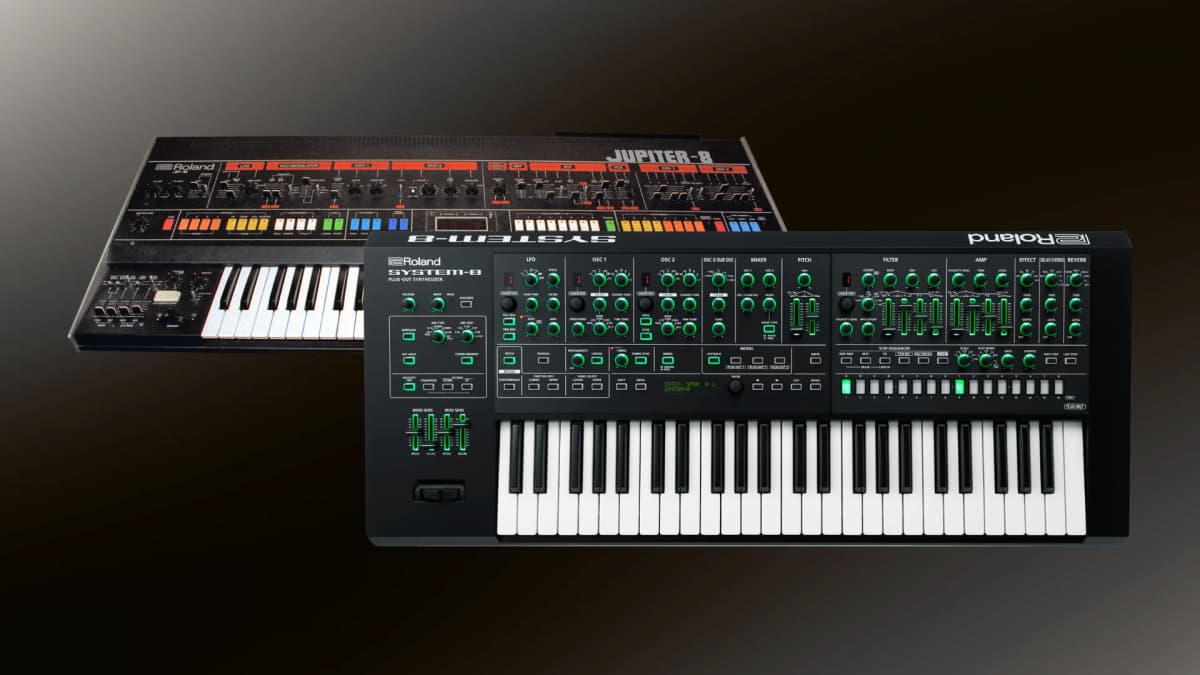
Choosing between the Jupiter-8 and the System-8? This Jupiter-8 vs System-8 comparison summarizes what Starsky Carr found when testing both instruments, so you can see how they differ in sound, controls and value before you buy.
Starsky Carr has wanted a Jupiter-8 for years. He knows its layout from the Jupiter-6, the Super Jupiter and the Udo Super 6, and he got to know its sound through software. Now he has a real one on loan, and he uses the opportunity to answer a question many people are asking: how close does the Jupiter-8 plug-out in the Roland System-8 really get?
The numbers frame the question. Used Jupiter-8s peaked around £30,000 a few years ago and now sell for roughly £20,000 or less, and with UK import costs a listing from Japan lands around £24,000. A System-8 costs a small fraction of that.
Source video: I Never Expected This… Jupiter 8 vs System 8 (Roland Cloud & JP08 Boutique) Deep Dive (Starsky Carr, YouTube)
He describes the real Jupiter-8 as feeling like an old friend, though it weighs a ton and the rear heat sink is uncomfortable to touch. The System-8 offers the Jupiter-8 as one of its plug-outs alongside the Juno-106 and the JX-3P. The panel’s green LEDs change depending on the loaded plug-out, and some controls are clever in practice: one knob changes the position of a modulation switch, and another selects the filter envelope. The Jupiter-8 plug-out uses Roland’s top-end ACB (analog circuit behavior) modelling, which emulates the circuits rather than only the sounds.
Before filming he built similar patches on both, matching envelopes, resonance, filter and LFO with PWM. On a frequency analyser the results are very close.
However the Jupiter-8 vs System-8 debate plays out for you, the best test is still playing both instruments side by side.
Oscillators and tuning
Interestingly, the oscillators on the real Jupiter-8 are not identical: VCO 1 has triangle and square while VCO 2 has sine and noise, with sawtooth and pulse on both. The System-8 has every waveform on each oscillator. Sawtooth, square, pulse and triangle sound very close, with small differences in the top-end slope that he calls hard to pull out by ear. On pulse width, the hardware seems to move in steps, which he speculates may be a sticky slider or the 12-bit converter of his earlier unit, while the System-8 is gloriously smooth.
Tuning is where character diverges in a way that is part of the charm. The Jupiter-8 drifts and needs retuning, so a patch can sound slightly different after calibration. The System-8 is perfectly in tune, but its circuit mod knob adds drift. At about 20 out of 127 it recreates that old vintage slop, with a chorus-like movement even from a single oscillator. Sync sounds the same on both, though the Jupiter-8 has a little more range.
In the Jupiter-8 vs System-8 comparison, price and playability matter as much as raw sound.
Filters, envelopes and modulation
On the 24 dB filter the two are very similar if not identical. Looking closely at the graphs, the System-8 is slightly brighter at the top end. The cutoff control of the System-8 is smooth, while the Jupiter-8’s is steppy. He notes it is easier to match what the Jupiter-8 does on the System-8 than the reverse. The 12 dB filter is equally close, with a slightly stronger resonant peak on the Jupiter-8. Both lose nearly everything as you play up the keyboard with the 24 dB filter, even with the same small vibrations.
The differences he found are minor. The Jupiter-8’s maximum envelope times are fractionally longer. PWM modulation from the filter envelope or the LFO goes slightly thinner on the real one. The Jupiter-8’s LFO is fractionally faster at the top and slower at the bottom, so it has a bit more range. The System-8 also seems unwilling to start its filter sweep above about 20 kHz.
The Jupiter-8 vs System-8 question rarely has a single right answer, because it depends on how you actually work.
Jupiter-8 vs System-8: which one makes more sense?
His conclusion is emphatic. The System-8 has the same character as the Jupiter-8, and he calls it a really, really good emulation. It is not identical, and people will pick up on differences such as modulation amounts and sync range, but he can recreate the tones he likes. Considering the price gap, that makes the case for the System-8 very strong for anyone who wants the sound rather than the object. The real Jupiter-8 remains what it is: a heavy, hot, drifting, collectible piece of analogue history.
That is the Jupiter-8 vs System-8 decision in short: match the instrument to the sound and workflow you actually want, and weigh the price difference before you commit.
If you are still undecided in the Jupiter-8 vs System-8 matchup, think about which controls you would reach for every day.
Cover image: composite of product photos. Roland Jupiter-8 photo by Ed Uthman (Wikimedia Commons), licensed CC BY-SA 2.0; cropped and combined with other images.
His connection with music began at age 6, in the 1980s, when his father introduced him to Jean-Michel Jarre's Rendez-Vous on vinyl. He works professionally in the legal field, while synthesizers became his space for abstraction and creative exploration. Founder of The Synth Source.