Home›Reviews›Juno-60 vs Juno-106: Synth-pop warmth or house-and-tech…
Reviews

Juno-60 vs Juno-106: Synth-pop warmth or house-and-techno immediacy?

Juno-60 vs Juno-106: how do they really differ? We break down sound, controls and value from SynthMania’s hands-on video test to help you choose.

Bernardo de Azevedo
Bernardo de Azevedo
· Updated
Roland Juno-60 vs Roland Juno-106 comparison

Choosing between the Juno-60 and the Juno-106? This Juno-60 vs Juno-106 comparison summarizes what SynthMania found when testing both instruments, so you can see how they differ in sound, controls and value before you buy.

The Roland Juno-60 and Juno-106 are two of the most frequently compared polysynths in the used market, and the question usually arrives in the same blunt form: which one should I buy? The most useful answer in this video does not come from a spec sheet. It comes from a simple observation about the music each instrument ended up making, backed by a look at who actually used them.

The reviewer from SynthMania offers his opinion “in a nutshell” and then spends the rest of the video testing it. If you want 1980s-style synth pop, he suggests the Juno-60. If you want the house and techno of the 1990s, the Juno-106. He is careful to call this a pattern he has observed, not a rule, and he reminds viewers that both instruments can play any genre.

Source video: Juno-60 vs Juno-106 (SynthMania, YouTube)

Table of Contents

  • Two very similar machines on paper
  • The Juno-60: arpeggios and a warmer, older sound
  • The Juno-106: MIDI, portamento and a more forward voice
  • Which one makes more sense?

Two very similar machines on paper

The starting point is that the two synths sound very similar. Both have 61 keys and six voices, and both use the same basic circuitry: DCOs, a VCF, a VCA, one LFO and one envelope. The reviewer notes that the components are slightly different, because the Juno-60 dates from 1982 and the Juno-106 from 1984, but that the sound remains close. In the side-by-side listening he plays, with strings and a bit of organ, he comes away saying again that the two sound very, very similar.

The differences are in the features. The Juno-60 has 56 memory banks while the Juno-106 has 128, which is more than double. The Juno-60 has an arpeggiator and the Juno-106 does not. The Juno-106 has portamento and the Juno-60 does not. Both have a high-pass filter, chorus and transpose, and both have patch shift controls and a hold pedal input.

However the Juno-60 vs Juno-106 debate plays out for you, the best test is still playing both instruments side by side.

The Juno-60: arpeggios and a warmer, older sound

The Juno-60 case rests on its arpeggiator. He demonstrates it as a simple arpeggio in octaves of the kind that is typical of 1980s synth pop, and explains that it can run on internal sync or external sync. That second option is what makes it useful in a modern setup: with a converter, it can be synced to a DAW so that a Juno-60 bass line, drums from the DAW and a pad from the Juno-106 all play together.

To support the genre argument, he cites the A to Z of Analog Synthesizers for the list of notable users of each model. For the Juno-60 the list includes names that he identifies with synth pop, and he describes the instrument’s sound as warmer and older, closer to the Jupiter-4 and Jupiter-8 of the early 1980s.

The practical catch is connectivity. The Juno-60 has no MIDI and uses Roland’s proprietary DCB interface, so you need a Roland interface, a third-party option, or a retrofit.

In the Juno-60 vs Juno-106 comparison, price and playability matter as much as raw sound.

The Juno-106: MIDI, portamento and a more forward voice

The Juno-106 case starts with MIDI in, out and through built in. In a production workflow, he argues, that simplicity mattered a great deal. The portamento is the second argument, since it allows acid-style lines. Third is the monophonic mode, which you engage by pressing the poly section buttons together, producing a much larger sound for bass lines or leads.

He describes the 106 as more forward and up front, more mid-range and a little more versatile, and he demonstrates this by building a short techno track from sequenced bass and percussive plucks, modulated with the LFO and filter resonance. The user list he cites for the 106 leans toward house, techno and electronica acts from the 1990s.

The Juno-60 vs Juno-106 question rarely has a single right answer, because it depends on how you actually work.

Juno-60 vs Juno-106: which one makes more sense?

If your music depends on arpeggiated patterns and a warmer vintage tone, and you are happy to solve the sync and interface problem, the Juno-60 fits the story that the reviewer tells. If you want built-in MIDI, more memory, portamento and a mono mode for basses and leads, the Juno-106 is the more practical instrument.

His conclusion is a good reminder that both machines can play polka, merengue, reggae or anything else. They simply shine, in his opinion, in those two applications.

That is the Juno-60 vs Juno-106 decision in short: match the instrument to the sound and workflow you actually want, and weigh the price difference before you commit.

Related comparisons

Sources

  • Juno-60 vs Juno-106 (SynthMania, YouTube). This article is an original editorial analysis based on that video’s transcript.

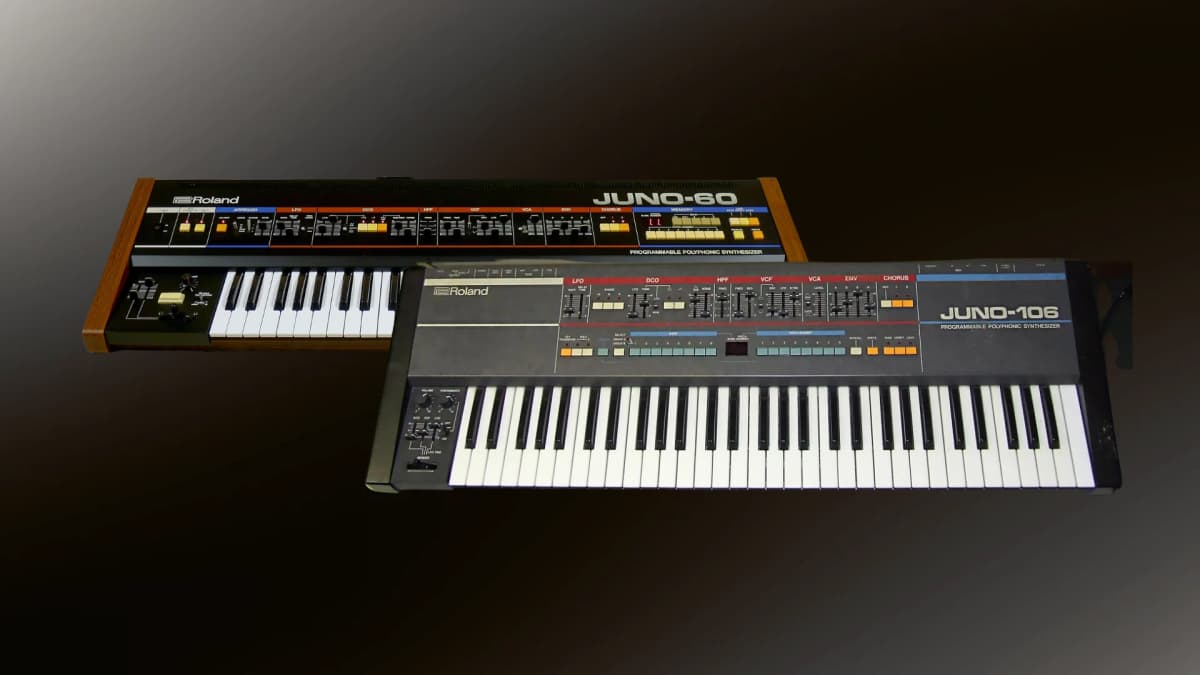
Cover image: composite of product photos. Roland Juno-60 photo by deepsonic (Flickr), licensed CC BY 2.0; cropped and combined with other images.


Bernardo de Azevedo
Written by
Bernardo de AzevedoFounder & Editor

His connection with music began at age 6, in the 1980s, when his father introduced him to Jean-Michel Jarre's Rendez-Vous on vinyl. He works professionally in the legal field, while synthesizers became his space for abstraction and creative exploration. Founder of The Synth Source.