Home›Reviews›Juno-6 vs Juno-60: Is the cheaper twin really the same …
Reviews

Juno-6 vs Juno-60: Is the cheaper twin really the same synth?

Juno-6 vs Juno-60: how do they really differ? We break down sound, controls and value from Alamo Music Sound Lab’s hands-on video test to help you choose.

Bernardo de Azevedo
Bernardo de Azevedo
· Updated
Roland Juno-6 vs Roland Juno-60 comparison

Choosing between the Juno-6 and the Juno-60? This Juno-6 vs Juno-60 comparison summarizes what Alamo Music Sound Lab found when testing both instruments, so you can see how they differ in sound, controls and value before you buy.

Online forums repeat the same advice about the Roland Juno-6 and Juno-60: they are basically the same synth, so buy the cheaper one. Zach Marr of Alamo Music Sound Lab was curious enough to test that claim for himself. His starting point is blunt. The Juno-60 commands a high premium, and the question is whether the Juno-6 gives you most of what you are paying for at a much lower price.

The answer he reaches is more nuanced than the forum wisdom. He finds real, concrete differences, and he is careful about how much weight to give them.

Source video: Roland Juno-60 vs. Roland Juno-6 | What's the difference? (Alamo Music Sound Lab, YouTube)

Table of Contents

  • A caveat about vintage gear
  • What the schematics and spec sheets say
  • How the two actually feel
  • Which one makes more sense?

A caveat about vintage gear

Before any comparison, he raises a fair point: vintage analog synths age differently, so two units of the same model can sound different because of wear and calibration. That makes it hard to attribute every difference between a Juno-6 and a Juno-60 to circuitry. He says he will try to respect that, and he is open about the fact that his list of technical differences comes from articles and posts by people who studied the schematics, not from opening the machines himself.

However the Juno-6 vs Juno-60 debate plays out for you, the best test is still playing both instruments side by side.

What the schematics and spec sheets say

The differences he lists are specific:

  • The chorus is set up differently. Chorus 1 is slower on the Juno-6, chorus 2 is similar on both, and chorus 3 is wildly different.
  • The Juno-6 has no DCB output, the Roland interconnect that predates MIDI, and no patch memory. The Juno-60 has both.
  • There is no independent VCA control on the Juno-6, while the Juno-60 has one.
  • The output is unipolar on the Juno-6 and bipolar on the Juno-60, and the Juno-60 uses CMOS chips.
  • The high-pass filter is continuous on the Juno-6 and offers four settings on the Juno-60.

He treats the missing features as minor. A Juno-6 can be retrofitted with MIDI, and the instrument is simple enough to program that the lack of patch memory is not a big deal for him. He also mentions the argument that the circuitry required to store patches changes the tone, but says he cannot confirm or deny it.

In the Juno-6 vs Juno-60 comparison, price and playability matter as much as raw sound.

How the two actually feel

His listening conclusion is that the Juno-6 sounds more direct. It feels, in his words, a bit more 1970s, with more edge and a more in-your-face character. He links this to a cleaner signal path, since the Juno-6 has less going on inside it. The Juno-60, in contrast, has what he calls a magical lushness that he associates with the Jupiter-8 and with Roland’s sweet spot in 1982.

He admits he hoped the Juno-6 would simply be a budget route to Juno-60 sound, and he was surprised to find that the Juno-60 has something extra. He believes the difference comes from the circuitry rather than calibration, while acknowledging that someone could calibrate the units and prove him wrong, and that you can dial in similar patches on both.

The Juno-6 vs Juno-60 question rarely has a single right answer, because it depends on how you actually work.

Juno-6 vs Juno-60: which one makes more sense?

His practical advice is balanced. If you want a Juno-60 specifically, or if the magic tone is the point, nothing else will replace it. But if you want a vintage analog Juno at a much lower price, the Juno-6 is a great option with its own color and tone, not merely a lesser copy.

He ends by asking viewers whether they hear the difference or whether he is splitting hairs, which feels fitting for a comparison where the gap is real but small.

That is the Juno-6 vs Juno-60 decision in short: match the instrument to the sound and workflow you actually want, and weigh the price difference before you commit.

Related comparisons

Sources

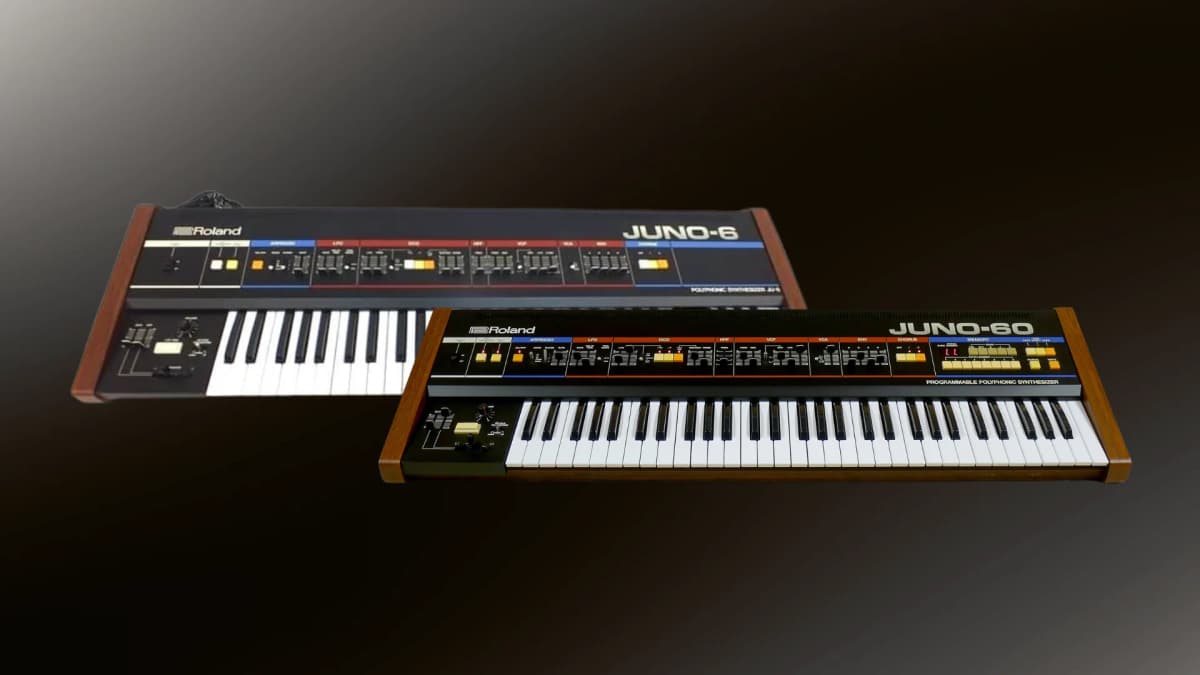
Cover image: composite of product photos. Roland Juno-60 photo by deepsonic (Flickr), licensed CC BY 2.0; cropped and combined with other images.


Bernardo de Azevedo
Written by
Bernardo de AzevedoFounder & Editor

His connection with music began at age 6, in the 1980s, when his father introduced him to Jean-Michel Jarre's Rendez-Vous on vinyl. He works professionally in the legal field, while synthesizers became his space for abstraction and creative exploration. Founder of The Synth Source.