Home›Reviews›JN-80 vs DeepMind 12: Streamlined Juno-60 vibe or featu…
Reviews

JN-80 vs DeepMind 12: Streamlined Juno-60 vibe or feature-rich 12-voice machine?

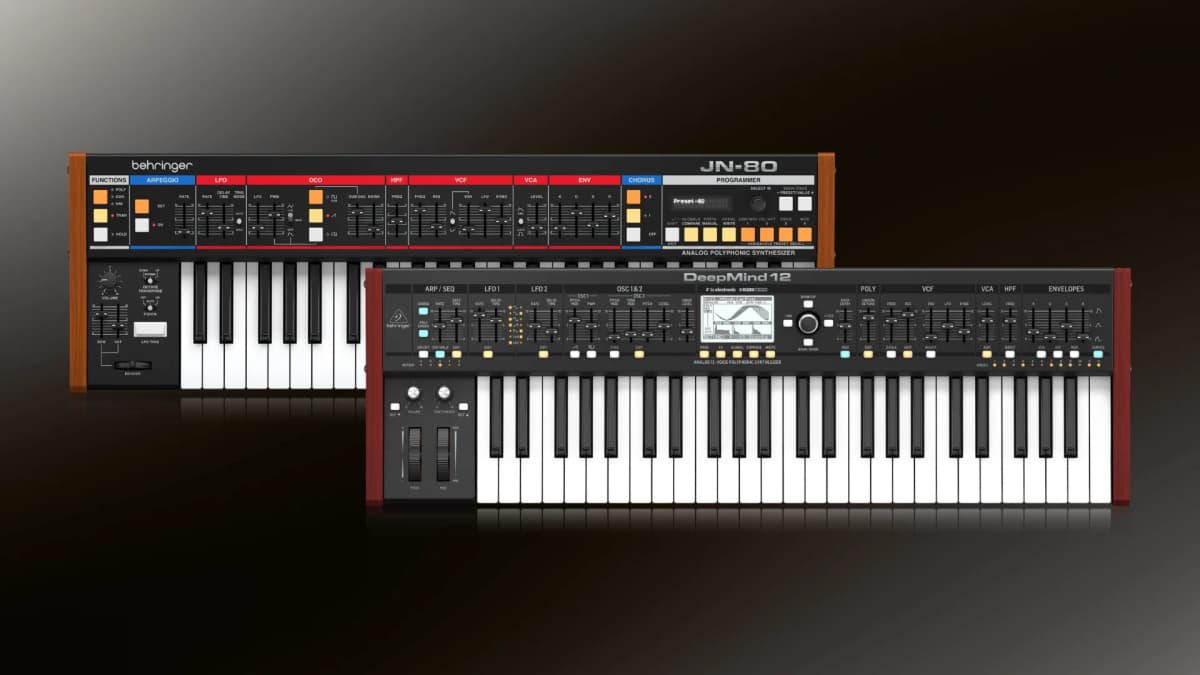
JN-80 vs DeepMind 12: how do they really differ? We break down sound, controls and value from tomm noise’s hands-on video test to help you choose.

Bernardo de Azevedo
Bernardo de Azevedo
· Updated
Behringer JN-80 vs Behringer DeepMind 12 comparison

Choosing between the JN-80 and the DeepMind 12? This JN-80 vs DeepMind 12 comparison summarizes what tomm noise found when testing both instruments, so you can see how they differ in sound, controls and value before you buy.

Tomm Noise was asked whether he had compared the Behringer JN-80 with the DeepMind 12, and he had never played a DeepMind 12 until a few days earlier, when he bought a B-stock unit. His video is deliberately unscripted. He admits it may not make sense to compare them since they are not very similar, but they are in a similar price range, and both are inspired by Roland’s Juno line: the JN-80 more by the Juno-60, the DeepMind 12 by the Juno-106.

Source video: Behringer JN 80 vs Deepmind 12 comparison (tomm noise, YouTube)

Table of Contents

  • Features at a glance
  • Oscillators, voices and calibration
  • Filter and envelopes
  • Chorus and unison
  • Which one makes more sense?

Features at a glance

The DeepMind 12 is far more advanced. It has a modulation matrix, built-in effects (four at once), two LFOs, three envelopes and 12-voice polyphony. The JN-80 has one envelope shared by VCA and VCF, one LFO with an enhanced feature set compared with an original Juno-60, and eight voices.

However the JN-80 vs DeepMind 12 debate plays out for you, the best test is still playing both instruments side by side.

Oscillators, voices and calibration

On an initialised sawtooth, the JN-80 sounds a bit brighter; changing the DeepMind 12’s VCA mode from transparent to “ballsy” makes it louder. The levels of pulse and sub oscillator differ, which makes it hard to compare. Both warmed up for an hour and were calibrated before filming, a revealing detail: calibration took about 30 seconds on the JN-80 and about an hour on the DeepMind 12.

He notices that not every voice sounds the same. On the JN-80 the eight voices are similar, while on the DeepMind 12 one voice stands out, and in stereo the VCAs on each side sometimes open at slightly different speeds, shifting the stereo field in the attack. Some will like it as more vintage and lively. The DeepMind 12’s pulse width goes narrower, and its PWM modulation goes deeper, through zero.

In the JN-80 vs DeepMind 12 comparison, price and playability matter as much as raw sound.

Filter and envelopes

The DeepMind 12’s filter frequency never goes below about 50 Hz by default, so the sound never fully mutes, whereas the JN-80 can be fully closed. With resonance up, the DeepMind 12 loses a lot of volume, while the JN-80 is more stable, and its resonance is much stronger and starts earlier, with a cleaner filter. On the JN-80 there is a kind of interaction between filter frequency and oscillator shape that sounds like intermodulation.

Envelope times are much longer on the DeepMind 12, though they can also be very short, and having three envelopes is a plus. He says this is not about comparing every difference but about how each feels to use.

The JN-80 vs DeepMind 12 question rarely has a single right answer, because it depends on how you actually work.

Chorus and unison

On the JN-80, you just press chorus one, two or both. On the DeepMind 12 you go to the effects page and set a chorus as an insert effect; he could get close but not the same. The JN-80 uses bucket-brigade delays, whereas the DeepMind 12’s chorus is digital. Its Dimension-D-style chorus sounds, to him, different from the original Dimension D, a little thin and muffled. In unison, the DeepMind 12 uses 12 voices against eight, and its detune goes wider.

JN-80 vs DeepMind 12: which one makes more sense?

His closing frame is the one he thinks matters: if you want an analog Juno copy, you must decide between feature-rich and modern, or vintage, streamlined, very focused and immediate. The DeepMind 12 gives more voices, modulation, effects and envelopes. The JN-80 is the simpler, brighter, more immediate Juno-60 experience.

That is the JN-80 vs DeepMind 12 decision in short: match the instrument to the sound and workflow you actually want, and weigh the price difference before you commit.

Related comparisons

Sources

Bernardo de Azevedo
Written by
Bernardo de AzevedoFounder & Editor

His connection with music began at age 6, in the 1980s, when his father introduced him to Jean-Michel Jarre's Rendez-Vous on vinyl. He works professionally in the legal field, while synthesizers became his space for abstraction and creative exploration. Founder of The Synth Source.