Home›Reviews›DeepMind 12 vs OB-6: Two completely different instrumen…
Reviews

DeepMind 12 vs OB-6: Two completely different instruments, one shared inspiration

DeepMind 12 vs OB-6: how do they really differ? We break down sound, controls and value from Starsky Carr’s hands-on video test to help you choose.

Bernardo de Azevedo
Bernardo de Azevedo
· Updated
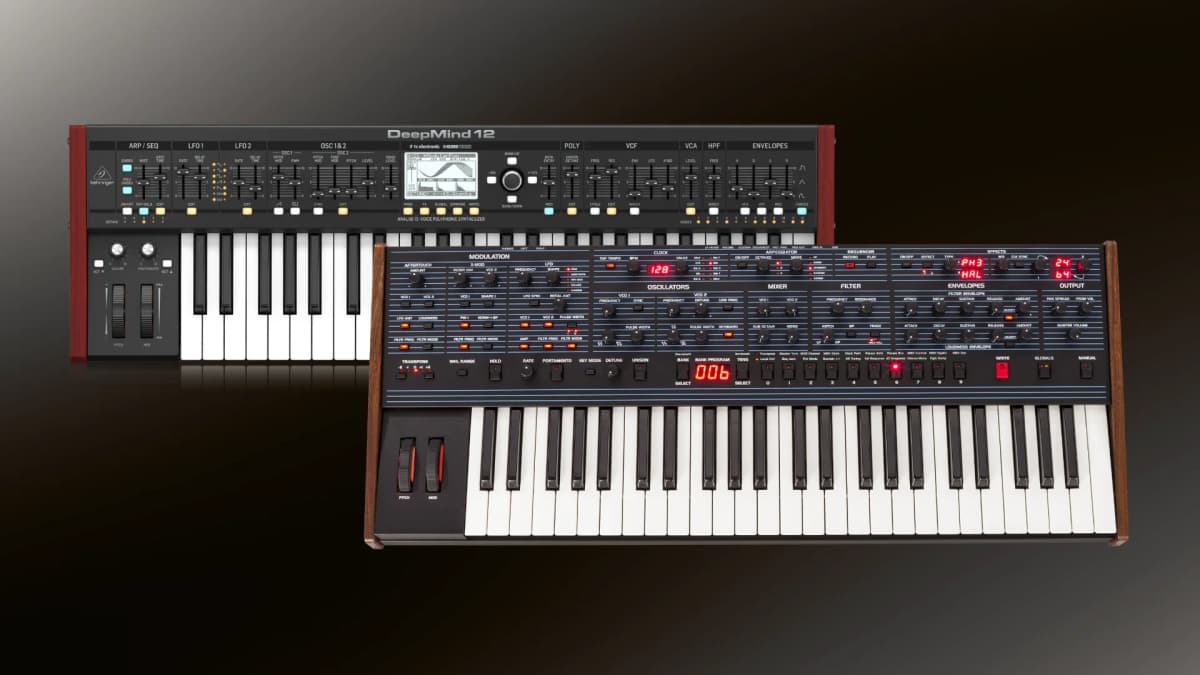
Behringer DeepMind 12 vs Sequential OB-6 comparison

Choosing between the DeepMind 12 and the OB-6? This DeepMind 12 vs OB-6 comparison summarizes what Starsky Carr found when testing both instruments, so you can see how they differ in sound, controls and value before you buy.

The Behringer DeepMind 12 and the Sequential (Dave Smith Instruments) OB-6 are not natural rivals, and Starsky Carr opens his video by saying so. The point is not to crown a winner, because that would not be a fair comparison. He describes it as “nerdy synth fun”: how close can the far cheaper DeepMind 12 get to the sound of the OB-6, and where does it stop?

The context matters. The DeepMind 12 was originally going to be a Juno-106 clone, and its architecture is much closer to the Prophet-6, which is why he has already compared it with both. The Prophet-6 family costs three or four times as much, so any overlap is notable.

Source video: Deepmind 12 vs DSI OB6 (Starsky Carr, YouTube)

Table of Contents

  • Character: the drift of the DeepMind 12
  • Oscillators and the sub
  • Filters: SEM against a more conventional design
  • Which one makes more sense?

Character: the drift of the DeepMind 12

While matching patches, he noticed something specific about the DeepMind 12: as soon as you start stacking oscillators, it has a lovely drifty, wavy, rich and lush feel that not many synths have. He is careful to frame this as what makes it unique, not as a criticism.

He also points to the places where the DeepMind 12 goes beyond the OB-6: a sub oscillator, a larger modulation section with more routing capability, and fully fledged effects units.

However the DeepMind 12 vs OB-6 debate plays out for you, the best test is still playing both instruments side by side.

Oscillators and the sub

The oscillator sections differ in ways that make exact matching difficult. On the OB-6, the second oscillator moves from triangle to sawtooth to square, and when you blend sawtooth and pulse the volume rises noticeably, which does not happen on the DeepMind 12, so he has to compensate when comparing levels.

The DeepMind 12 has a square-wave sub one octave below oscillator 1, which he describes as a more gritty feel than the OB-6’s triangle. In his view, anything with a sub on the DeepMind 12 sounds more full, so it can actually produce some sounds that the Prophet-6 cannot. It also has a tone modulation that flips the waveform over on itself. Looking at the oscilloscope, it is not quite PWM, and any sounds that depend on it are difficult or impossible to get on the OB-6.

In the DeepMind 12 vs OB-6 comparison, price and playability matter as much as raw sound.

Filters: SEM against a more conventional design

The OB-6 is famous for its SEM-style filter, which is state-variable and goes from low-pass through notch to high-pass, with a band-pass mode as well. The DeepMind 12 has a two-pole or four-pole low-pass and high-pass with a boost, so a perfect match is impossible.

The most interesting finding concerns resonance. The OB-6’s resonant peak is wider than the DeepMind 12’s, which is tighter. It also keeps its volume and bass as resonance increases, unlike a Moog-style filter. The DeepMind 12’s resonance, by contrast, is wild; with the control fully up it is very loud, and it self-oscillates, whereas the OB-6 does not.

His practical advice for emulating the OB-6 on the DeepMind 12 is to keep the resonance around six and never above seven, and to nudge it slightly higher as you move up the frequency range to match the peak. Even so, he stresses that the filters sound different and will never match.

The DeepMind 12 vs OB-6 question rarely has a single right answer, because it depends on how you actually work.

DeepMind 12 vs OB-6: which one makes more sense?

The conclusion he arrives at is practical rather than competitive. If you want that wide, fizzy SEM resonance and the Oberheim character, the OB-6 does it and the DeepMind 12 cannot fully replicate it. If you want a lush, drifty, feature-rich poly with a sub, deeper modulation and built-in effects at a fraction of the price, the DeepMind 12 offers things the OB-6 does not. The DeepMind 12 can get close to the OB-6 for many patches, but it gets there by a different route.

That is the DeepMind 12 vs OB-6 decision in short: match the instrument to the sound and workflow you actually want, and weigh the price difference before you commit.

Related comparisons

Sources

  • Deepmind 12 vs DSI OB6 (Starsky Carr, YouTube). This article is an original editorial analysis based on that video’s transcript.

Bernardo de Azevedo
Written by
Bernardo de AzevedoFounder & Editor

His connection with music began at age 6, in the 1980s, when his father introduced him to Jean-Michel Jarre's Rendez-Vous on vinyl. He works professionally in the legal field, while synthesizers became his space for abstraction and creative exploration. Founder of The Synth Source.