

Home›Articles›JIANT FM: free FM-1 firmware from Buenos Aires with USB…
Articles

JIANT FM: free FM-1 firmware from Buenos Aires with USB stem recording and animated engines

JIANT FM firmware for the M-VAVE FM-1 adds synthesized engines, a song generator and per-track USB stems. What works, what is beta and how to install.

Bernardo de Azevedo
Bernardo de Azevedo
· Updated
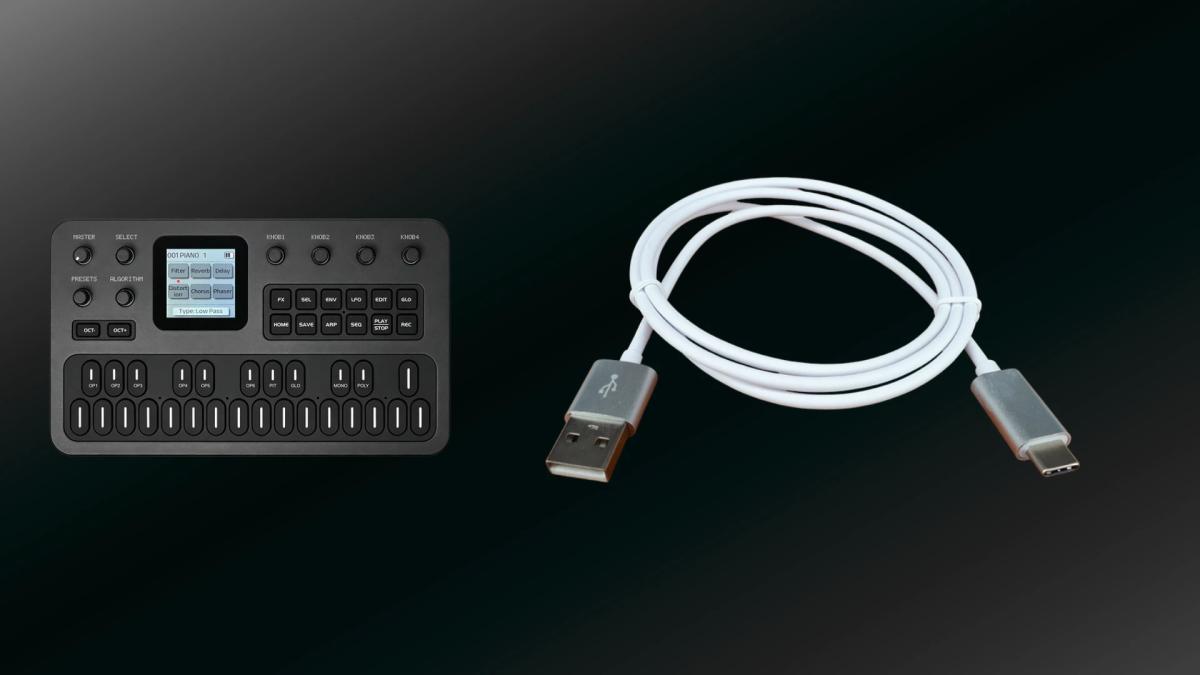
JIANT FM firmware: M-VAVE FM-1 pocket synthesizer beside a USB cable

JIANT FM firmware is a free, open-source operating system for the M-VAVE FM-1, made by Juan Jiant, a muralist and visual artist from Buenos Aires who publishes as juanjiant-bit on GitHub. It aims to let a player build whole songs on the pocket synth without a computer, and it can send each track to a computer on its own USB audio channel. The central question is how mature a project can be when its version number changed several times in two weeks.

Table of Contents

JIANT FM firmware at a glance

The project page describes JIANT FM as a complete instrument that runs inside the FM-1, with six tracks of synthesized sound, a sequencer, effects, a song system and a set of browser tools. It is licensed under GPL-3.0 and built on Felucca by Hügelton Instruments, the base introduced in our Felucca article. The page states that it is not affiliated with or endorsed by M-VAVE or Hügelton.

The video above is titled “FM1 – JIANT FM test – v0.99” and was uploaded on 18 October 2026 by the channel WiliWoW Music. A forum post in the Elektronauts FM-1 thread from the same day refers to a JIANT FM v0.99 USB audio recording. The video is a third-party demonstration, and its contents could not be checked beyond its title and channel.

The funding model of the JIANT FM firmware is simple. According to the JIANT FM firmware project page, supporters on Ko-fi, or on Cafecito for Argentine supporters paying in pesos, receive new versions before they go public and help decide what comes next. The source code is published on GitHub under GPL-3.0.

Engines, sequencing and effects

Every sound in the JIANT FM firmware is synthesized, with no user sample playback. The JIANT FM firmware project page lists eleven engines: ANALOG, FM6, PHASE, LOFI, VOICE, WHEEL, NOISE, ANIMAL, STRING, ADD and DRUM-X. The README is more precise: the stable par12 line has ten, and ADD, the additive engine, is available only in the par10 edition and the add15 beta. Older text on both pages still says nine, and MATRIXSYNTH posts on 10 and 11 October, quoting the developer, mentioned eight, so the count reflects different versions and not different products.

FM6 is a six-operator engine with 32 algorithms and DX7 bank support, and the MATRIXSYNTH post adds that it imports Dexed .syx files. DRUM-X is an eight-sound synthesized kit with a MORPH control that moves the kit between two characters. Skiff, another Felucca derivative, took its DRUM-X engine from JIANT FM, according to Skiff’s licensing document.

Each track has a 64-step piano-roll sequencer with chords, probability, ratchets, additional playheads, off-grid recording down to a 64th of a step, and a MUTATE function. The README adds parameter locks, a modulation sequencer, macros and a modulation matrix. A set of random “dice” functions rolls new sounds, and a filter is available on every engine, including a comb filter tuned to the played note.

Effects are broad for the format: delay, five reverbs, chorus, a slicer, a DJ filter and live punch-in effects that can be recorded as automation. One reverb is tuned to the scale in use and another can freeze into a granular cloud, per the MATRIXSYNTH description. The master section has a limiter, clipper, punch, tape stage and four-band EQ, and an always-on leveler is meant to keep volume consistent between patches.

Songs, the generator and the interface

The song system of the JIANT FM firmware is credited in the README to SLOOP, the live-looping firmware described in our SLOOP article. The project page describes four sections per project and an ARRANGE page, and the manual specifies eight projects, each with four sections, and an arrangement of up to 16 rows, each row a section played for 1 to 64 bars and optionally tied to a scene. A generator, started from the home screen, can sketch a song idea from one of 43 genres or in an EXPLORE mode.

The look of the firmware is unusual. According to the README, the interface uses a thermal-camera colour palette, several selectable skins and a graphic for each engine, which MATRIXSYNTH describes as a line-drawn creature that changes with what is played. The README also states six navigation rules that apply across every section, documented in an interactive map. This reflects the author’s background as a visual artist, though no review has yet assessed its effect on fast operation. One forum user, Function1, wrote that they turn off the graphic animations and enlarge the text.

The JIANT FM firmware project page lists MIDI over USB, Bluetooth and TRS, but the manual states that Bluetooth MIDI is not available with JIANT and that the TRS jack is input only, so USB and TRS input are the connections to count on. A learn function accepts up to ten CC mappings. The README also lists an experimental dual-core audio mode, with a single-core fallback, and credits Melodee and the fm1-x0x project for informing that work and Skiff for the twelve-voice design.

How JIANT FM firmware records stems

The stems feature is the project’s most practical differentiator. According to the manual, the menu path MENU, USB, USB AUDIO, STEMS makes the FM-1 appear as an eight-channel USB audio input at 44.1 kHz and 16 bit: tracks one to six on their own channels, plus left and right channels for the effects return.

A DAW can then capture those channels separately, so that the tracks can be mixed individually instead of being flattened into a stereo file. The manual notes that the stems are taken before the master section, so the eight channels sum to the mix as the effects buses hear it.

A related mode called STEMS+IN sends a phone’s microphone into the FM-1 and returns ten channels, including the voice, and the project page lists it as in testing. The manual labels it a test version and says the phone app involved is, for now, called JIANT Probe. The project page also mentions a separate product that is “coming soon”, without naming it or its platform, so it should not be counted on yet.

The README claims that since version 0.8.9 the USB audio path keeps its timing under load, with no lost buffers or dropped packets. The manual’s own history complicates that statement: it records that stems taken up to version 0.9.7 lost blocks of audio many times a second, which version 0.9.8 addressed, and that STEMS+IN and, more rarely, STEMS still lost blocks until a further fix in 0.9.10.

The manual advises re-recording takes made with the affected versions. Two further practical points come from the manual: the speaker EQ also affects USB output, and choosing the STEREO USB audio mode, which turns off the serial console, is said to help macOS 13 to 15 see the audio input.

Installing and the warnings that matter

The browser tools for the JIANT FM firmware run in Chrome or Edge and connect over USB. The project page asks for a data-capable cable, a direct connection without a hub, and other MIDI programs to be closed. According to the manual, the installer first checks that the FM-1 runs official V15 or JIANT, so a unit running another custom firmware must be returned to official firmware first.

That return option saves a complete backup, though it needs M-VAVE’s own FM-1 package, which the project cannot host. The manual also says not to unplug the cable while the firmware is written, and that an interrupted installation resumes when the same button is pressed again.

The version situation needs care, and it carries a safety warning. A notice dated 28 October at the top of the README says a tester reported an FM-1 that would not boot after installing the par14 build; the cause was unconfirmed, readers are told not to install par14 on hardware, and all par14 packages were removed from the installers. The README adds that automated tests and a successful package build did not establish hardware safety, and that a SAMPLE edition was withdrawn on 30 October.

At the time of writing the README listed STANDARD par12 as the stable default in the public installer, ADDITIVE add15-beta5 in a separate beta installer, and 0.9.9-gen2 as the version to go back to if a release causes trouble. The project page, meanwhile, still named v0.9.9-par9, so the documentation is spread across several places that do not fully agree. Readers should follow the install and recovery guide as well as the project’s own warnings, and back up before any change of version.

A further warning concerns file compatibility: a project saved in a newer version may not open correctly in an older one. The manual also explains that the music being played lives in RAM, that an automatic copy is made about ten seconds after the last change while stopped, and that restoring it at power-on is off by default and skipped after a crash. Unsaved work can therefore be lost, which matches one user’s report discussed below.

Development pace and AI-assisted code

The speed of change in the JIANT FM firmware stands out. A MATRIXSYNTH post on 10 October gave the version as 0.5, another on 11 October quoted the developer as announcing 0.6.29, a video title from 18 October says v0.99, and the project page and README now show 0.9.9-par9 and par12, with par14 withdrawn and an add15 beta in testing. Those labels follow different schemes, so any version cited in this article should be checked against the current page.

The 11 October MATRIXSYNTH post also quotes the developer as saying that the project is independent and that AI-assisted coding is used to realise the ideas. That puts the project in the territory discussed in our piece on vibe-coded firmware. The README describes automated tests and says physical FM-1 testing of the add15 beta was still pending, while the par14 withdrawal shows that passing tests and a successful build did not guarantee a unit that boots. The pace of iteration is therefore a reason for caution.

What users have said

MATRIXSYNTH presented the project in two video posts credited to JIANT, with no reviewer commentary. On the Elektronauts thread, a user called Fedemone called it possibly the most impressive firmware so far while asking how it feels for jamming, given the number of menus visible in demos. Sezare56 praised its depth and evolving sound design, but said it should be simplified and more focused.

In another post, Function1 reported that JIANT crashed on their unit and lost all unsaved data, and took it as a reminder to save. The same post named JIANT, Skiff and Melodee among current favourites. Earlier in the thread, a user called ex said it seemed “very solid” while admitting to going by videos only. These are individual impressions from a forum, not test results.

Final perspective

JIANT FM firmware is the most visually idiosyncratic of the current Felucca derivatives, and its per-track USB stems are a concrete feature that benefits anyone who records into a DAW. The sound design tools are extensive, with synthesized engines, probability and ratchet sequencing and a song generator, and the documentation exists in English and Spanish.

The drawbacks are equally concrete. One build, par14, was withdrawn after a tester’s unit failed to boot, the newer line is in beta, the companion app is not released, and at least one user lost unsaved work. Prospective users should treat it as an actively changing experiment, save often, and check the project page for the current state before installing.

Sources

  1. JIANT FM project page, Juan Jiant
  2. JIANT FM installer page, Juan Jiant
  3. JIANT FM README, juanjiant-bit (GitHub)
  4. JIANT FM user manual, juanjiant-bit (GitHub)
  5. JIANT FM: a living, bio-synthetic firmware for the M-VAVE FM-1, MATRIXSYNTH
  6. JIANT FM / FM1 Firmware / NEW Floatbeat Engine cinematic jam, MATRIXSYNTH
  7. FM1 – JIANT FM test – v0.99, WiliWoW Music, YouTube
  8. M-vave fm-1 thread, page 21, Elektronauts
  9. M-vave fm-1 thread, page 22, Elektronauts
  10. M-vave fm-1 thread, page 23, Elektronauts
  11. Skiff LICENSING.md, illuminus5
Bernardo de Azevedo
Written by
Bernardo de AzevedoFounder & Editor

His connection with music began at age 6, in the 1980s, when his father introduced him to Jean-Michel Jarre's Rendez-Vous on vinyl. He works professionally in the legal field, while synthesizers became his space for abstraction and creative exploration. Founder of The Synth Source.