

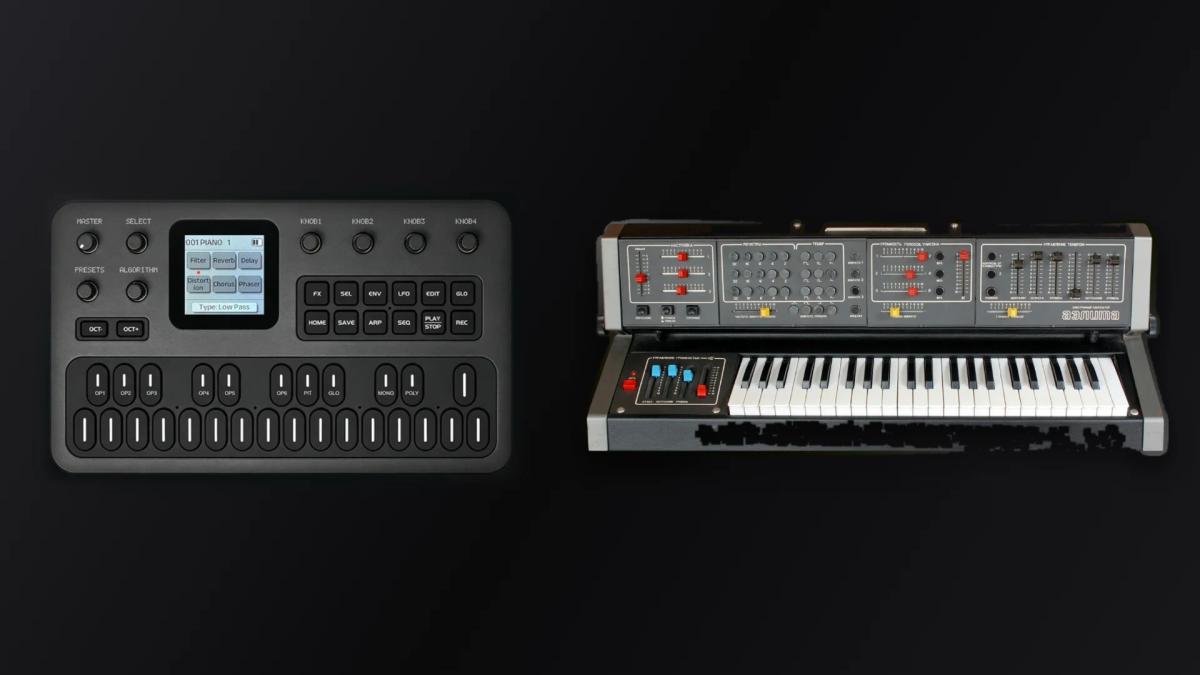
The Jangada firmware, published on GitHub by zednaked, is a fork of Felucca for the M-VAVE FM-1 that favours drones, grit and a Brazilian reading of industrial music. It started as an alpha in early October, and that history matters, because the project changed quickly in the weeks that followed. This article looks at what the Jangada firmware contains, how its status has shifted, where its ideas come from, and which claims still rest on the author’s word alone.
Table of Contents
What the Jangada firmware sets out to be
The project’s README calls Jangada an alternative firmware for the FM-1 with a dark, industrial and Brazilian accent. The name plays on Felucca, which is a Nile sailboat, while a jangada is the raft-like boat of Brazil’s northeast. The author is identified only by the GitHub name zednaked, and the repository gives no further personal details.
The README of the Jangada firmware is unusually explicit about taste. It says Jangada does not want to be a compendium of the other FM-1 firmwares, and it names industrial music, film scores and the manguebeat movement as reference points. Its idea of a drone is a held chord that keeps moving on its own while the player works on other tracks. Effects are meant to be triggered by holding a button, so that the screen needs little attention.
That stance separates it from the larger platforms. Felucca aims to be a general multi-engine instrument, and our Felucca article explains that foundation. The Jangada firmware takes the same base and narrows it towards a particular sound world.
Alpha beginnings and where the project stands
Jangada was an alpha at the start, and the author said so. The earliest entries on the releases page are all marked as pre-releases: 0.1-alpha on 4 October, 0.2 on 5 October, and 0.3 to 0.5 on 6 October. The 0.1-alpha notes call it the first public alpha, say the software is used at the user’s own risk, and promise that the FM-1’s boot area is never written.
The picture has since changed. The README now names version 1.0.1 as the current release, and the release page for that version, dated 16 October, is marked as the latest release and not as a pre-release. Its notes describe an editor protocol update for DAWs and mixers and state that existing presets and projects are kept. They also say the update was tested on the host with the full test suite and on an FM-1 running the Nirbija mixer; no broader hardware testing is described.
The practical reading is that Jangada began as an alpha and its current release is no longer marked as a pre-release, although the author’s release notes do not call it stable. The README still carries a plain use-at-your-own-risk notice, no third-party review had been published at the time of writing, and the author’s testing claims have not been independently checked. Readers should treat it as young software.
The FM-1 Firmware Hub describes Jangada as having “ten engines” at the time of writing, which lags the README. Version numbers and counts here are therefore a snapshot, and the repository is the authority.
Engines and the modulation matrix
The Jangada firmware lists thirteen engines in its README: ANALOG, FM6, PHYS, ROBO, NOISE, DIGITAL, PHASE, LOFI, SAMPLE, VOICE, TRIO, WHEEL and GRAIN. What sets it apart from its parent, according to the Jangada README, is depth: each engine exposes 16 parameters, where Felucca has 8.
ANALOG is the headline engine. It offers a superwave mode with up to six detuned copies, a sub-octave square, slow per-voice drift, and several filter types including a four-pole ladder filter that the author compares to a Moog-style design. A per-voice saturation stage with warm, hard and folding options sits after the filter. FM6 is the six-operator engine, built on Dexed’s msfa core, with 32 algorithms, eight factory patches and two flash banks of 32 voices each.
The ROBO engine groups machine-like voices, including VOSIM, a Xenakis-style stochastic generator, Walsh functions and a small scanned-synthesis model. PHYS offers modal, string, membrane and sympathetic-string models. The README attributes the ideas behind ROBO to a contributor named gospodindilly-ops.
Modulation runs through a matrix of four slots. The README lists thirteen sources, among them LFO, envelope, velocity, key, random, mod wheel, aftertouch, expression and a drift source, four of them being macro knobs. Destinations include the filter, pitch, shape or any engine parameter. Dexed or another DX7 editor can edit the FM6 track live over MIDI, according to the README.
Drones, grit and a Brazilian kit
The drone controls are the most distinctive part of the Jangada firmware. Each track has HOLD, EVOL, TENS and RAMP settings: EVOL adds slow random walks to filter and shape, TENS opens the sound and spreads the voices, and RAMP sets how many bars the tension takes to build. The README claims these cycles run from tens of seconds to minutes.