Home›Reviews›Behringer Edge vs Moog DFAM: Can the desktop cousin fil…
Reviews

Behringer Edge vs Moog DFAM: Can the desktop cousin fill the same sonic space?

Edge vs DFAM: how do they really differ? We break down sound, controls and value from Starsky Carr’s hands-on video test to help you choose.

Bernardo de Azevedo
Bernardo de Azevedo
· Updated
Behringer Edge vs Moog DFAM comparison

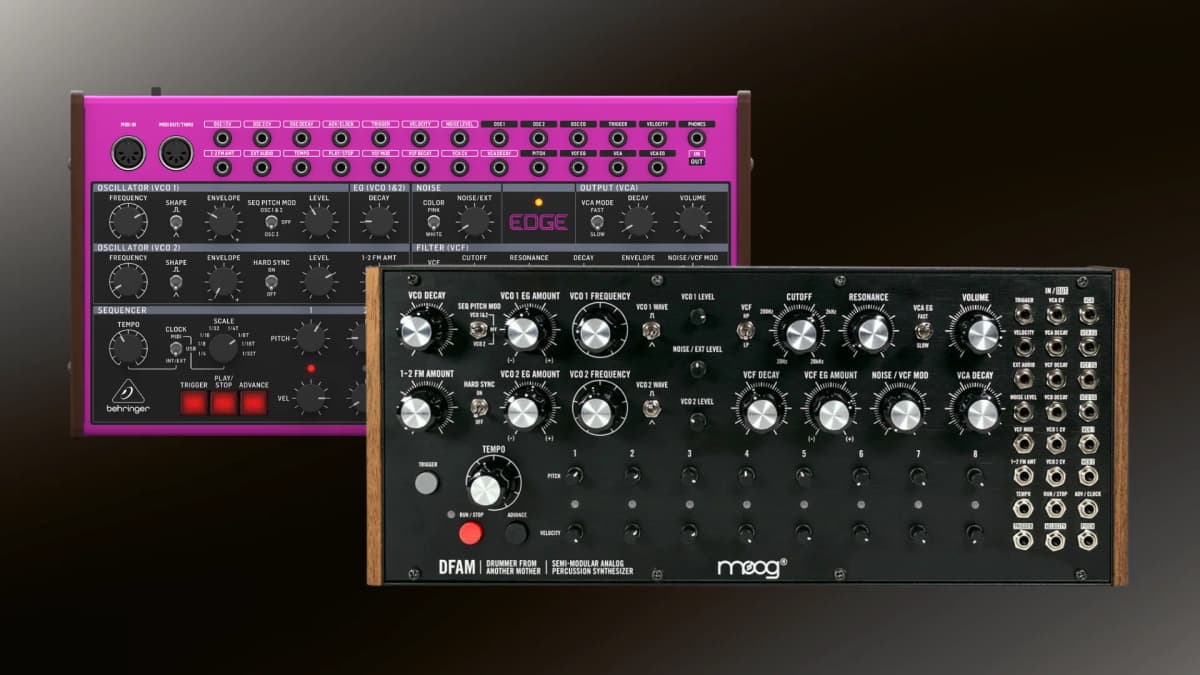
Choosing between the Edge and the DFAM? This Edge vs DFAM comparison summarizes what Starsky Carr found when testing both instruments, so you can see how they differ in sound, controls and value before you buy.

The Behringer Edge is built on the Moog DFAM, the drummer-oriented semi-modular that has become a favorite for percussive and experimental patches. The Edge keeps the idea but changes the package. So the question for anyone who cannot afford a DFAM, or who simply wants a different format, is a practical one: if you buy the Edge, are you getting the same instrument?

The reviewer in this video is careful about what he is trying to answer. This is not a microscopic oscillator-by-oscillator measurement. It is a test of whether the Edge fulfills the same musical role, in the same sonic territory, and feels similar in use.

Source video: Behringer EDGE vs Moog DFAM Are they the same? (Starsky Carr, YouTube)

Table of Contents

  • What the Edge changes
  • Matching patches by ear
  • Where the differences show up
  • Which one makes more sense?

What the Edge changes

According to the reviewer, the Edge is almost identical in functionality to the DFAM. The differences he lists are modest and mostly about connectivity and convenience. On the Edge you can choose between pink and white noise, which the DFAM cannot do. It adds MIDI in, out and thru, plus USB, so it can be clocked from anything with MIDI or USB, and you can change the scale. The form factor is the biggest practical difference: the DFAM can be mounted in a Eurorack case, while the Edge cannot.

However the Edge vs DFAM debate plays out for you, the best test is still playing both instruments side by side.

Matching patches by ear

To test the sound, he matched knob positions between the two machines, and says he got close in roughly a minute. The Edge’s trigger output even drives the DFAM in the demonstration. He explicitly declines to chase a perfect match, calling that a route to madness, because both instruments also depend on a step sequencer and its parameters, and tiny knob movements create large changes.

Listening to oscillators, triangle waves and FM, he says he struggles to find big obvious differences. The FM behaves almost identically, with one nuance: it is not quite as high pitched on the Behringer. The noise modulation also sounds the same to him, and when he sets up identical sequencer patterns both machines produce the same kind of tones.

In the Edge vs DFAM comparison, price and playability matter as much as raw sound.

Where the differences show up

The clearest difference in his testing is the VCA decay. With the decay fully up, the cutoff open and the resonance down, the Moog has a much longer tail than the Behringer. He is careful to note that he is using a pre-production Edge, so this may change, and that he only noticed it after hours of playing because, with a sequencer, long tails rarely matter. If you plan to use the machine for effects or sustained synth parts, however, it could be a factor.

Pink noise is the other distinction. The Edge can switch the noise color, which changes how the filter and oscillators sit in the mix, while the DFAM cannot.

The Edge vs DFAM question rarely has a single right answer, because it depends on how you actually work.

Edge vs DFAM: which one makes more sense?

His verdict is that the Edge does the same job as the DFAM, in the same sonic space, although the two are not identical and he could probably match them better if he were obsessed. For someone who does not need Eurorack and who values MIDI, USB and a lower barrier to entry, the Edge makes a good case. For a player who wants the Moog name, the longer VCA tail and a Eurorack-compatible module, the DFAM remains the original.

That is the Edge vs DFAM decision in short: match the instrument to the sound and workflow you actually want, and weigh the price difference before you commit.

Related comparisons

Sources

Bernardo de Azevedo
Written by
Bernardo de AzevedoFounder & Editor

His connection with music began at age 6, in the 1980s, when his father introduced him to Jean-Michel Jarre's Rendez-Vous on vinyl. He works professionally in the legal field, while synthesizers became his space for abstraction and creative exploration. Founder of The Synth Source.