I have not independently checked that number, so it should be read as Williams’s recollection. Wikipedia notes that Williams was nominated for an Academy Award for the score in 1978, the year his Star Wars score won, and that at the 1979 Grammys he won Best Instrumental Composition for “Theme from Close Encounters” and Best Album of Original Score.
An installer becomes a musician
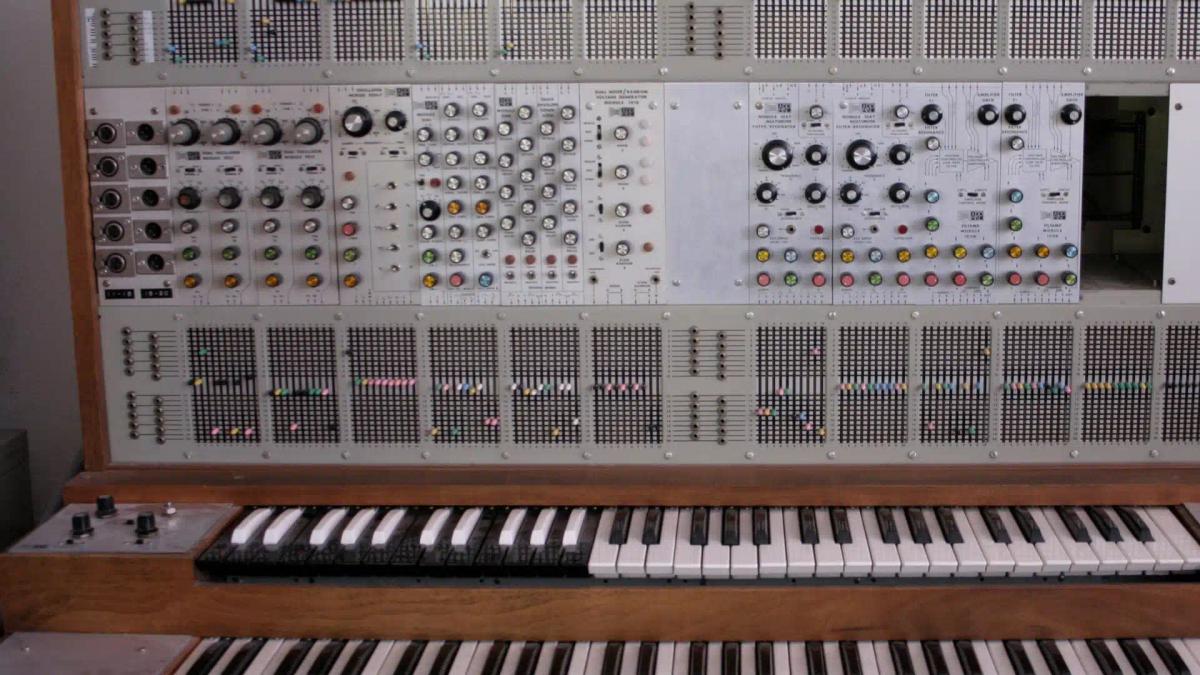
The synthesizer in the film was an ARP 2500, and the man who plays it is Philip Dodds, known elsewhere as Phil or Phillip. Wikipedia describes him as ARP’s vice president of engineering. ARP sent him to install the instrument on set, and Spielberg then cast him as Jean Claude, the musician who performs the sequence on the synthesizer.
The casting story has more than one version. Wikipedia’s articles on the ARP 2500 and on Dodds say he was cast after being sent to install the unit. The Dawson excerpt adds a detail: the actor originally meant to play the part fell ill, and Spielberg saw Dodds working on the machine, liked his look and cast him. That account appears in only one source I read, and the excerpt itself does not verify it against others.
Practical details are easier to confirm. Vintage Synth and Synthtopia report that the production used a fully loaded main cabinet, two fully loaded wing cabinets and dual keyboards in a custom case. Wikipedia’s ARP 2500 article adds that the unit used in the film was damaged by artificial fog, though that appears in a single article.
The scene at Devils Tower
In the story, witnesses in Dharamsala, India, report that the UFOs make the five-tone sound. Scientists broadcast the phrase into space and receive numbers back, which turn out to be coordinates for Devils Tower, near Moorcroft, Wyoming. At the climax, according to Wikipedia, the researchers try to communicate with the visitors using light and sound on a large electrical billboard.
According to Dawson, the motif is played on the ARP 2500 in the Devils Tower sequence, and Dodds plays the signal faster and louder as the French scientist, Lacombe, played by François Truffaut, walks out along the runway. The mothership echoes the notes, which Dawson calls an interstellar jam session of increasing tempo and complexity. Wikipedia adds that Lacombe also uses Curwen hand signs that correspond to the five-note phrase, and that the extraterrestrial responds in kind.
What the film did for the ARP 2500
For the ARP 2500, the film was a spectacular cameo and not a rescue. Vintage Synth calls the appearance perhaps the most famous and obvious vintage synthesizer cameo in a movie, and says many viewers know the motif without knowing which instrument played it. The museum entry says only that the five notes “likely” came from the ARP 2500, a reminder that even the identity of the instrument is sometimes treated cautiously.
Wikipedia’s ARP Instruments article records that the company declared bankruptcy in May 1981 after financial trouble linked to the Avatar, another product that sold poorly. The 2500’s own production run ended in the same year. The film’s synthesizer outlived the company’s finances in the public imagination, and the motif is parodied to this day. Vintage Synth notes that Monsters vs. Aliens (2009) has its president play the phrase on what is clearly a Yamaha DX7, not an ARP.
Final perspective
Close Encounters shows how little a famous sound can depend on commercial success. The ARP 2500 sold around a hundred units, had an interface the museum record calls unintuitive, and appeared in the film largely because an engineer was on set to install it. Yet a single scene turned it into the best-known synthesizer in cinema.
The story also shows how film music is made from compromise and choice. Williams wrote hundreds of candidates, and he and a director who could not agree settled the matter by stopping at the number they had reached. The five notes had to be simple enough for humans and aliens to share in a story, and that simplicity is probably why they survive. A phrase that works as a greeting is also a phrase that works as a parody and a memory of 1977.
Related stories
Sources