Home›Articles›Telharmonium: The 200-ton instrument that tried to pipe…
Articles

Telharmonium: The 200-ton instrument that tried to pipe music through the telephone network

Telharmonium: The Telharmonium was an electrical music machine so large that it needed the floor space of a small power station, and its inventor meant it to…

Bernardo de Azevedo
Bernardo de Azevedo
· Updated
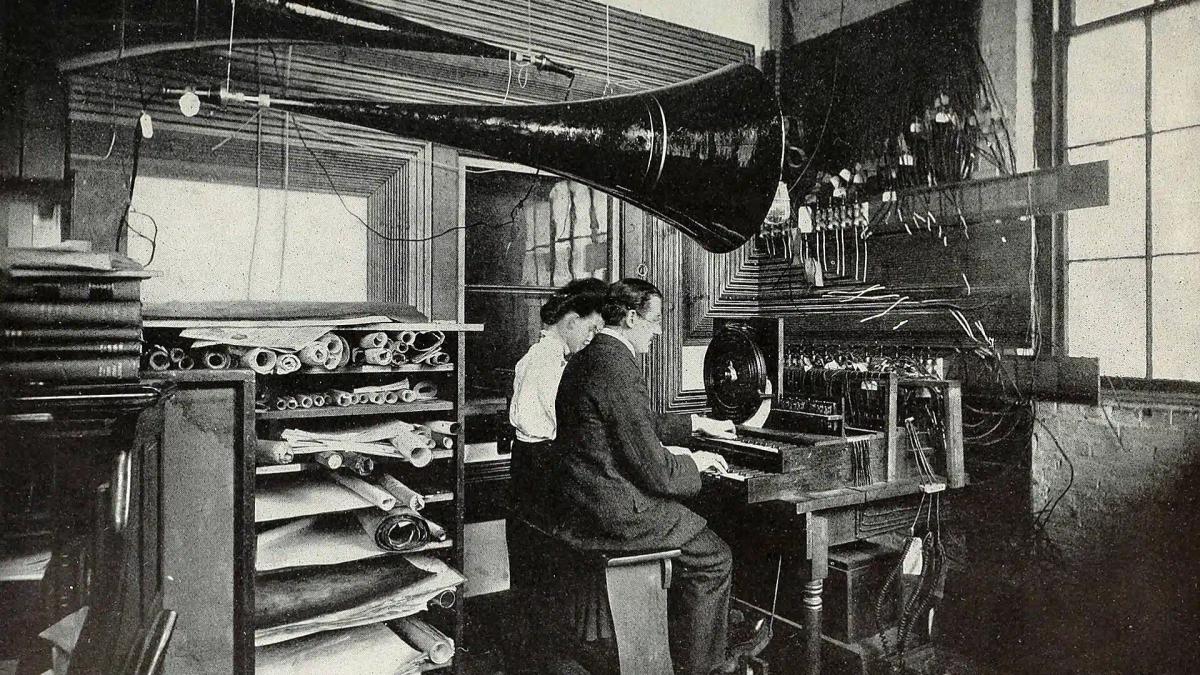
Telharmonium - historic photo

The Telharmonium was an electrical music machine so large that it needed the floor space of a small power station, and its inventor meant it to be heard not in a concert hall but at the far end of a telephone line. Thaddeus Cahill patented the idea in 1897, built it in ever larger versions, and by 1906 was playing it in New York for listeners who could not see the generators making the sound.

It worked, in the narrow sense that it turned electricity into music and sent that music over wires. The business built around it never did.

The story is usually told as a curiosity, a giant brought down by radio. That version hides something more interesting. Cahill understood, before the vacuum tube existed, that musical tones could be assembled from simple electrical components and delivered like a public utility. The real question is why an idea so right in outline collided so hard with the equipment of its day.

Table of Contents

  • Telharmonium: a lawyer’s idea of music on tap
  • From a seven-ton prototype to a machine for 30 railroad cars
  • How the Telharmonium made a note
  • Telharmonic Hall and the subscription dream
  • Why the telephone network pushed back
  • What the Telharmonium left behind
  • Final perspective

Telharmonium: a lawyer’s idea of music on tap

Thaddeus Cahill was not an electrical engineer by training. According to a 1906 profile in The World’s Work, he lived in Washington, D.C., graduated from Columbian Law School in 1892 and was admitted to the bar in 1894. Wikipedia adds that he also invented improvements for pianos and typewriters, and that he conceived the Telharmonium while working as a congressional aide. His goal was to send music over telephone wires to anyone who wanted it.

The core insight was to skip the loudspeaker-instrument pairing entirely. Rather than using electricity to drive an instrument that then produced sound, Cahill proposed generating the sound itself as alternating current and sending that current straight down the line. At the receiving end, a metal cone attached to a telephone receiver served as a crude loudspeaker. He called the machine the Dynamophone at first, and the name Telharmonium came to stand for the whole system.

The US patent, number 580,035, was issued on April 6, 1897. Cabinet magazine adds that Cahill had worked as a court stenographer in his teens, improving stenograph machines and typewriters, and that he read Helmholtz’s On the Sensation of Tone, which gave him the idea of building timbre from combinations of harmonics.

From a seven-ton prototype to a machine for 30 railroad cars

By 1901 Cahill had a working model with eight of the twelve generators he had planned. It weighed about seven tons, which sounds enormous until you meet its successor. The World’s Work reported that he showed a complete machine in Washington to Lord Kelvin in April 1902, and that a test had carried music about 70 miles to New Haven over a leased wire.

The next version was built in Holyoke, Massachusetts, where Cahill had moved his laboratory in 1903 according to the same profile. By then he and two partners had founded the New England Electric Music Company, although the partners later left and Cahill financed the work with his siblings, as Cabinet magazine tells it. The Holyoke machine weighed more than 200 tons and cost $200,000, with 145 alternating-current generators and switchboards holding nearly 2,000 switches.

Moving it to New York in 1906 took 30 railroad cars. The 1906 profile describes a hotel ballroom about a mile away with two receiving horns, and a small dark room containing 400 telephone receivers with their noses buried in sawdust. Across all three versions, Perfect Circuit estimates that Cahill’s spending reached about $1 million between 1897 and 1914.

How the Telharmonium made a note

The principle behind the Telharmonium was additive synthesis, built from rotating machinery. Each generator was tuned to produce an alternating current at the frequency of a particular pitch, and keys on the console worked switches that sent chosen currents onward. Transformers then mixed those currents into richer tones before they went onto the wire. The 1906 profile explains that harmonic stops let a performer imitate the colors of a flute, clarinet, strings or brass.

Playing it was a team effort. Cabinet magazine describes two to four players at the console, with a separate operator handling volume in steps and the timbre controls. The keyboards were unusual too, with 48 keys per octave to allow just intonation. That is an attractive musical idea and a hard thing to ask of working musicians. The same account says that volume sagged as more notes sounded and that the receivers added a distorted attack, two problems Cahill never fully solved.

Telharmonic Hall and the subscription dream

In New York, the Telharmonium moved into Telharmonic Hall at 39th Street and Broadway. The dynamos ran in the basement while listeners sat upstairs. Cabinet reports eight telephone receivers with paper horns hidden around the hall, tucked behind ferns, columns and furniture, so the music seemed to come from nowhere. Wikipedia notes that performances in 1906 were well received.

The plan was larger than a single room. The 1906 profile expected the first customers to be theaters, concert halls, restaurants, hotels and department stores, with private homes to follow. Cahill hoped to run several separate lines of music, perhaps ragtime on one and sacred or classical music on another, so subscribers could choose.

It is a recognizable ancestor of the subscription music service, imagined long before anyone could stream a note. Cahill’s company never turned a profit on it, though, and Perfect Circuit records that Telharmonic Hall closed in 1910.

Why the telephone network pushed back

The deepest problem was the telephone line itself. An ordinary telephone receiver needs only a tiny current to produce sound. The 1906 profile says that Cahill’s system sometimes drove as much as an ampere, briefly, for loud passages. Currents of that size did not stay politely inside their own wires. Music leaked into neighboring lines, so ordinary callers were sometimes interrupted by the Telharmonium, a problem Wikipedia describes as crosstalk.

Cabinet magazine says AT&T’s chief engineer, Hammond Hayes, was impressed but concluded the instrument would disturb regular service even with special circuits, and that AT&T would not let the company use its conduits and manholes. Wikipedia also reports that Bell refused to let the company use its lines. Add the cost of a 200-ton generator plant, the difficulty of playing it and the arrival of radio, and the economics collapsed. Wikipedia places the company’s failure in 1914, and Cabinet says the machine was scrapped before 1920.

What the Telharmonium left behind

No recordings of the Telharmonium are known to exist, according to both Wikipedia and Cabinet. Cahill died in 1934. What survives is influence, some of it direct and some of it only a family resemblance. Wikipedia reports that Ferruccio Busoni was inspired by the instrument when he wrote his Sketch of a New Aesthetic of Music in 1907, and it credits the machine as an inspiration for later electronic composers such as Edgard Varèse.

The clearest technical descendant is the Hammond organ. It also generated tones with rotating tonewheels, but its signals were read by conventional pickups and boosted by an amplifier, so the output needed only microwatts instead of a generator hall. That one change, amplification, turned a building-sized idea into furniture. Wikipedia also notes that Mark Twain is listed among the admirers of the Telharmonium, though Cabinet points out that the quotation attributed to him has no source, so it is safer to treat that detail as unproven.

Final perspective

The Telharmonium failed for reasons that had little to do with the quality of its idea. Its tones were built from pure components, its distribution was networked, and its business model was a subscription. What it lacked was the amplifier, which would soon make all of that possible at a fraction of the size. Cahill was trying to do with brute mechanical power what electronics would later do with a handful of tubes.

That makes the Telharmonium less a dead end than an early draft. It shows how often a technology’s concept arrives ahead of the component that makes it practical, and how a failed product can still define the questions that later instruments answer. Every synthesizer that builds sound from simple waveforms, and every service that delivers music on demand, is working in territory Cahill staked out in 1897 with a patent and a very large machine.

Related stories

Sources

Bernardo de Azevedo
Written by
Bernardo de AzevedoFounder & Editor

His connection with music began at age 6, in the 1980s, when his father introduced him to Jean-Michel Jarre's Rendez-Vous on vinyl. He works professionally in the legal field, while synthesizers became his space for abstraction and creative exploration. Founder of The Synth Source.