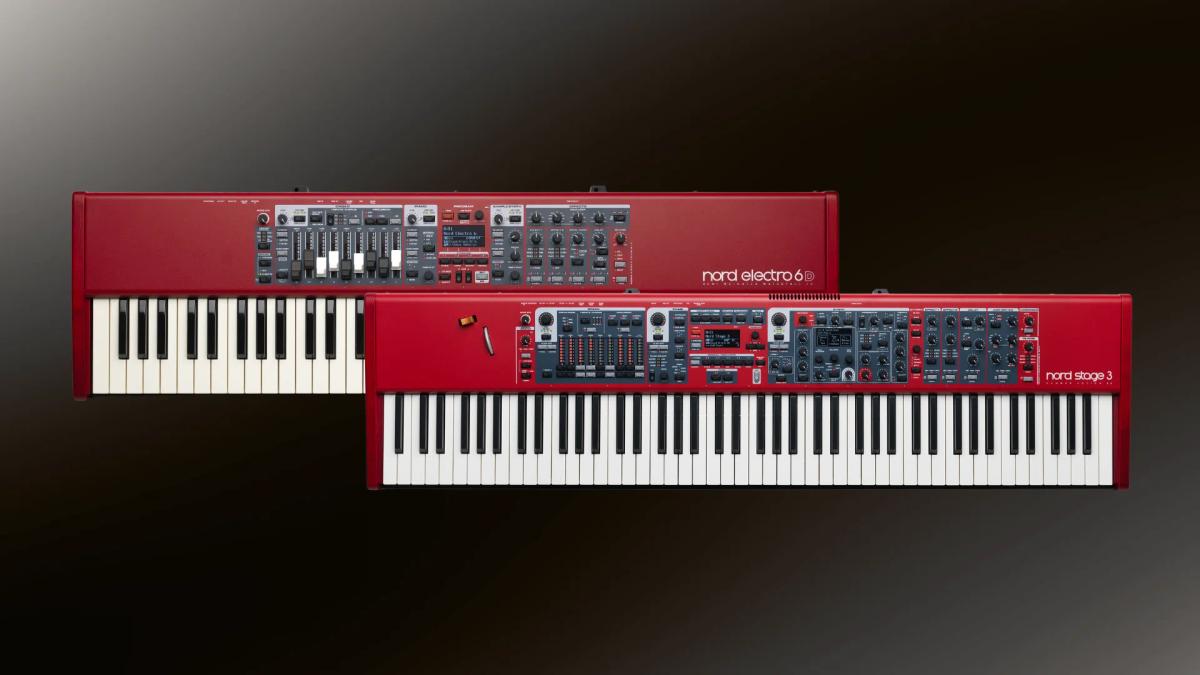
In the Nord Electro 6D vs Nord Stage 3 comparison, price and playability matter as much as raw sound.
The synth section, arpeggiator and controls
The Electro’s synth section is simple: categories, decay and release, attack, dynamics and octave. The Stage 3’s synth has an oscillator with sine, triangle, square and other waveforms, shape, filter with resonance, LFO, arpeggiator, envelopes and a lot more. Its arpeggiator can be latched so that it keeps playing while you hold or lift the keys, and it can be monophonic or polyphonic. The Stage 3 also has a dedicated transpose button, a morph function, a mod wheel, pitch bend, aftertouch that can control volume or expression, and an easy-to-assign expression pedal.
On the Electro the expression pedal input is not as easy to assign and needs the program settings. The Stage 3 can also act as a master controller for another keyboard, which the Electro cannot.
The Nord Electro 6D vs Nord Stage 3 question rarely has a single right answer, because it depends on how you actually work.
Effects and memory
The effects are basically the same: tremolo/pan, rotary (separate on the Electro for the organ), chorus, delay, EQ, compressor and reverb. The routing is slightly different. On memory, he recalls the Electro 6D has about 1 GB and the Stage 3 about 2 GB, and says the same piano and Hammond timbres can be loaded in both. The Electro just cannot modulate the wave in real time as the Stage 3 does.
Nord Electro 6D vs Nord Stage 3: which one makes more sense?
His conclusion is practical: look at what features you really need. If the Stage 3’s panels, zones, synth section and master-controller function matter for your performances, it is worth it. If you can solve everything with the Electro 6D, you save a considerable amount of money, since pianos and organ sounds can be the same on both.
That is the Nord Electro 6D vs Nord Stage 3 decision in short: match the instrument to the sound and workflow you actually want, and weigh the price difference before you commit.
Related comparisons
Sources