Home›Reviews›Moog Muse vs Arturia PolyBrute 12: Iconic Moog voice or…
Reviews

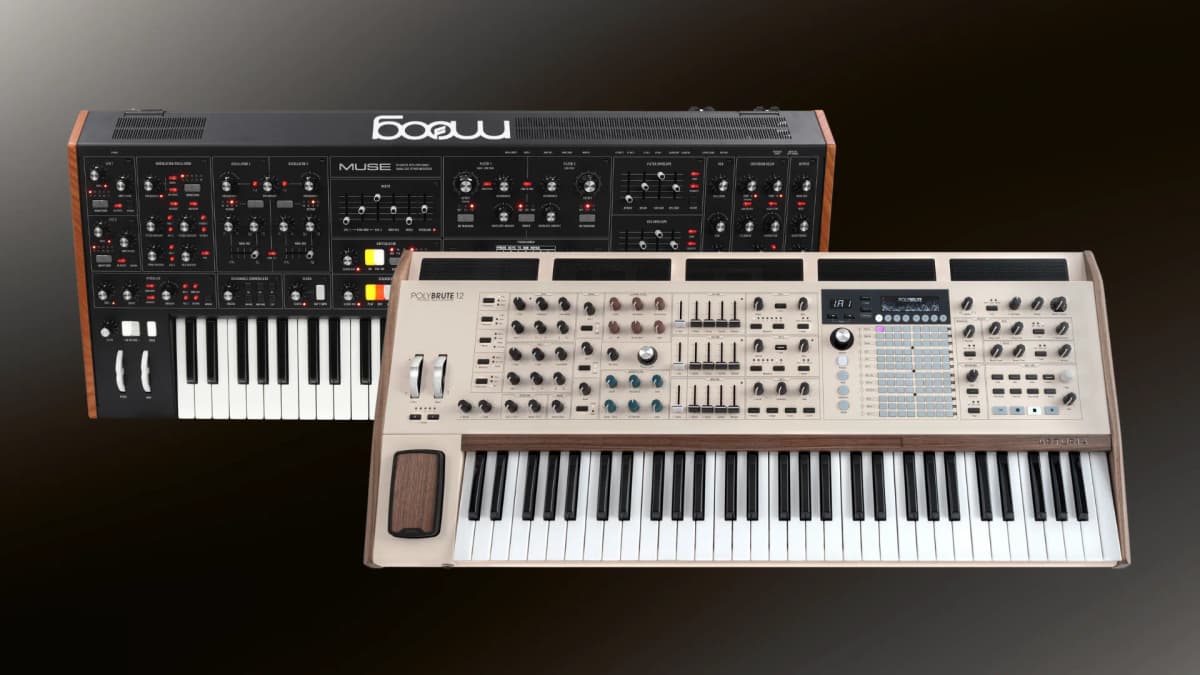
Moog Muse vs Arturia PolyBrute 12: Iconic Moog voice or the feature-rich flagship?

Muse vs PolyBrute 12: how do they really differ? We break down sound, controls and value from Sanjay C’s hands-on video test to help you choose.

Bernardo de Azevedo
Bernardo de Azevedo
· Updated
Moog Muse vs Arturia PolyBrute 12 comparison

Choosing between the Muse and the PolyBrute 12? This Muse vs PolyBrute 12 comparison summarizes what Sanjay C found when testing both instruments, so you can see how they differ in sound, controls and value before you buy.

The Moog Muse and the Arturia PolyBrute 12 sit at the top of the analog polyphonic market, and for anyone shopping at that level the choice is rarely about whether either one is good. Both are. The reviewer behind this comparison puts it plainly: once you reach this price point, you are most likely deciding between exactly these two. What matters is what each one gives you for the money, and what each one asks you to give up.

Sanjay C reaches his verdict by walking through the instruments area by area, and the answer is a split decision that depends on what you value.

Source video: Moog Muse vs Arturia Polybrute 12 – Which synth WINS? (Sanjay C, YouTube)

Table of Contents

  • Voices, price and expression
  • Oscillators and filters: the character difference
  • Modulation, effects and sequencing
  • Software, workflow and build
  • Which one makes more sense?

Voices, price and expression

The Muse has eight voices and the PolyBrute 12 has twelve, and that difference explains a good part of the price gap, which he cites as $3,499 for the Moog and $3,999 for the Arturia. He notes that voice count is not just a number: if you play full chords with a sustain pedal, you will eventually hit the limit on either synth, but he finds himself hitting it on the Muse much more often.

Both have 61 velocity-sensitive keys. The Muse has standard aftertouch, while the PolyBrute 12 offers what Arturia calls full touch MPE, which uses the whole range of touch and press and can drive expressive control, including envelopes, without moving a knob. For performers who like to shape sounds with the hands rather than the panel, that is a real advantage for the Arturia.

However the Muse vs PolyBrute 12 debate plays out for you, the best test is still playing both instruments side by side.

Oscillators and filters: the character difference

The Muse has two main oscillators with waveforms from triangle to saw, plus square and pulse, along with a third modulation oscillator that can also be used as a pure oscillator or a per-voice LFO and a ring modulator for metallic tones. He says it can sound like a classic Moog. The PolyBrute 12 also has two oscillators, with a metalizer for added harmonics, pulse width control and a sub.

The filters are where the two diverge most clearly. The PolyBrute 12 pairs a Steiner-Parker filter with a ladder filter that can be used independently or combined, and the Steiner-style brute control adds growl. The Muse has two filters based on the Moog 904A ladder design, the same as the Model D, with the first switchable between low pass and high pass, and with serial, stereo and parallel routing.

In the Muse vs PolyBrute 12 comparison, price and playability matter as much as raw sound.

Modulation, effects and sequencing

Both synths offer deep modulation. The PolyBrute 12 has three LFOs and a mod matrix that looks intimidating but, he says, is fairly simple in use. The Muse has two LFOs, a macro knob, an assign button and a mod map, and its approach is slightly more screen-oriented.

On effects, he gives a clear edge to Arturia. The PolyBrute 12 has built-in reverb and delay with easily accessible controls, plus chorus, phaser, flanger, ring mod, bitcrusher, downsample and distortions. The Muse has a diffusion delay modeled on early digital rack units. On sequencing, the PolyBrute 12 offers polyphonic sequences up to 64 steps with accents, slides and modulation tracks, while the Muse has 256 sequences of up to 64 steps with probability and random modes.

The Muse vs PolyBrute 12 question rarely has a single right answer, because it depends on how you actually work.

Software, workflow and build

Software integration is another point for Arturia. The PolyBrute Connect software mirrors the hardware exactly and works as a plugin in a DAW, remembering the state of the synth. Moog, he notes, does not really have software integration.

As for build, he calls the PolyBrute 12 a beast, heavy and deep with metal and wood, though the cream-pink color was unexpected. The Muse feels premium in a classic Moog way, with a metal body and wood on the side.

If you are still undecided in the Muse vs PolyBrute 12 matchup, think about which controls you would reach for every day.

Muse vs PolyBrute 12: which one makes more sense?

His conclusion is that Arturia has the edge in many areas, including more voices, MPE keys, onboard effects and software integration. The Moog costs less, and for some players that iconic sound is enough to settle the question. Either way, he calls the Muse one of the most capable polyphonic synths Moog has made in a long time.

That is the Muse vs PolyBrute 12 decision in short: match the instrument to the sound and workflow you actually want, and weigh the price difference before you commit.

Related comparisons

Sources

Bernardo de Azevedo
Written by
Bernardo de AzevedoFounder & Editor

His connection with music began at age 6, in the 1980s, when his father introduced him to Jean-Michel Jarre's Rendez-Vous on vinyl. He works professionally in the legal field, while synthesizers became his space for abstraction and creative exploration. Founder of The Synth Source.