Home›Articles›Gary Numan: How a Minimoog nobody collected turned a pu…
Articles

Gary Numan: How a Minimoog nobody collected turned a punk band into the sound of 1979

Minimoog: Gary Numan’s route to the top of the British charts began with an instrument he says he had never seen before. According to his own account, a…

Bernardo de Azevedo
Bernardo de Azevedo
· Updated
Gary Numan - historic photo

Gary Numan’s route to the top of the British charts began with an instrument he says he had never seen before. According to his own account, a Minimoog was sitting in a studio where his punk band had booked three days, and by the end of the first day he wanted to throw out the plan.

The accident is the part of the story everyone repeats. The more useful question is what it says about how new sounds reach the mainstream, since the same artist who got hooked on a borrowed synthesizer would, a year later, have a number-one single that had no obvious hook.

Table of Contents

  • Gary Numan: a punk band with a punk plan
  • The Minimoog in the control room
  • A record the label did not want
  • Gooseberry Sound Studios and a song about robots
  • The Polymoog, the Odyssey and a number one without a hook
  • Why the accident worked
  • Final perspective

Gary Numan: a punk band with a punk plan

Gary Numan was born Gary Webb on 8 March 1958 in Hammersmith, London. Wikipedia says he began as frontman of Tubeway Army, which signed to Beggars Banquet Records in 1978. The band’s first single, “That’s Too Bad”, was released in February 1978 and did not chart. The same article states that he adopted a punk style mainly to win a recording contract, and that Ultravox’s Systems of Romance, also from 1978, was a major influence on his later move to electronic music.

So the plan for the first album was conventional. Tubeway Army was a three-piece punk band, with Paul Gardiner on bass and Jess Lidyard on drums. In an interview quoted by Synthtopia and Matrixsynth, Numan said they had three days in the studio to record songs they already played live. Wikipedia places the sessions for the debut album in July and August 1978 at Spaceward Studios in Cambridge, with Mike Kemp as engineer and mixer, though it does not say where in those sessions the synthesizer turned up.

The Minimoog in the control room

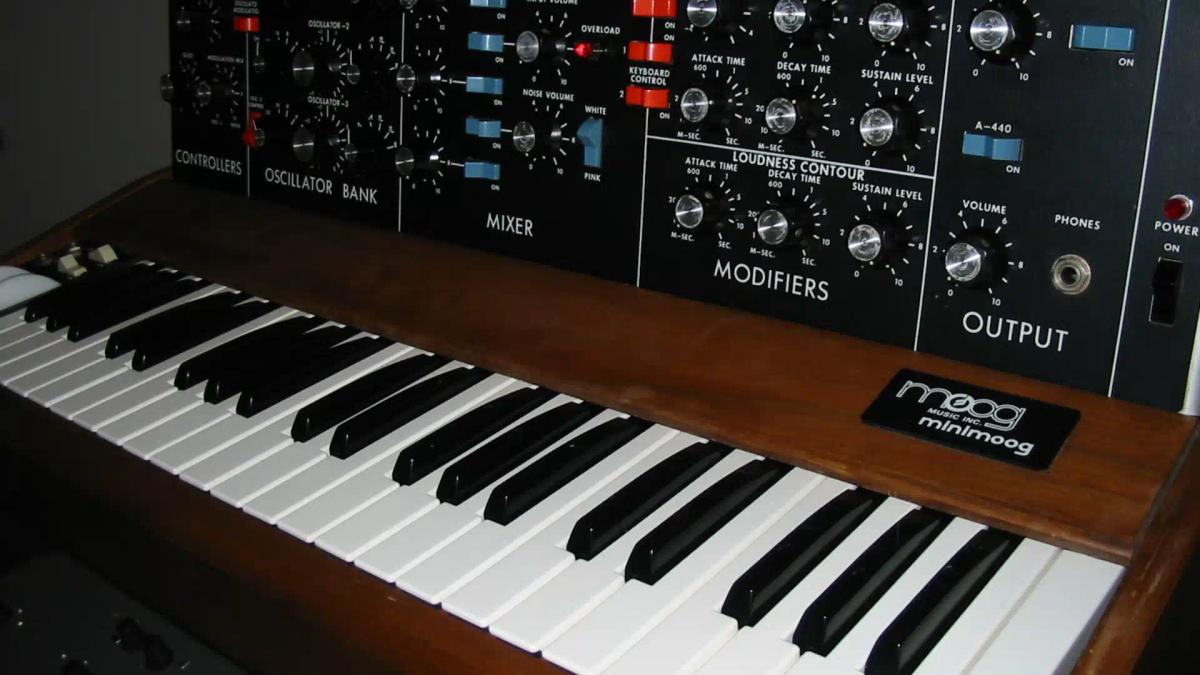
What happened next depends on Numan’s telling. He says he had never seen a synthesizer, and that a Minimoog in the studio was left there after someone rented it and forgot about it. The version he gave to the site UnderTheRadar, as quoted by Synthtopia, is that a hire company never collected it. He called finding it a very happy accident.

MusicRadar describes the moment more physically. Numan spotted a Minimoog Model D in the control room, pressed a key without knowing how to set it up, and a low growl filled the room. He later compared the feeling to an earthquake that he loved. Before the band had finished setting up, he began reworking their punk songs as electronic ones.

Take the story with a little caution. It comes from Numan’s own interviews, and Wikipedia’s wording is only that he found a Moog synthesizer left behind in the studio. Even so, the consequences are documented. The debut album that emerged was released on 24 November 1978 on Beggars Banquet, and it showed his new interest in dystopian science fiction and synthesizers.

A record the label did not want

Numan told the record company he wanted to go electronic. According to the same interview, the label was unhappy because it had signed a punk band, and he had used up the budget, so there was no money for a second attempt at the sessions. The album was released anyway. MusicRadar adds that Beggars Banquet’s Martin Mills was hesitant, which led to a heated meeting before Numan got the go-ahead.

The debut did not make an immediate impression. Wikipedia reports that an initial limited run of 5,000 copies sold out but did not chart. Only after the 1979 reissue, which followed the success of Replicas, did it reach No. 14 on the UK Albums Chart. In Numan’s account, the record sold better than expected, and the label let him make another album. He also said that by then he had spent only about eight hours with a synthesizer, because he could not afford to buy one.

Gooseberry Sound Studios and a song about robots

Replicas was made at Gooseberry Sound Studios in London in January and February 1979, with Numan writing and producing “Are ‘Friends’ Electric?” himself. Wikipedia says the song was written on an out-of-tune pub piano and began as two separate songs that were combined. Numan recorded it with a Polymoog, a Minimoog and conventional bass and drums, with flanged guitar and subdued vocals.

The lyrics grew out of short stories he wrote about what London might be like in 30 years, and he cited Philip K. Dick and J.G. Ballard as influences. The song concerns artificial “friends” that visit homes and look human, and the one in the song is a prostitute. Numan said the song had no recognisable hook, and a Smash Hits critic called it a dark, threatening wall of synthesised sound.

The Polymoog, the Odyssey and a number one without a hook

The single was released on 4 May 1979. It entered the UK chart at No. 71 and reached No. 1 at the end of June, staying there for four weeks. A limited picture disc of 20,000 copies helped, as did robotic performances on The Old Grey Whistle Test and Top of the Pops. The album Replicas followed to No. 1 in July 1979, and in 1980 Telekon gave him a third chart-topping album, with “We Are Glass” and “I Die: You Die” reaching No. 5 and No. 6.

Wikipedia adds that he retired from touring after concerts at Wembley Arena in April 1981, though that decision was short-lived. The Pleasure Principle appeared in September 1979, and its single “Cars” also reached No. 1.

The instruments behind those records were not only the Minimoog. MusicRadar says the Polymoog, released in 1975, was key to The Pleasure Principle, and that its Vox Humana preset was used on “Films” and “Cars”. Numan has said he leaned more toward the ARP Odyssey than the Minimoog, calling it phenomenal. The album was not purely electronic: Ultravox’s Billy Currie played violin on “Complex” and “Conversation”, and Chris Payne played viola on “M.E.”, a song Numan said is sung from the viewpoint of the last living machine on Earth.

Its cover reworked Magritte’s 1937 painting The Pleasure Principle (Portrait of Edward James). When the band toured, they carried 22 synthesizers across five stage locations, all owned by Numan.

Why the accident worked

Accidents rarely work without preparation, and Numan had a few advantages. He was already writing about dystopia and had been listening to Ultravox, so a synthesizer found him at a moment when he had material that suited it. The punk background also shaped the sound, and the success was fast: the gap between the Minimoog afternoon and a chart-topping single was a matter of months. MusicRadar notes that The Pleasure Principle used short, roomy reverbs and unquantised drums, keeping a live feel.

There is also the economics. Synthtopia points out that synthesizers were extremely expensive at the time, so part of his signature sound came down to luck and the fact that one was available to try. He admitted being baffled by questions about programming. His way in was blunt: find a sound he liked, and write around it.

Final perspective

The story of the forgotten Minimoog is satisfying because it makes a movement look like a lucky break. The surviving evidence supports the broad shape: a band booked for a punk session, an unfamiliar synthesizer in the room, a label that was unhappy and a debut that only sold after its successor had topped the chart.

What it also shows is how fragile a musical genre can be at its start. Synth-pop in Britain did not need a large studio, a technical background or even much experience. A few days, an available instrument and a songwriter willing to abandon his plan were enough. Even Numan’s most famous single was a patchwork of an out-of-tune piano tune and a synthesizer part, and its instrumental was reused in the mashup behind the Sugababes’ 2002 chart-topper “Freak like Me”.

Wikipedia lists Richard X as the producer who sampled it for that mashup, and the American group Information Society covered it on Don’t Be Afraid in 1997. The Minimoog did not make Numan a star by itself, but it gave a writer with strange ideas a sound that matched them.

Related stories

Sources

Bernardo de Azevedo
Written by
Bernardo de AzevedoFounder & Editor

His connection with music began at age 6, in the 1980s, when his father introduced him to Jean-Michel Jarre's Rendez-Vous on vinyl. He works professionally in the legal field, while synthesizers became his space for abstraction and creative exploration. Founder of The Synth Source.