

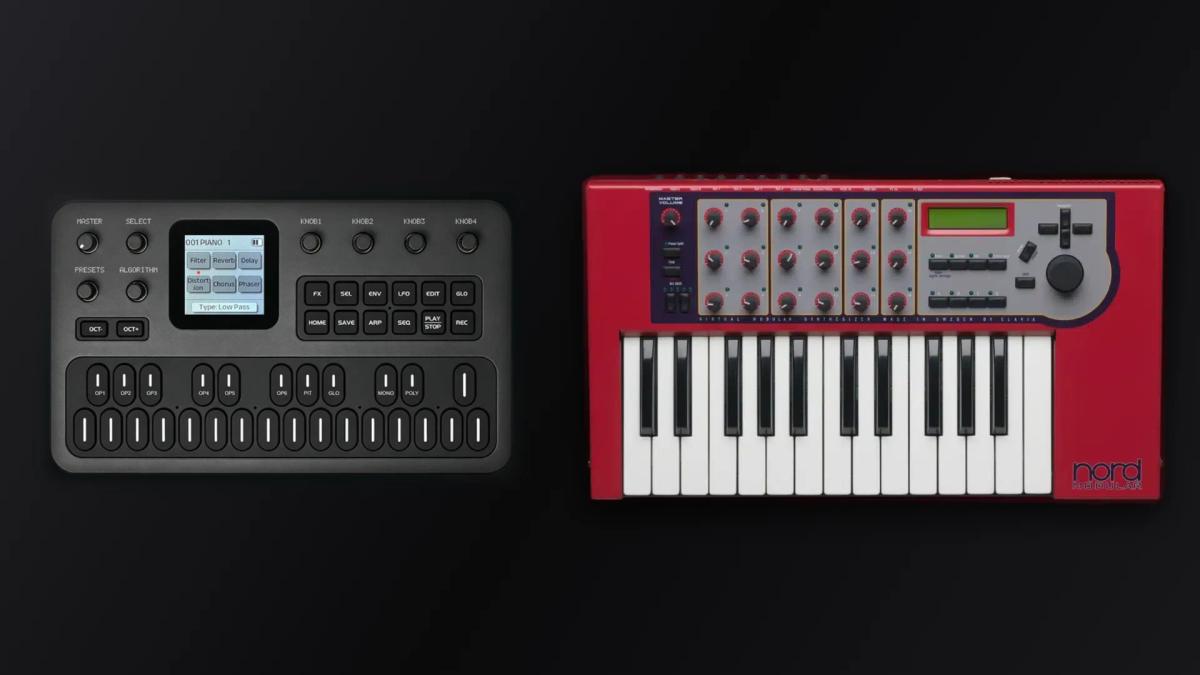
The Lunar Modulator firmware is an open project by a developer who publishes as ip2k. It ports sound engines derived from Mutable Instruments code to the M-VAVE FM-1 and lets anyone play a virtual FM-1 in a web browser. It is also unusual among FM-1 firmwares because it cannot yet be installed on a real unit. This article reports what the Lunar Modulator firmware project’s own pages say about its engines, its licensing statements and its status, and it separates what already works in the browser from what remains planned.
Table of Contents
What the Lunar Modulator firmware is, and what it is not
The README gives the Lunar Modulator firmware project’s status as active development and states, in a box headed “Preview: not yet installable on an FM-1”, that the firmware runs today as a virtual FM-1 in a browser, using the firmware’s own screen and sound. Much of the repository is research material on the hardware, the update protocol and recovery. In short, the instrument exists in software, the hardware work is still being validated, and the project should not be read as a finished firmware.
On the chip side, the README says a small performance diagnostic runs on a development board for the JieLi AC79 processor family, which is the family inside the M-VAVE FM-1. It adds that the complete instrument still needs validation on the FM-1 and that no Lunar application has run on an FM-1. Automated tests of the browser page run in Chromium, Firefox and WebKit, while native Safari has passed only a filtered patch-list check.
Synthtopia’s roundup of alternative FM-1 firmware, published on 4 October 2026, described the project as open firmware that makes the FM-1 a “multi-engine instrument”, listing five sound engines, four effects and a step sequencer with parameter locks. The roundup does not say whether the firmware can be flashed. The repository states plainly that it cannot, and its README now lists thirteen engines, so the roundup reflects an earlier state of the Lunar Modulator firmware.
The browser-playable virtual FM-1
In the Lunar Modulator firmware, the simulator draws the front panel to scale, with 27 keys, 14 buttons with LEDs, a master control and seven encoders. The screen is the firmware’s 240 by 240 display. Input comes from the mouse, touch, the computer keyboard or a MIDI keyboard, and the README lists note velocity, pitch bend of two semitones, volume and all-notes-off among the supported MIDI messages. The simulator does not send MIDI out.
Lunar Modulator also has a project page where the same virtual panel runs in the browser. A “Power on” button starts the audio, because browsers only start sound after a click. The page says that files are read and written in the browser and that nothing is uploaded or sent to a device.
The README and the project page now describe the same simulator features. These include an eight-track sequencer with parameter locks, an arpeggiator, a modulation rack that starts with two LFOs, two envelopes and a random source, and projects saved in the browser. The README adds an editor with a song workspace, import of MIDI files and WAV export. It states that sending projects to an FM-1 over USB or Bluetooth is future work.
Engines and effects
According to the README, the simulator now offers thirteen sound engines, plus a test sine. Macro combines eight synth models in one with 12 voices, covering virtual analogue, phase distortion, wavetable and two-operator FM among others. Macro Heavy has 4 voices and covers string machine, chords, speech, drums and other larger models. Shapes has 47 digital oscillator shapes. Six-Op FM carries 96 patches and 8 voices, and Sophie is a 16-pad metallic FM percussion kit.
Up to four sounds play at once, each with its own engine and two insert effects. The four are mixed through two master effects and a limiter that keeps a full chord from clipping. The README groups 24 effects, among them reverbs, delays, filters, dynamics and distortion types. A memory meter tracks an estimated FM-1 memory budget, and combinations above it are refused.
The project page names FM6 for DX7-format patches, Acid Bass, Acid Gen, Comet Kit, Crater Kit, Drawbar, Trio and Phase Bend. The README states that Acid Bass, Comet Kit, Crater Kit and the three Felucca engines are in builds with a GPL switch turned on, and that the switch is on in every build while the project is being tested. The FM6 engine plays DX7 voices, ships with 32 voices of its own and has 32 slots for .syx files, and the page tells users to load only files they are entitled to use.
Why it is not installable on a real FM-1 yet
The README answers the question of real-hardware installation directly with “Not yet.” It names two preconditions. The firmware has to run on the FM-1’s chip: it already compiles for the processor with JieLi’s tools, and a resampler diagnostic runs on the development board, but the running instrument has not been built or tested on an FM-1. A safe way back must also stay proven.
The reason given is that the FM-1 keeps one copy of its firmware and has no recovery button, so a failed install could leave the synth unable to start. The README reports progress on the way back. On the project owner’s unit, matching full backups were taken and a small unused flash sector was written and restored, with the full memory matching afterwards.
After an interrupted install left that unit unable to start, it was brought back to the stock V15 firmware on 26 October with a Raspberry Pi Pico 2 W running a community recovery tool, which the README marks as reported by the owner. It also says that restoring the unit’s own earlier image has not been done and that a failed Lunar build has not been recovered yet.
The planned installer would answer the FM-1’s own update requests, so that a unit running Lunar Modulator could return to stock firmware. The README describes the first installable build as a small preview, offered first to owners who can already back up and restore their own unit. The project page says nothing about installing on hardware. Readers who are curious about the risks should consult the site’s guide to the FM-1’s internals and its install and recovery guide, though at present there is nothing to install.