Home›Reviews›Hydrasynth Explorer vs MiniFreak: Immediate performance…
Reviews

Hydrasynth Explorer vs MiniFreak: Immediate performance synth or bottomless sound-design machine?

Hydrasynth Explorer vs MiniFreak: how do they differ? Sound, controls and value compared, based on The Unperson’s hands-on test.

Bernardo de Azevedo
Bernardo de Azevedo
· Updated
ASM Hydrasynth Explorer vs Arturia MiniFreak comparison

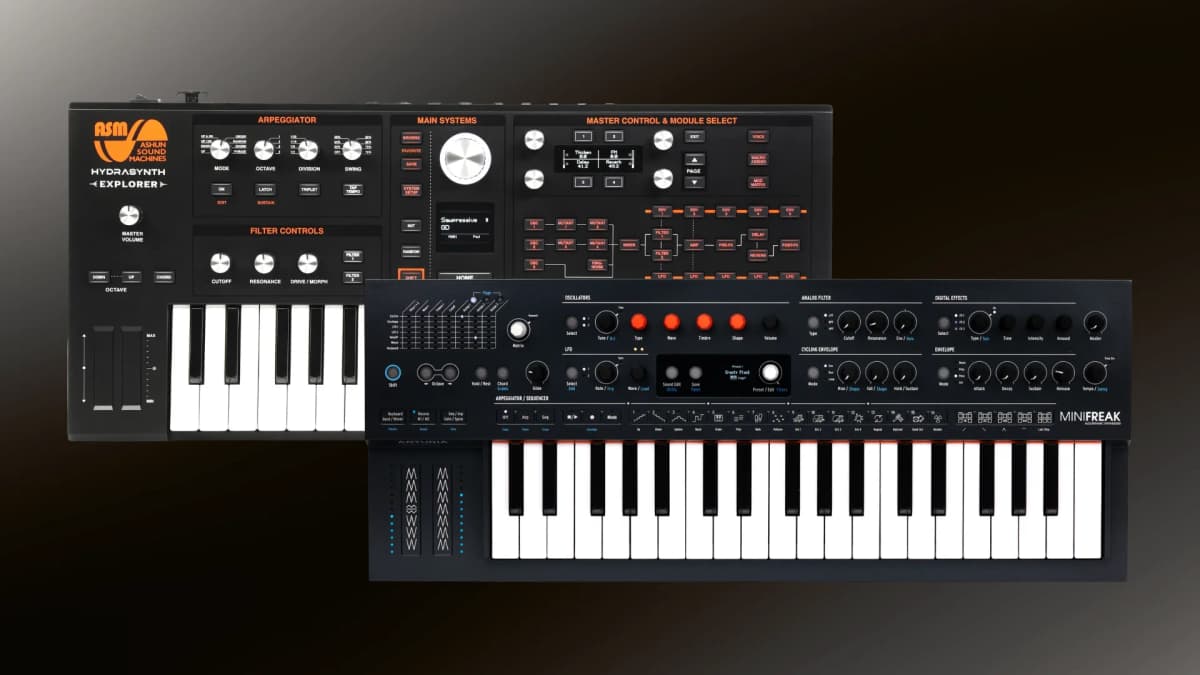
Choosing between the Hydrasynth Explorer and the MiniFreak? This Hydrasynth Explorer vs MiniFreak comparison summarizes what The Unperson found when testing both instruments, so you can see how they differ in sound, controls and value before you buy.

Two modern polyphonic synthesizers at around £500: the ASM Hydrasynth Explorer and the Arturia MiniFreak. Ellie, of The Unperson, breaks down each one, plays presets she made, and lays out pros and cons for anyone unsure which to buy.

Source video: ASM Hydrasynth Explorer vs. Arturia MiniFreak! Qual é o melhor para você? (The Unperson, YouTube)

Table of Contents

  • The MiniFreak: algorithms, an analog filter and a great sequencer
  • The Hydrasynth: wavetables and depth
  • Immediacy against depth
  • Which one makes more sense?

The MiniFreak: algorithms, an analog filter and a great sequencer

The MiniFreak is a six-voice, two-oscillator poly with an analog filter and VCA and a digital effects section. What gives it a unique character is that the oscillators work with algorithms instead of waveforms, many of them from the Mutable Instruments Plaits module: FM, chord, modal and speech, plus algorithms from Noise Engineering. A firmware update even added granular sampling. There are three effect slots with ten effects; the effects are somewhat limited, with only two parameters each, but the parameters can be modulated.

It has two LFOs and two envelopes assigned through a handy modulation matrix, a mod wheel, pitch bend and two macros. The arpeggiator and sequencer, she says, are what really bring it to life: well thought out, with many options, making it very fun and performance-based.

However the Hydrasynth Explorer vs MiniFreak debate plays out for you, the best test is still playing both instruments side by side.

The Hydrasynth: wavetables and depth

The Hydrasynth is an eight-voice, three-oscillator poly and, as she puts it, quite different. There are 219 waveforms, any eight of which can be morphed to create a wavetable, further shaped by mutators for FM, wave stacking, oscillator sync, harmonics and pulse width modulation. Two filters run in series or parallel with sixteen filter types. The effects section is pretty extensive: four slots including dedicated delay and reverb, plus pre and post effects with nine effect choices, many with up to eight parameters.

There are five LFOs, five envelopes and an extensive mod matrix. A random button randomises every parameter and produces crazy sounds, a good starting point for patches. The arpeggiator is deep, but there is no sequencer, although sequences can be programmed into individual oscillators.

In the Hydrasynth Explorer vs MiniFreak comparison, price and playability matter as much as raw sound.

Immediacy against depth

Her summary: the MiniFreak is a lot more immediate, with less menu diving, and its sequencer makes it more of a performative instrument that is more fun live. Her main complaint is the lack of stereo spread when designing patches; stereo is available through the digital effects, but they are limited. She expects more from Arturia, which has already delivered two substantial updates.

The Hydrasynth is more of a sound-design synthesizer, incredibly deep but with a fair amount of menu diving, which makes it less immediate. Her main complaint is the absence of a sequencer, which she says feels easy to implement and would make it a lot more fun.

Hydrasynth Explorer vs MiniFreak: which one makes more sense?

Both are really great, and pretty different. Choose the MiniFreak if you value immediacy, a hands-on workflow and a sequencer that invites you to perform. Choose the Hydrasynth if you want deep sound design and are comfortable spending time in menus. Neither is the wrong choice, and both have an upgrade path through firmware.

That is the Hydrasynth Explorer vs MiniFreak decision in short: match the instrument to the sound and workflow you actually want, and weigh the price difference before you commit.

Related comparisons

Sources

Bernardo de Azevedo
Written by
Bernardo de AzevedoFounder & Editor

His connection with music began at age 6, in the 1980s, when his father introduced him to Jean-Michel Jarre's Rendez-Vous on vinyl. He works professionally in the legal field, while synthesizers became his space for abstraction and creative exploration. Founder of The Synth Source.