

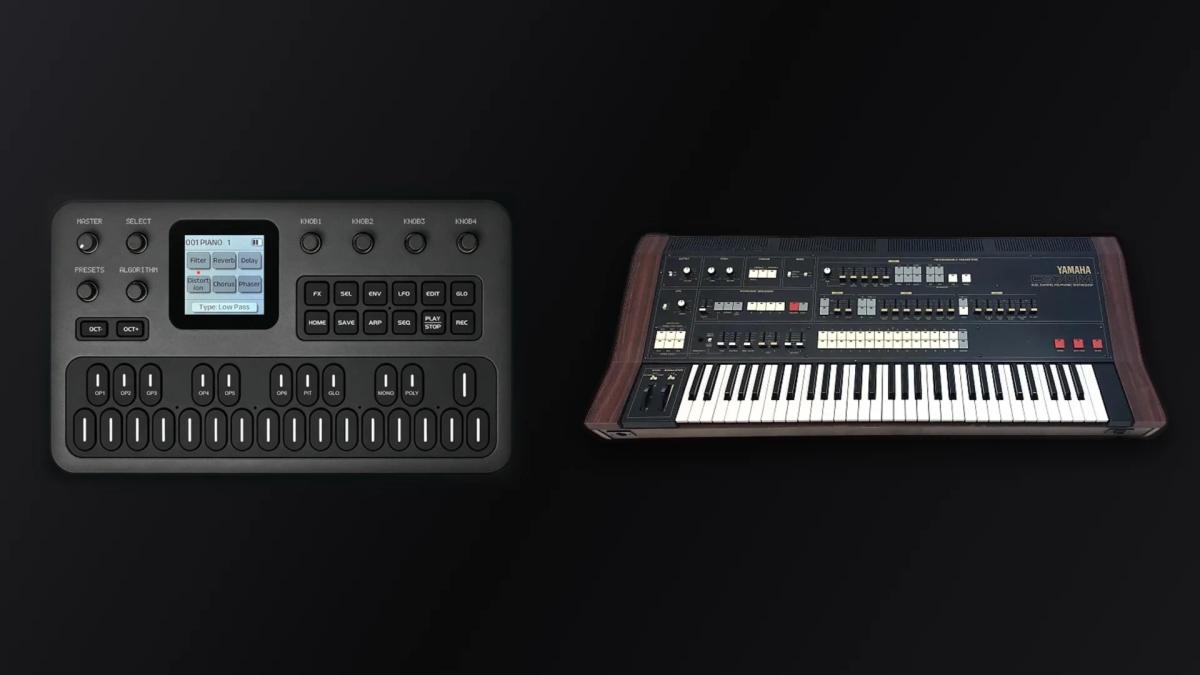
Felucca MPE is a fork of the Felucca firmware for the M-VAVE FM-1, written by Stanley Gurvich of Emerald Moon Labs. It teaches the pocket synth to respond to MIDI Polyphonic Expression, so that each finger on a compatible controller can bend, press and slide its own note, and it adds two modulation sources that give every voice its own movement. The central question is practical: what does per-note expression change on a 27-key, roughly $70 instrument, and how far can a project that has so far run only in an emulator be trusted?
Table of Contents
What Felucca MPE adds to the FM-1
The M-VAVE FM-1 is a compact six-operator FM synth, and on a conventional MIDI setup a bend, a filter move or an LFO acts on every sounding note of a track at once. Felucca, the multi-engine firmware by Leo Kuroshita of Hügelton Instruments, already widened what the hardware can do. Felucca MPE keeps that base and changes how incoming MIDI is divided among voices.
According to the project’s README on GitHub, the work began on 13 October 2026 and sits on Felucca 1.6.1, with the same sounds, sequencer, effects and project files as the upstream release. The additions are a new MPE setting for MIDI IN, per-note pitch bend, two new modulation sources named PRES and TIMB for pressure and slide, and two sources that need no MPE controller at all, a voice LFO (VLFO) and DRIFT.
The framing matters for readers who already own a controller. MPE gives each note its own MIDI channel, which is what lets one finger glide while the rest of a chord holds still. A standard polyphonic keyboard cannot do that, and upstream Felucca offers no MPE option among its MIDI IN settings, which is the gap this fork fills.
Controllers and what the sources name
The README and the accompanying MPE.md name two controllers: a ROLI Seaboard RISE 49 and an Embodme Erae Touch (Mk 1). Both were played into the browser emulator, and the author’s verdict is that the result “feels like any other MPE synth.” That sentence describes the emulator, not the FM-1 itself.
MPE.md also gives setup notes for ROLI’s Seaboard and LUMI instruments in MPE mode through the ROLI Dashboard software, using the lower zone, 15 member channels and a bend range of 48. The LUMI is therefore mentioned as a setup target, but only the Seaboard RISE 49 and the Erae Touch are reported as actually played. No other controller is named, so claims about other MPE hardware, such as expressive pad or string controllers, would be guesswork until users report back.
Felucca MPE describes itself as not affiliated with M-VAVE, ROLI or Embodme.
How per-note expression maps to the sound
The pitch side is the most straightforward. Each member channel carries its own bend, which the firmware applies to one voice only. The default range is 48 semitones, matching the MPE convention, and the author states it can be raised to 96 through the RPN 0 message. Upstream Felucca limits bend to 24 semitones, so Felucca MPE also widens that ceiling for every MIDI IN setting. Two fingers on the same key become two separate voices, and a released note keeps its bend through its release tail.
Pressure and slide go through the existing modulation matrix on the MOD page. PRES reads the finger’s channel pressure, and TIMB reads the slide dimension, which MPE sends as CC74. Both are smoothed over roughly 3 milliseconds and belong to one voice each. They can be routed to the per-note destinations AMP, CUT, SHP and PITCH, with AMT setting the depth. On other destinations, such as pan or the effect sends, they take the value of the most recent note.
The documentation suggests two starting points. Routing PRES to AMP makes a note swell as the finger presses harder and stay silent at rest. Routing TIMB to CUT lets a slide along the key open the filter on that note alone. A small PRES-to-PITCH amount turns pressure into vibrato. Outside MPE mode, PRES falls back to the track’s channel aftertouch and TIMB reads zero.
For a pocket instrument this changes the playing feel considerably, since a finger can shape the filter or the tone-shaping control of one note while the rest of a chord stays put. The documented per-note destinations are limited to the four listed above, so the expression does not reach individual FM operators.
Voice LFO and DRIFT without a controller
The two modulation sources that do not depend on MPE are arguably the more broadly useful part, because they work on the FM-1’s own keys and on its sequencer under any MIDI IN setting.
VLFO takes the track’s LFO and reads it at a different point of its cycle for each of the eight voice slots, spaced 45 degrees apart. With an ordinary LFO, all notes of a chord move together. With VLFO routed to pitch at a low amount and slow rate, the notes drift against each other like an ensemble or a mild chorus. Routed to cutoff, it makes a chord shimmer note by note. VLFO is always bipolar, and with a sample-and-hold wave every voice receives the same value.
DRIFT is a slow random wander for each voice, independent of the LFO. According to the documentation, each voice picks a new random target about every three seconds and glides toward it at its own moment. On pitch, the README gives about 15 cents of deviation at AMT 1 and about 30 at AMT 2, which it likens to the drift of an old analog synth. Routed to cutoff, it makes the filter move slightly on every note.
The changelog also reports measurements from the author’s tests on a chord: with a pitch amount of 6, the plain LFO kept the notes within 6 cents of each other, while VLFO spread them by up to 158 cents. These figures come from the project’s own test runs and have not been independently reproduced.