

Home›Articles›Demake: an ambient lofi sample machine for the FM-1, bu…
Articles

Demake: an ambient lofi sample machine for the FM-1, built from pedal recordings

Demake firmware turns the M-VAVE FM-1 into an ambient lofi machine with 64 built-in recordings, a huge shared reverb and chords. Read the details.

Bernardo de Azevedo
Bernardo de Azevedo
· Updated
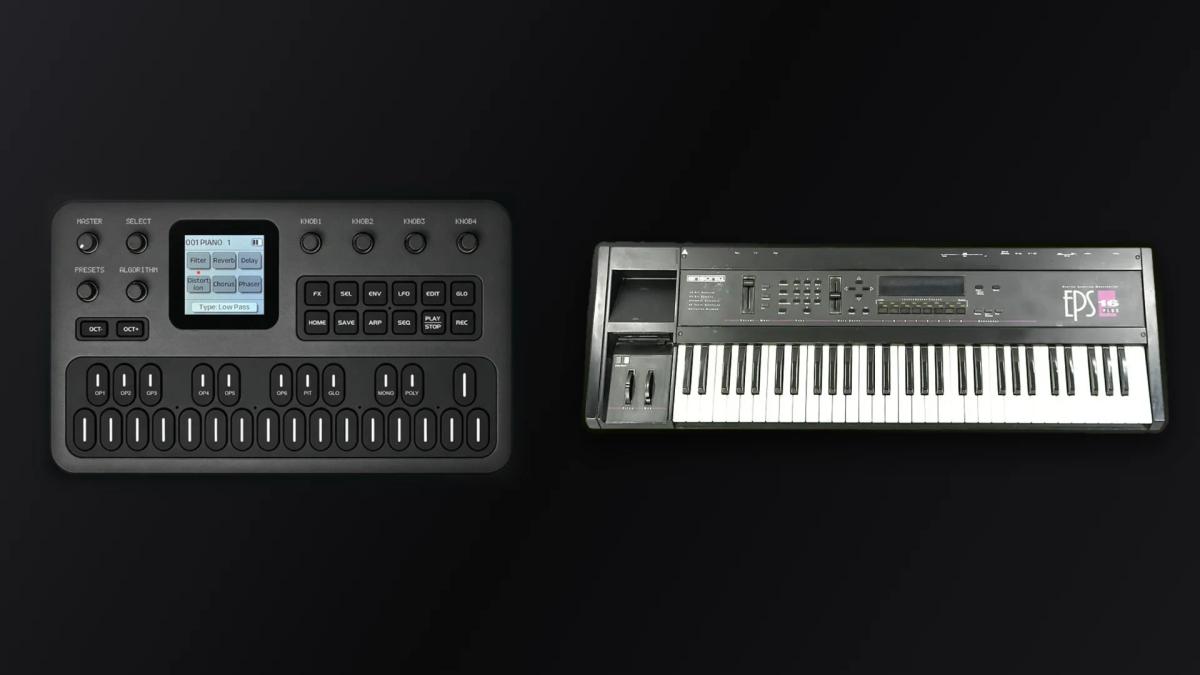
Demake firmware: M-VAVE FM-1 pocket synthesizer beside the Ensoniq EPS-16 Plus

Demake is an ambient lofi firmware for the M-VAVE FM-1 from Sequencist, the developer who also wrote MONO2K. Where that project imitates an Elektron workflow, the Demake firmware builds its sound from recordings rather than FM operators: 64 sounds that, according to its README, the author made with pedals, played through three synths, a chord machine and a very large shared reverb. The central question is what a pocket synth built for DX7-style patches gains from becoming a small sample-based instrument with a deliberately worn sound, and what it gives up.

Table of Contents

What the Demake firmware is

The name borrows from video games. A demake usually means a modern game rebuilt for obsolete hardware. The README applies the word loosely, saying the instrument is voiced like a late-90s console demake and drawn in a grey, dithered style with a single “thermal” highlight colour for whatever is active. No game is being ported, so the term describes an aesthetic rather than a technical goal.

In practical terms the firmware has three synths that share twelve voices, a filter, per-synth effects, a shared reverb called the Space, whole-mix tape-style processing and a sequencer that arranges patterns into scenes and songs. The project page runs the same core in a browser, so the Demake firmware can be tried without hardware.

According to the README it runs on the open FM-1 platform of CS-1 and Felucca, as MONO2K does, and is licensed GPL-3.0-only. It is separate from M-VAVE’s own firmware, to which the installer can return the device. The FM-1 profile explains why a firmware like this is possible at all.

Sixty-four recordings and three synths

Instead of oscillators, each synth plays looped recordings. The README says there are 64 sounds, made with pedals and kept as they were, built in like a rompler with nothing to load, and that the recordings are the author’s own. The manual likewise describes them as built in. How the recordings were made beyond the pedals is not documented, and no way to import other material is described.

A sound offers a start point, a loop mode (full, once or a chosen region), tuning in semitones with cents, a second recording layered beneath the first, glide, velocity response and, according to the README, a “grit” setting that runs the voice at 22 or 11 kHz.

Each sound is named after a plant, in Latin, and the home screen shows a pixel landscape matched to the kind of sound. The README lists thirteen landscapes, among them peaks, a beach at sunset, a harbour in fog and a lighthouse on a cliff, and the one on screen keeps moving while the instrument plays.

This is a deliberate trade. Twelve shared voices, half of them on the chip’s second core, and fixed material limit what the Demake firmware can do, but the constraint keeps every sound within one family. The LFO, one per synth, can target pitch, cutoff, level, pan or the sample start point, which is a useful extra when the source material cannot be reshaped.

Filters, effects and the Space

The filter has seven shapes plus off: two low-pass slopes (LP24 and LP12), high-pass, band-pass, notch, peak and a vowel mode in which the cutoff glides through u, o, a, e and i. Each synth has an envelope and an LFO running from 0.05 to 20 Hz, with optional fade-in and tempo sync.

The effects are where the lofi character lives. Each synth has its own reverb (room, plate, spring or hall), a delay (plain, ping-pong, tape echo or grains) and a motion stage that covers chorus, vibrato, drift, ensemble, phaser, flanger or tremolo. According to the manual the delay runs at 11 kHz, and the tape echo reaches 0.69 seconds with a slow wow.

Over the whole mix sit two further stages. Colour offers saturate, crush, lossy, noise, warm and distort. Media adds tape, cassette, VHS, vinyl, radio and dictaphone. The shared Space receives a send from all three synths. Its types are hall, space, haze, bloom, lofi, shimmer, reverse and freeze, with tails reaching 21 seconds in Hall and about two minutes in Space, and Freeze holds the contents for up to five minutes.

This article is based on the project’s documentation and has not been tested on hardware, so none of this can be judged for sound quality. What the documentation does show is that the Demake firmware has a broad effect set aimed at one purpose, which is slow, smeared material.

Chords, rolls, scenes and songs

Harmony is handled by a chord machine. A key plays the chord built on it in the chosen song key, so pressing A gives Am7 and F gives Fmaj7. Chord types run through sevenths, triads, ninths, add9, sus2, sus4, 6/9 and power chords, and each synth can have its own voicing and strum. There are sixteen progressions and four user slots, and a synth can follow the chords, the key or another synth’s notes at an offset.

Each synth has a roll of 1 to 256 steps, so the three loops drift against each other. Notes can be recorded live with micro-timing preserved. A Vary section offers Mutate, Chance and Evolve, and the arpeggiator has thirteen play patterns such as Hill, Valley, Walk and Pinky, according to the README.

Above that, each synth stores eight patterns, and sixteen scenes assign one pattern to each synth. A song strings scenes into up to 128 steps of one to eight bars, with a choice of ending (loop, stop or fade), and can be recorded live by switching scenes while HOME is held. Each synth keeps its own chord keys, so one page can play pads while another follows the harmony, which gives a small player a surprising amount of arrangement control.

Installing Demake and sharing flash

The installer page for the Demake firmware asks for Chrome or Edge, a data-capable USB cable and MIDI permission, and takes about a minute. It labels the install file as a test build, and the README’s status line gives version 0.4.24, the same number as the latest release at the time of writing. As with any flashing, read the project’s own warnings and the site’s install and recovery guide first. Returning to M-VAVE’s V15 file is possible from the same page, and powering on while holding OCT− starts a rescue loader.

The more consequential warning concerns storage. Demake keeps up to 14 songs and 32 of the user’s own sounds in a 64 KiB part of the FM-1’s data area. The README says there is no backup tool yet, that other firmwares use the same region (it names Felucca’s samples and loops from CoralFlower), and that either side can overwrite the other’s data. Installing Demake writes only the program, not the data area, but switching to a firmware that saves there means expecting Demake’s songs to be lost.

MONO2K keeps its store elsewhere. Demake’s README says it leaves MONO2K’s region alone, and the install page says MONO2K’s saves are kept, so the two projects from the same author can coexist as far as data is concerned.

Limits and what is still pending

The manual lists undo, short loops and more effect types as coming, and the releases page describes the project as a beta below 1.0. The six listed releases run from 25 to 28 October, and the notes for 0.4.23 describe fixes for crashes caused by a CPU multiply fault, a MIDI note bug in the chord keys and chord inversions beyond the available notes. That list is typical of fast iteration, and it is a reminder to expect bugs.

Fixed limits in the Demake firmware include the 64 recordings, 12 voices, eight patterns per synth, sixteen scenes and 32 sound slots. Saving must be done while stopped. No sample import is documented, so the character of the instrument depends entirely on whether the author’s recordings suit the player.

Documentation also trails the releases in places. The project page and the manual name no version at all, the install page shows version details only after the device is connected, and six releases appeared in four days, so any version number should be treated as a snapshot.

Alongside other ambient and lofi firmware

The FM-1 has several firmwares that touch ambient or sample territory. GR!MM, from the GRiMMBIENT project, offers VA, FM and sample sources, eight factory samples that can be supplemented by the user’s own through its editor, and TAPE, GRAIN, DELAY and SPACE effect pages. Demake chooses the opposite approach on content: no documented importing, but a larger fixed library, a chord machine and a scene-and-song structure.

Felucca’s general-purpose engine set, with thirteen engines and four tracks, is a different kind of instrument again. Demake sits closer to a rompler than a sampler, aimed at one mood, and the author’s other FM-1 firmware, MONO2K, pursues an unrelated design goal on the same platform.

No independent coverage of Demake had been located at the time of writing. The Synthtopia roundup of alternative FM-1 firmware was posted on 4 October, before the first Demake release, and the text of the Firmware Hub credits MONO2K’s author but does not mention Demake, although its catalogue loads dynamically, so neither is strong evidence either way.

Final perspective

The Demake firmware is a focused answer to a narrow question: what happens if the FM-1 stops imitating a DX7 and acts as a small, atmospheric sample player, with the Demake firmware as the answer. The documentation supports a coherent design, with sensible limits and a clear statement about where data lives and when it can be lost.

Its weaknesses are equally clear. Fixed material, no backup tool, a test-build label and a pace of releases that implies unfinished corners. Players who want sounds they can reshape will look elsewhere, whereas listeners drawn to tape smear and long reverbs, and who are prepared to back up manually, have a distinctive option and a browser version to test first.

Sources

  1. Demake, an ambient lofi machine for the M-VAVE FM-1, Sequencist
  2. Demake manual, Sequencist
  3. Demake install page, Sequencist
  4. InigoHernandez/demake-synth, GitHub
  5. Demake releases, GitHub
  6. InigoHernandez/mono2k, GitHub
  7. Felucca, GitHub (Hügelton Instruments)
  8. GR!MM, GRiMMBIENT
  9. The Firmware Hub, The Firmware Hub
  10. Demake (video games), Wikipedia
  11. Alt Firmware Options For The M-Wave FM-1 Pocket Synthesizer, Synthtopia
Bernardo de Azevedo
Written by
Bernardo de AzevedoFounder & Editor

His connection with music began at age 6, in the 1980s, when his father introduced him to Jean-Michel Jarre's Rendez-Vous on vinyl. He works professionally in the legal field, while synthesizers became his space for abstraction and creative exploration. Founder of The Synth Source.