Still Point and the music nobody played
One of her most striking works predates the machine. Still Point, composed in the 1940s according to Wikipedia, is an electroacoustic piece for turntables, a double orchestra and five microphones. The BBC rejected it, and it went unperformed in her lifetime. The first performance came on 24 June 2016, with Shiva Feshareki and the London Contemporary Orchestra, and a revised version was played at the BBC Proms on 23 July 2018.
The delay between composition and performance is part of her story. Wikipedia does not give a precise year for the work, only the decade, so no more exact date is claimed here. It also notes smaller film credits. Electronic sounds from her piece Atoms in Space appear, uncredited, in the 1962 film Dr. No, and she contributed uncredited electronic sounds to The Innocents in 1961 and worked with the filmmaker Geoffrey Jones on Snow in 1963 and Rail in 1967.
The machine after Oram
Oram never abandoned the idea. Goldsmiths says she began a smaller Mini-Oramics in the early 1970s, possibly inspired by the Minimoog, though as far as is known she never completed a prototype. In the 1980s she developed a software version for the Acorn Archimedes, funded by a grant from the Ralph Vaughan Williams Trust. Strokes in the 1990s ended her working life, and she died in Maidstone on 5 January 2003, aged 77.
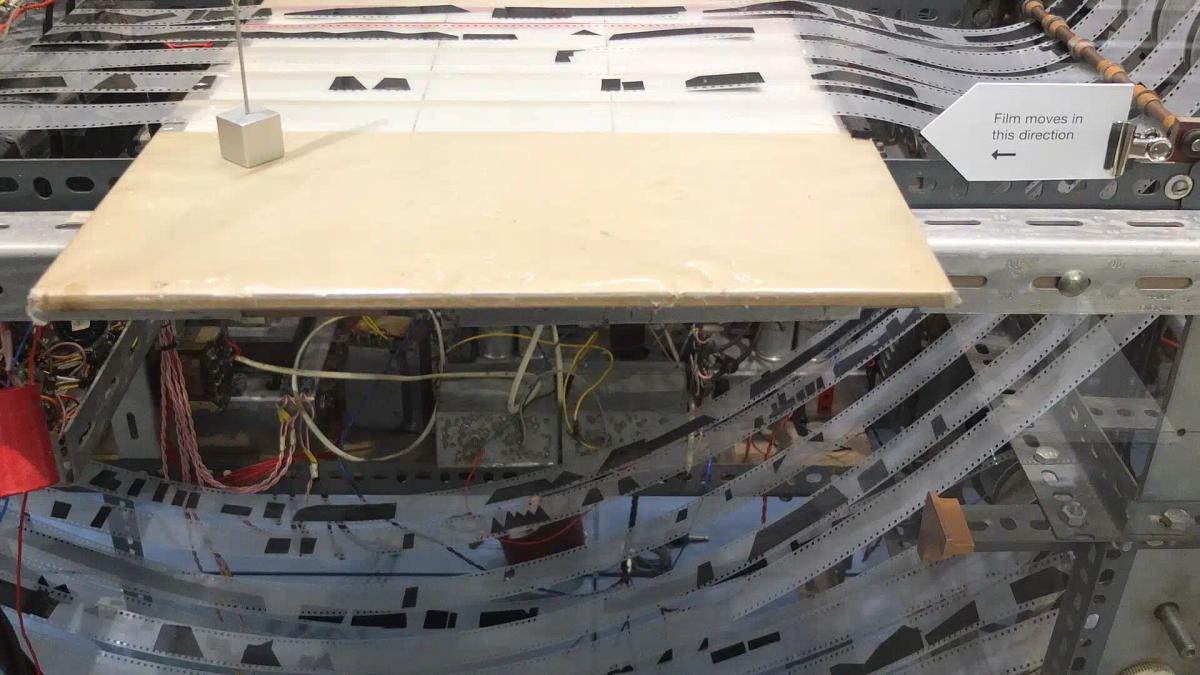
The Science Museum Group’s collection includes the Oramics machine itself, its Programmer, its Sound Generator and a set of waveform slides. Oram also wrote about her ideas. Her book An Individual Note of Music, Sound and Electronics, which explores acoustics and the history of electronic music in a philosophical way, received a second edition from Anomie Publishing in 2016 and a third in 2020 with the Daphne Oram Trust, according to Wikipedia.
Her archive went to Goldsmiths in 2008, where it is held in Special Collections and open to the public. The original Oramics machine was shown at the Science Museum in London from 2011 to 2015, according to Wikipedia. In 2016 the Goldsmiths PhD student Tom Richards built a working Mini-Oramics, working as if the year were 1973 and using only technology available then. Goldsmiths says it took him three years, and that six contemporary composers, including Ain Bailey and Rebecca Fiebrink, have been testing the instrument.
Final perspective
The Oramics machine looks like a dead end only if you judge it by sales. As an idea, it points toward sound as a picture, a score that is also an instrument, and a composer who specifies waveforms directly rather than playing notes. Oram approached that destination with film, photocells and patient engineering.
The harder lesson is about who gets to build such tools. Oram started inside a major broadcaster and left because it would not center the work she thought mattered. She carried on in a Kent oast house with small grants. The result was a machine few could use, but one that shows how much composition could change when the tool itself becomes part of the score.
That is why the Daphne Oram story keeps drawing musicians and historians back to it.
Few chapters of synthesizer history show as clearly as Daphne Oram how far a single idea can travel.
What makes the Daphne Oram story memorable is how ordinary the people involved were, and how improbable the outcome turned out to be. Anyone retelling the Daphne Oram story has to admit that part of it comes down to timing and luck. The Daphne Oram story also shows how quickly a promising idea can slip out of public view.
Revisiting the Daphne Oram story today, it is striking how many details were lost or rewritten over the years. Each retelling of the Daphne Oram story adds a little more context to what the original documents leave out. If there is one lesson in the Daphne Oram story, it is that technology rarely follows a straight line.
Related stories
Sources