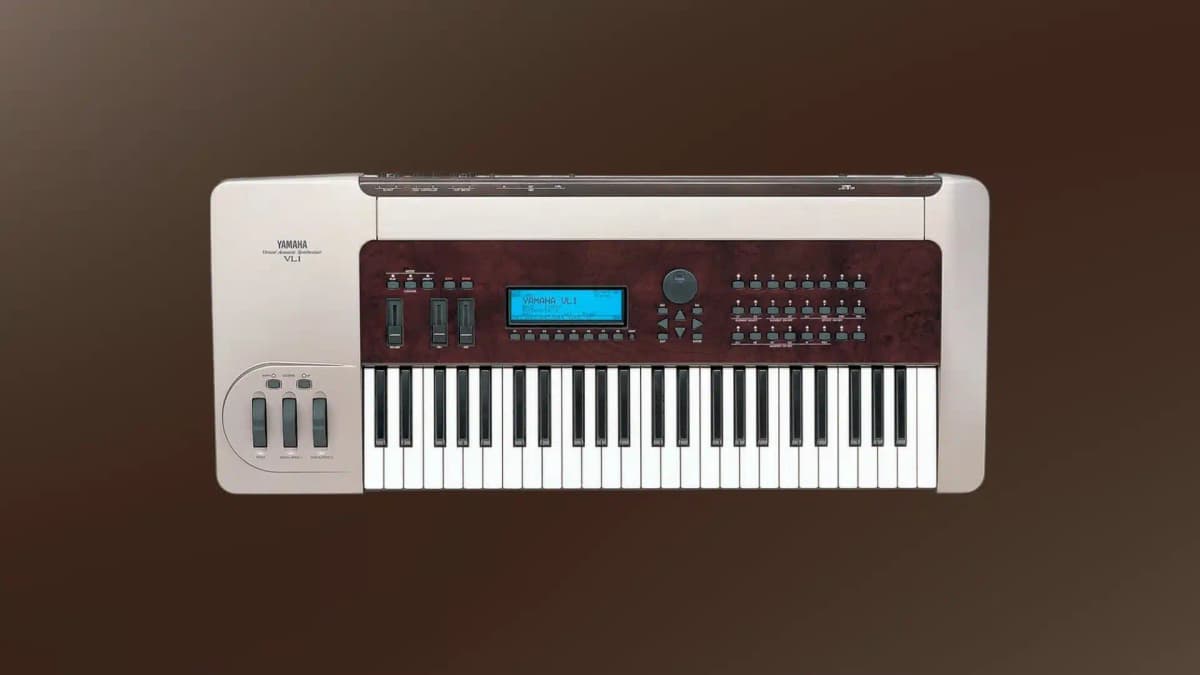
Yamaha VL1: The physical modeling pioneer that traded polyphony for expression
The Yamaha VL1 is a 49-key, two-voice keyboard synthesizer that Yamaha introduced in 1993 as the first commercially available instrument built on physical modeling, which the company branded Virtual Acoustic synthesis.
The Yamaha VL1 is a 49-key, two-voice keyboard synthesizer that Yamaha introduced in 1993 as the first commercially available instrument built on physical modeling, which the company branded Virtual Acoustic synthesis. Instead of replaying recordings or stacking oscillators, it calculated in real time how a reed, a lip or a bow excites a tube or a string, and it asked the player to control that model with a breath controller, pedals and wheels.
It was expensive, nearly monophonic and difficult to program, and it did not sell well. It still matters because it moved physical modeling out of university research and into a working instrument, and because it framed expression, not voice count, as the problem worth solving.
The Yamaha VL1 sounds less like a synthesizer imitating an instrument than like an instrument behaving. Sound On Sound’s 1994 review heard the pitch wheel walk a brass voice through the overtone series of a real brass instrument, and noted that blowing too hard into the breath controller produced “all sorts of interesting instabilities.” Two years later the same magazine described the family trait in plain terms: as breath pressure rises, VL sounds “stutter and then lock onto the note.” That moment of catching is the core of the Yamaha VL1’s identity, and it is something a sample cannot do.
The instrument excels at wind and brass voices, saxophones above all, along with bowed string models and hybrids that have no acoustic equivalent. Yamaha’s own chronology lists Yamaha VL1 sounds with names like “Jet Lip Bow” and “Feed Back,” which hint at how far the models could be pushed away from realism. Because drivers and resonators can be combined freely, the Yamaha VL1 is often most interesting when it obeys acoustic rules with invented materials.
Its character is articulate rather than lush. A two-note instrument offers no pad-like width; instead, tonguing, growl, breath noise and scream are part of the vocabulary. Not every listener was convinced by the static tone. One user on Sonic State found the raw sound not very different from a good sample-based synth, but described the expressive range as “simply tremendous.” Heard as a held note, it is a good imitation. Played, it becomes something else.
Features and architecture
Manufacturer: Yamaha
Year introduced: 1993, according to Yamaha; demonstrated at the 1994 NAMM show, with the Sound On Sound review appearing in July 1994
Production years: from 1993; a Version 2 operating system and voice set, covering the Yamaha VL1, VL1-m and VL7, was documented by Yamaha in 1995; discontinued, with no clearly documented end date in the sources consulted
Synthesis type: Self-oscillating Virtual Acoustic synthesis (S/VA), Yamaha’s implementation of physical modeling based on waveguide techniques licensed from Stanford University
Polyphony: 2 voices; most factory patches are monophonic, with a few duophonic
Original price: £3,999 including VAT in the UK; ¥470,000 in Japan
Oscillators: no conventional oscillators; each voice uses 1 or 2 Elements, each built from a Driver (the excitation, such as a reed, lips or bow) and a Pipe or String (the vibrating resonator), which can be combined freely
Instrument editing: the instrument models are factory-defined and not directly editable; sound design works through controller scaling, offsets and a large set of parameters, reported at close to 1,000
Filter: Resonant Dynamic Filter with low-pass, high-pass, band-pass and notch modes
Other modifiers: Harmonic Enhancer (a two-operator FM section), five-band parametric EQ with key scaling, Impulse Expander simulating a resonant cavity, and a Resonator built from five parallel delays
LFOs: tied to performance controls; Vibrato drives pitch or embouchure and Growl drives pressure through LFOs, effect LFO rates can follow MIDI controllers, and some Version 2 voices use delayed vibrato
Envelopes: present, but shown only as numeric values in the page-based editor
Modulation system: any incoming MIDI controller can be assigned to instrument controls including pressure, embouchure, pitch, vibrato, tonguing, amplitude, scream, breath noise, growl, throat formant, dynamic filter, harmonic enhancer, damping and absorption
Sequencer / arpeggiator: none documented
Effects: dedicated 32-bit DSP effects with modulation (flanger, pitch change, chorus), delay, reverb and distortion
Memory: 128 internal RAM voices with battery backup; 3.5-inch floppy drive for saving voices and loading third-party disks
Keyboard: 49 keys, velocity sensitive, with channel aftertouch; pitch bend, modulation and an additional assignable wheel, two sliders and octave shift buttons
Inputs / outputs: stereo audio outputs via two 20-bit Burr-Brown DACs; breath controller input; two foot controller inputs
Included controllers: BC2 breath controller and FC7 foot pedal
MIDI / USB: MIDI In and Out; no USB
Display: 240 x 64 dot backlit LCD
Dimensions / weight: 914 x 380 x 105 mm, 12.5 kg
Power: internal switch-mode power supply, 16 W consumption
Strengths
Its expressive response is the real achievement. Breath, embouchure, tonguing and growl drive a model that reacts like an acoustic system, so the player shapes every attack instead of triggering a fixed recording.
It treats articulation as sound design. Note transitions, breathy onsets and overblown edges come from the model itself.
The Driver and Pipe/String structure allows impossible hybrids. Mixing excitations and resonators lets the Yamaha VL1 produce instruments that behave plausibly without existing in the acoustic world.
It was a complete performance package: breath controller and foot pedal included, plus an extra wheel, sliders and aftertouch.
Limitations
Two-voice polyphony, with most patches monophonic, confines it to solo and lead roles. It cannot carry chords or pads on its own.
The price placed it far from most musicians. At £3,999 in the UK, it was a professional and institutional purchase rather than a home studio instrument.
The learning curve is steep. Sound On Sound described a dense parameter set, a page-based operating system with poor graphics and envelopes displayed only as numbers.
The core instrument models cannot be edited directly. Users can scale and shape how a model is played, but cannot build a new driver or resonator from scratch on the instrument.
It rewards a breath controller and punishes its absence. Yamaha itself recommends playing it with a breath controller, and users report that wind voices are hard to play convincingly from the keys alone.
Some practical details felt unfinished, such as a floppy drive hidden under the top panel.
Historical context
Yamaha’s path to the VL1 began in 1987, when the company set up a research group, K’s Lab, under Dr. Toshifumi Kunimoto and asked it for a next-generation tone generation system within five years. The team’s breakthrough came from an older acoustics thesis showing that a tapered tube could be approximated by two straight cylindrical tubes, which made a saxophone far more practical to model. That insight, combined with waveguide synthesis techniques based on Julius O. Smith’s work at Stanford and licensed from the university, produced the S/VA engine and the custom DSP chips inside the Yamaha VL1.
The timing was premature. Physical modeling had lived mainly in academic research and software, and the processing power to run it in real time was scarce, which explains both the price and the limited polyphony. Stanford’s own retrospective on its physical modeling program notes that physical modeling was seen by Stanford’s licensing office and by Yamaha as the successor to FM, the technology that had already made Yamaha dominant through the DX7.
Sound On Sound read the Yamaha VL1 in exactly those terms in 1994, comparing it to the pattern in which an expensive flagship such as the GS1 was followed by an affordable best-seller like the DX7. Yamaha did push the technology downward. In late 1994 it announced the VL1-m, a 3U rack version with essentially the same facilities at £2,199 in the UK, and the VL7, a monophonic keyboard compatible with Yamaha VL1 voices at the same price.
In 1996 the VL70-m half-rack module brought the sound down to £499, roughly an eighth of the Yamaha VL1’s launch price. The polyphonic VP1, which Yamaha dates to 1994, sat even higher: Sound On Sound’s VL1 review reported a rumoured price closer to £10,000. Unlike FM, none became a mass-market success.
Legacy and significance
The Yamaha VL1’s importance is clearer in hindsight than in its sales figures. Kunimoto summarized it frankly: the Yamaha VL1 “didn’t do very well in terms of business at the time, but the physical modeling concept had far greater implications.” The circuit modeling behind its effects grew into the Virtual Circuitry Modeling later used in Yamaha’s digital mixers, and the VL engine survived in smaller, cheaper modules such as the VL70-m.
Its larger legacy is conceptual. The Yamaha VL1 argued that the next frontier in synthesis was not more voices or more samples but a richer relationship between gesture and sound. CDM has drawn a line from the Yamaha VL1 through later wind controllers to the Eigenharp and MPE, and argued that the Osmose owes it a debt. Whatever the exact lineage, the Yamaha VL1 was the first commercial product to make continuous physical control the center of the instrument.
It also marks the point where physical modeling became something a musician could buy and play on stage. Sound On Sound’s reviewer ended his assessment with the line “Synthesis will never be the same again.” The prediction was too bold for the market of the 1990s, which never turned the VL line into a mass-market success. But it was not wrong about the direction of the idea.
Artists, users, and curiosities
At launch, Yamaha surrounded the Yamaha VL1 with prominent endorsements. Sound On Sound’s review quoted Howard Jones saying that “if the VL1 was a car, it would definitely be a Ferrari,” and Jean-Michel Jarre calling it “the science fiction of musical instruments.” In 1994 Yamaha’s Phil “Bad Mister” Clendeninn demonstrated it on National Public Radio, and Katsunori Ujiie later recorded video demonstrations of its classic voices for Yamaha. By 1996, Sound On Sound noted it had found applications “from jazz to techno.”
One documented studio use comes from industrial music. The release notes of Front 242’s 2003 album Pulse, as reproduced on Discogs, list the Yamaha VL1 among “some of the tools used,” a decade after the instrument’s introduction.
The most memorable curiosity is the origin of its saxophone. Yamaha’s researchers credit their practical breakthrough to an old thesis showing that a tapered tube could be approximated by two straight cylinders, an idea that made the conical bore of a saxophone computable on 1990s hardware. Another easily missed detail: the Yamaha VL1’s flanger and distortion were models of electronic circuits, making this wind-instrument synth the quiet beginning of Yamaha’s circuit modeling work.
Yamaha VL1 market value
Current market position: a rare, historically important discontinued instrument valued mainly by collectors, wind controller players and physical modeling enthusiasts
New price signal: no new units; at launch it cost £3,999 in the UK and ¥470,000 in Japan
Used market signal: sales are infrequent, and no reliable current price benchmark could be confirmed in the sources consulted; condition, operating system version and included accessories all matter
Availability: hard to find; CDM described it as “a phenomenally rare instrument,” and listings that do appear often bundle flight cases, accessories and voice disk libraries
Buyer notes: check which operating system version is installed, confirm the floppy drive works or has been replaced, test the backlit display, check the internal memory battery, and confirm the breath controller and foot pedal inputs respond correctly
Support ecosystem: Yamaha still hosts Version 2 voice lists and MIDI documentation; the VL7 was built to be compatible with Yamaha VL1 voices, and the VL1-m and VL70-m carried Virtual Acoustic synthesis into rack form
Market character: collectible and specialized rather than broadly sought after; the instrument appeals more to players who want its expressive response than to buyers looking for a general-purpose classic synth
Long-term position: likely to remain a niche but secure historical landmark, with interest rising and falling alongside wider attention to physical modeling and expressive control
Conclusion
The Yamaha VL1 was not built to be popular, and it was not. It was built to prove that a synthesizer could model how instruments are played, not only how they sound, and it did that years before the market was ready to pay for it. The Yamaha VL1 matters because it was the first time the physics of an instrument and the gestures of a player were joined inside a commercial synthesizer, and much of today’s interest in expressive control is still working through the question it asked.
His connection with music began at age 6, in the 1980s, when his father introduced him to Jean-Michel Jarre's Rendez-Vous on vinyl. He works professionally in the legal field, while synthesizers became his space for abstraction and creative exploration. Founder of The Synth Source.