

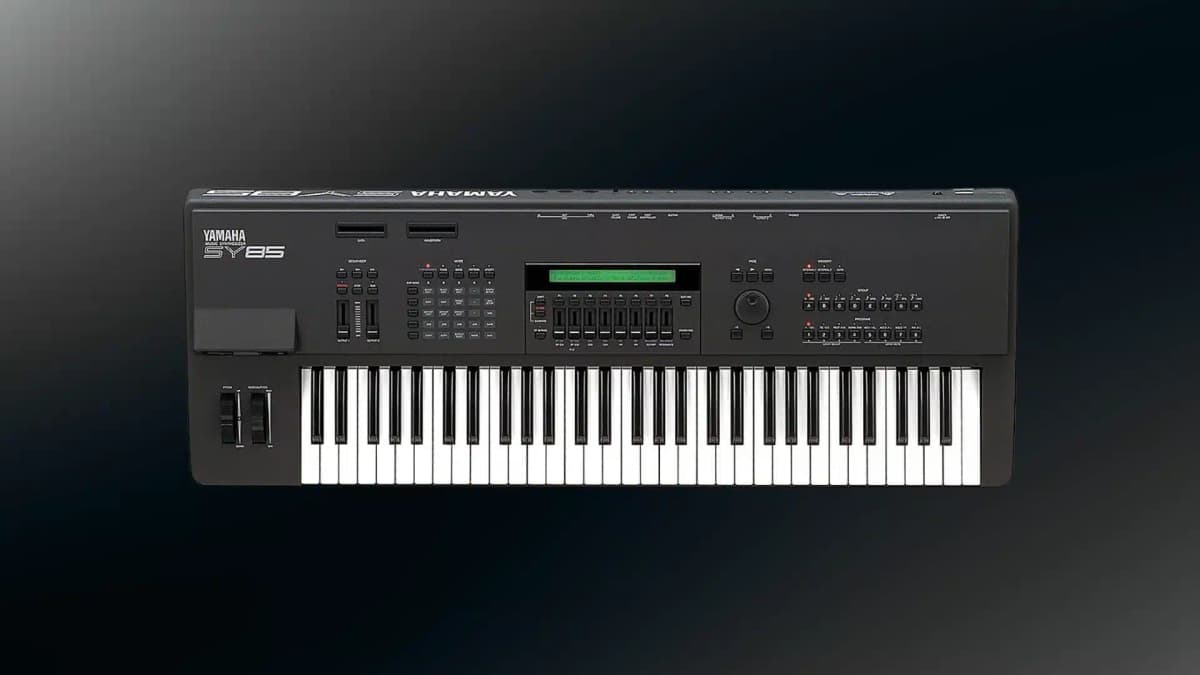
The Yamaha SY85 is a 61-key digital workstation that Yamaha introduced in 1992, built around its AWM2 sample playback engine, 6MB of wave ROM, resonant digital filters, two effects processors and a nine-track sequencer. Unlike the SY77 and SY99 that came before it, it has no FM synthesis at all, which makes it Yamaha’s first pure sample-plus-synthesis workstation in the mold of the Korg M1. It also offered user sample RAM, expandable from 512KB to 3.5MB, at a time when that was rare in a mid-priced keyboard, and eight real-time sliders under the display. It matters as the instrument that brought Yamaha’s workstation line into the sample-based mainstream and, through its rack twin the TG500, shaped a large share of 1990s studio sound.
Table of Contents
Yamaha SY85 sound and character
The Yamaha SY85 sounds polished, wide and dense rather than raw. Its 244 basic waveforms cover pianos, strings, brass, woodwinds, basses, guitars, drums, effects and synth waves, and contemporary reviewers were struck by how complete the factory sounds felt. Sound On Sound’s Derek Johnson described a rich, lush sound and praised the digital filters, the depth and warmth of the waveforms, the lively strings and the solid drum kits, while finding the brass a little weak. Music Technology’s Ian Waugh went further, writing that the Yamaha SY85 had some of the best play-me sounds he had heard and singling out its guitars.
Much of that impression comes from layering and effects. A Performance can stack or split up to four Voices, and the two effects processors, which Yamaha’s manual describes as essentially the same as the SY99’s, can run in series or in parallel with reverbs, choruses, delays, distortion, rotary speaker and an exciter. Owners still single out the effects as the source of the instrument’s size; one Sonic State user wrote that listeners asked which studio he had recorded tracks that came straight from the onboard sequencer.
Underneath, the voice architecture is more synth-like than the presets suggest. Each waveform passes through a resonant filter that can be low-pass, high-pass, band-pass or band-reject, an amplitude envelope with 21 preset shapes or full editing, and an LFO for vibrato, tremolo and filter wah. That makes analog-style basses, filtered pads and moving textures possible, and later sample libraries drawn from the SY85 and TG500 highlight its pads, Moog-like basses and house pianos. The character is unmistakably early-1990s digital: clean, slightly grainy at the edges, and less individual than a Yamaha FM instrument, a point SOS made when it said the Yamaha SY85 lacked an immediately recognizable Yamaha sound.
Features and architecture
- Manufacturer: Yamaha Corporation, Japan
- Year introduced: 1992; Music Technology ran an Yamaha SY85 competition in its August 1992 issue, and the major UK reviews appeared in October and November 1992
- Production years: from 1992; the end of production is not clearly documented, and the W5 and W7 workstations that succeeded the SY series arrived in 1994
- Synthesis type: AWM2 sample playback with digital resonant filters (sample plus synthesis); no FM
- Category: 61-key music workstation with user sampling RAM
- Polyphony: 30 notes according to Yamaha and the contemporary reviews; Vintage Synth Explorer lists 32
- Multitimbrality: 16 parts, with a 16-part Multi attached to each sequencer Song
- Original price: ¥210,000 in Japan according to Yamaha’s synth chronology; £1,399 including VAT in the UK; a $1,995 US list price according to Sound Programming, with some later sources quoting around $1,500, probably a street figure
- Current market price: recent used listings collected by Sound Programming run from roughly $310 to $420; clean examples with disks or a case sell higher
- Oscillators: one AWM2 waveform per Voice drawn from 6MB of ROM holding 244 waveforms; up to four Voices layered or split in a Performance
- Sampling: no audio input; samples load from floppy disk or over MIDI using the Sample Dump Standard into 512KB of volatile wave RAM, expandable to 3.5MB with two non-volatile SYEMB06 boards (1MB) and SIMMs (2MB); up to 64 samples in memory
- Filter: digital resonant filter with low-pass, high-pass, band-pass and band-elimination types
- LFOs: one per Voice with vibrato (pitch), tremolo (amplitude) and wah (filter) destinations
- Envelopes: amplitude envelope with full editing or 21 preset types; filter settings include velocity-sensitive presets
- Modulation system: velocity, aftertouch, mod wheel, foot controller and assignable sliders routed to pitch, filter, amplitude and effects
- Controllers: pitch and modulation wheels; eight continuous sliders for Quick Edit and real-time control, two of them user-definable
- Sequencer / arpeggiator: nine tracks (eight instrument tracks plus a rhythm track), 10 Songs, about 20,000 notes, 48 ppqn, 100 drum patterns of up to four bars; real-time and step recording; no arpeggiator
- Effects: two processors with 90 types each, running in series or parallel, with single, dual and cascaded configurations
- Memory: 256 Voices in four banks of 64 and 128 Performances; MCD64 RAM cards for Voice and Performance data
- Storage: built-in 3.5-inch double-density floppy drive; reads and writes Standard MIDI Files (Format 0)
- Expansion: a data card slot and a waveform ROM card slot, plus internal wave RAM expansion slots
- Keyboard: 61 unweighted keys with velocity and aftertouch
- Inputs / outputs: two assignable stereo output pairs (four outputs), headphones, foot controller and foot volume jacks
- MIDI / USB: MIDI In, Out and Thru; no USB or SCSI
- Display: backlit 40-character by 2-line LCD
- Dimensions / weight: 1,024 x 367 x 119 mm and 14 kg according to Yamaha
- Power: internal supply; power consumption listed at 20W
Strengths
- The factory sounds were unusually complete for 1992. Pianos, strings, guitars, drums and pads arrived ready to use, which is why reviewers recommended it to gigging players as much as to programmers.
- User sample RAM made it more than a ROMpler. Being able to load custom samples, and keep up to 1MB of them through power cycles with the SYEMB06 boards, was rare in a mid-priced keyboard of its time.
- The effects section is genuinely strong. Two processors in series or parallel, with four output buses, give the layered Performances much of their scale.
- Eight sliders under the display make editing fast. Quick Edit puts envelopes, filter and effect levels on physical controls, a real advance over the menu-only editing of many contemporaries.
- The keyboard is good. SOS found the action firmer and less springy than most mid-priced synths, and owners still use the Yamaha SY85 as a master controller.
- It is a practical all-in-one studio. A 16-part engine, a nine-track sequencer with MIDI file support and a floppy drive covered a full arrangement without a computer.
Limitations
- Thirty-note polyphony is tight once Performances layer four Voices, and the TG500 rack version doubled it for good reason.
- Wave RAM is volatile unless the SYEMB06 boards are fitted, so standard samples disappear at power-off and must be reloaded every session.
- There is no audio input, so it cannot sample directly; samples have to arrive by floppy or by slow MIDI sample dump, and there was no SCSI option.
- File handling was clumsy. Reviewers complained that individual Voices and Songs could not be saved or loaded on their own, and the double-density drive is small for a full 3.5MB of samples.
- The sequencer is better for recording a known arrangement than for composing, according to Music Technology, and it lacks a master track.
- The manual runs past 300 pages with weak indexing, and the interface is typical Yamaha: logical once learned, obtuse at first.
- Aging units commonly suffer a dead memory battery that wipes the internal sounds, and floppy drives whose belts have deteriorated.
Historical context
By the end of the 1980s Yamaha’s FM dominance had been broken by sample-based instruments such as the Roland D-50 and the Korg M1. Yamaha answered first with hybrids: the SY77 of 1989 combined AWM2 samples with Advanced FM and introduced Yamaha’s digital filter, the SY55 followed in 1990, and the SY99 of 1991 added the ability to load external samples. Yamaha’s own history calls the SY99 the ultimate 1990s workstation, but Hollow Sun argues that the hybrid identity of the SY77 and SY99 confused buyers and that their cost and complexity limited their appeal.
The Yamaha SY85 dropped FM entirely. It appeared in Yamaha’s 1992 lineup next to the SY35 and the TG500 and TG100 tone generators, and reached UK reviewers that autumn at £1,399. Music Technology judged it a step up from the SY77 in most respects, with four times as many Voices, the ability to layer them and more polyphony, and noted that discounted SY77s were selling for about half their original price; its advice to buyers tempted by those deals was to save for the Yamaha SY85 instead. The TG500 rack module shared the engine, doubled polyphony to 64 notes and added 2MB of extra waveform ROM, but dropped the sequencer, floppy drive and sliders.
The early 1990s were hard for Yamaha’s synthesizer business. The company’s history describes a rising yen that eroded its price competitiveness overseas and a Japanese economic slump from 1991 onward. The SY85 was the last of the SY workstations, and in 1994 Yamaha replaced the line with the W5 and W7, which offered 8MB of wave memory and 16-part multitimbrality. The exact date the Yamaha SY85 left production is not documented in the sources consulted.