

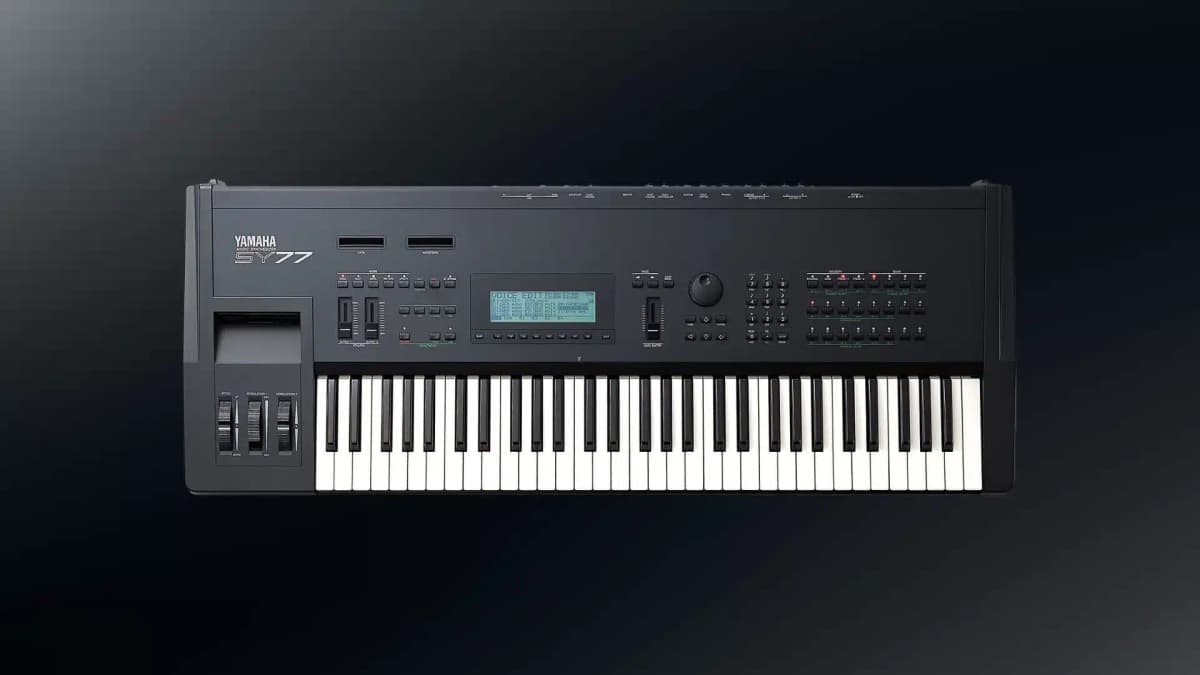
The Yamaha SY77 is a 61-key digital synthesizer workstation that Yamaha showed at the Tokyo Music & Sound Expo in late 1989 and released in Japan on December 1 of that year. It combined two tone generators: AFM, an expanded version of the DX7‘s six-operator FM, and AWM2, Yamaha’s 16-bit sample playback engine, with resonant digital filters, four effects processors, 16-part multitimbrality and a 16-track sequencer. Yamaha called the combination Realtime Convolution and Modulation synthesis, or RCM. What makes it matter at a glance is that it was the company’s answer to the sample-plus-synthesis workstations of Roland and Korg, built without giving up the deep FM that had defined Yamaha in the 1980s.
Table of Contents
Yamaha SY77 sound and character
The Yamaha SY77 sounds like two instruments that learned to talk to each other. The AFM side can reproduce the bright, glassy and metallic tones of the DX7, and convert DX patches, but adds 15 extra operator waveforms to the sine, 45 algorithms instead of 32, and up to three feedback loops. The AWM2 side supplies 112 or 113 sampled waveforms (sources give both figures) from wave ROM that Yamaha puts at 2MB (some spec listings say 4MB), including multisampled piano, strings, brass and analog-style waves. A single voice can stack up to two AFM and two AWM2 elements.
The distinctive part is the interaction. AWM2 samples can be used as FM modulators, so a breath noise, a piano attack or a vocal sample can modulate an FM carrier, a technique Yamaha reserved for the SY and TG series. The results range from realistic hybrids, where a sampled attack sits on an FM sustain, to evolving textures that neither engine could make alone. Paul Wiffen, seeing it at the Tokyo show for Sound On Sound, called the demonstrated piano, strings and brass the best “real” timbres he had heard from a Yamaha synth.
The filters change the picture compared with a DX7. Each element has two digital filters, one switchable between 12dB/octave low-pass with resonance and high-pass, the other always low-pass, with its own five-stage envelope and velocity or aftertouch control of cutoff and resonance. Martin Russ, reviewing the Yamaha SY77 for Sound On Sound, found them clean, crisp and clear, with a smooth transition into self-oscillation. They can approximate analog sweeps, though the character stays digital and precise.
Its weaknesses are on the edges. Some owners describe the low end as slightly muddy, the drum kit is dated, and the effects, at 15kHz bandwidth and mono in, are serviceable rather than lush. The Yamaha SY77 sits firmly in the clinical, detailed, early-1990s digital camp: rich in layered pads, bells, bright electric pianos and synthetic hybrids, rather than warm or loose.
Features and architecture
- Manufacturer: Yamaha Corporation
- Year introduced: 1989; shown at the Tokyo Music & Sound Expo in the autumn and released in Japan on December 1, 1989, with UK deliveries in early 1990
- Production years: 1989 to the mid-1990s; Yamaha has not published an exact end date, and references place the SY/TG range’s discontinuation between 1995 and 1997
- Synthesis type: RCM (Realtime Convolution and Modulation), combining AFM (Advanced FM) and AWM2 sample playback with digital filters
- Category: digital synthesizer workstation
- Polyphony: 32 notes (16 AFM and 16 AWM2), reduced when voices use several elements
- Multitimbrality: 16 parts, with 16 preset and 16 user Multis
- Original price: ¥300,000 in Japan, $2,995 list in the US, and £1,999 including VAT in the UK
- Current market price: Reverb’s price guide suggests about $480 for a used unit, with typical listings from about $170 to $850 depending on condition and servicing
- Oscillators: AFM with six operators per element, 45 algorithms, up to three feedback loops and 16 operator waveforms; AWM2 with 112 to 113 16-bit ROM waveforms in 2MB of wave ROM, according to Yamaha; AWM2 samples can modulate AFM operators
- Element structure: 11 element modes, from a single AFM element to four elements (two AFM and two AWM2) per voice, plus a drum set mode
- Filter: two digital filters per element, one switchable 12dB/octave low-pass with resonance or high-pass, one low-pass, with a dedicated filter envelope
- LFOs: per-element LFO with sine, sawtooth, triangle and sample-and-hold waves, routable to pitch, amplitude and filter cutoff
- Envelopes: multi-stage amplitude and pitch envelopes per element, plus a five-stage filter envelope
- Modulation system: velocity, channel aftertouch, two modulation wheels, foot controller and breath controller, assignable to many voice parameters
- Sequencer / arpeggiator: 16-track sequencer (15 tracks plus a pattern track), 99 patterns, one song, about 16,000 notes, 96 PPQN; no arpeggiator
- Effects: four effect blocks, two modulation (4 types) and two reverb and delay based (40 types)
- Memory: 128 preset and 64 user voices in battery-backed RAM; two card slots for voice data and waveform cards
- Storage: 3.5-inch 720K double-density floppy disk drive
- Keyboard: 61 keys, unweighted, with velocity and channel aftertouch; pitch wheel, two modulation wheels and a data entry slider
- Inputs / outputs: two stereo output pairs, headphones on the rear panel, sockets for footswitch, sustain, volume pedal, foot controller and breath controller
- MIDI / USB: MIDI In, Out and Thru; no USB
- Display: 240 x 64 dot backlit LCD
- Dimensions / weight: 1,046 x 407 x 119 mm, 17 kg
- Power: internal power supply, about 28W consumption
Strengths
- Its FM engine is deeper than the DX7’s. Extra waveforms, more algorithms and multiple feedback paths widen the palette while keeping compatibility with DX patches.
- Using samples as FM modulators is genuinely unusual. That interaction produces hybrid timbres that later sample-based workstations, and even Yamaha’s own FS1R, could not replicate.
- The resonant digital filters made Yamaha FM programmable in a subtractive way. Velocity and aftertouch control over cutoff and resonance add expressive shaping that the DX line lacked.
- The keyboard is widely praised. Owners often single out the unweighted action and aftertouch as among the best of the era, and the two modulation wheels were an uncommon touch.
- It is a complete production station. Sixteen multitimbral parts, a sequencer Sound On Sound described as friendly and carefully thought out, onboard effects and a disk drive made it self-sufficient in 1990.
- It is now inexpensive for what it offers. Used prices well under the cost of a modern mid-range synth make it one of the cheapest routes to deep hardware FM.
Limitations
- Programming is demanding. Four elements, each with FM operators, filters and envelopes, make sound design slow, and algorithm diagrams were printed on card sheets that are often missing from used units.
- Polyphony shrinks quickly. Thirty-two notes is the best case; a four-element voice leaves far fewer, which limits dense multitimbral arrangements.
- The sequencer has period limits. Only one track can be recorded at a time, there is one song in memory, and patterns play on a single channel.
- The effects are dated. A 15kHz bandwidth, mono inputs and a 300ms maximum delay make them sound thin next to later processors.
- Aging hardware needs attention. LCD backlights fail, floppy drive belts slip, keypad switches wear, and the backup battery needs replacing.
- It is heavy and large. At 17 kg with broad plastic end cheeks, it is a studio instrument more than a portable gigging keyboard.
- Floppy backups are awkward. Saving the full memory can require several disk swaps, and the 720K drive is not high density.
Historical context
By the late 1980s, the market had moved away from pure FM. Roland’s D-50 had combined sampled attacks with synthesis, and Korg’s M1 had defined the sample-based workstation with sequencer and effects. Yamaha’s own story, as told in its synthesizer history pages, was a push toward realistic acoustic sounds, analog-style filtering and expressive control, and the SY77 was where those aims came together. It introduced AWM2, the PCM engine later used across Yamaha’s range, and the term “element” that the Motif series still uses.
The Yamaha SY77 appeared at the Tokyo Music & Sound Expo in 1989 and went on sale in Japan in December. Sound On Sound published a two-part review by Martin Russ in early 1990, based on a prototype, and called it a dream of an instrument. The rack-mount TG77 followed with the same engine, voice structure and effects but no keyboard, sequencer or disk drive, adding eight assignable individual outputs; Sound On Sound reviewed it in January 1991 at £1,299. A later Wolf design review argues the Yamaha SY77 felt rushed into production because of competition from Roland and Korg.