

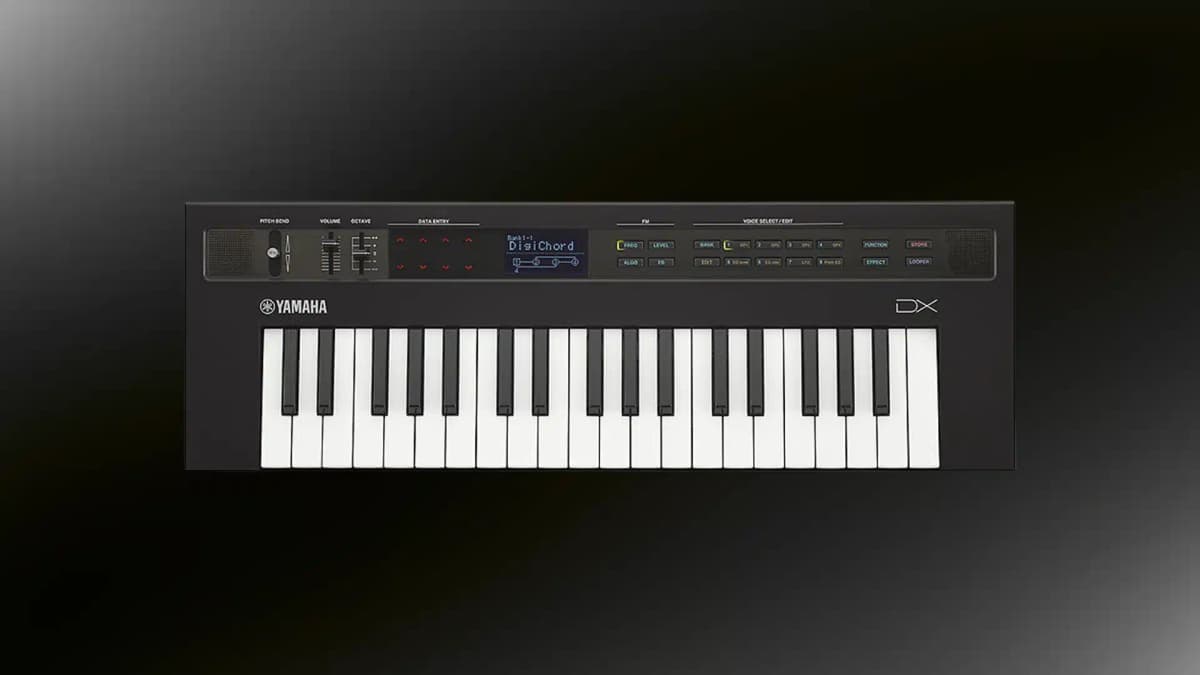
The Yamaha reface DX is a compact FM synthesizer that Yamaha announced in July 2015 as part of the four-model reface range and began shipping that September. It runs an eight-voice, four-operator FM engine with 12 algorithms and per-operator feedback, stores 32 patches, and adds two effects slots and a phrase looper, all housed in the same 37-key, battery-powered chassis as the reface CS, CP and YC. Instead of knobs, it uses a backlit display and four multi-touch strips for editing. Its significance lies in that interface: it turned FM programming, long associated with the menu-diving of the DX7 era, into something a player could do quickly by hand on a small instrument.
Table of Contents
Yamaha reface DX sound and character
The Yamaha reface DX sounds clean, bright and precise, the glassy quality that four-operator FM does well. MusicTech’s reviewer found it strongest on bells, pads, electric pianos and percussive tones, the territory associated with the DX7, and less convincing on the aggressive growls and bass sounds included among its more modern presets. Richard Devine, interviewed by Yamaha, described the output as clean and glassy and well suited to sound design.
The engine has four operators arranged by 12 algorithms. Each operator has its own frequency, level, keyboard scaling, velocity response and envelope, and Yamaha added per-operator feedback, a significant departure from older FM instruments, which typically offered feedback on one operator only. Turning feedback up morphs an operator’s sine wave toward a sawtooth or, in the other direction, toward a square wave, so even a single operator can produce harmonically rich tones. That widens the palette beyond what four sine-wave operators would usually allow and makes thick leads and buzzy basses easier to build.
A pitch envelope and a single LFO, with several waveforms, handle modulation. Two effects slots, each choosing from distortion, touch wah, chorus, flanger, phaser, delay and reverb, contribute a great deal to the finished sound: MusicTech observed that the effects can shape a patch as much as the FM layers do, and distortion or touch wah in particular push it away from the stereotypical 1980s DX sound.
In character it is a modern, clean-sounding digital instrument with a strong vintage reference. It does not reproduce the deeper six-operator DX7 sound, and patches from older Yamaha four-operator synths cannot be imported, but within the four-operator format it is flexible and responsive. Eight voices are enough for leads, basses and modest chords, though Sound On Sound’s Paul Nagle found them limiting for pads and sustained electric pianos.
Features and architecture
- Manufacturer: Yamaha Corporation
- Year introduced: 2015; announced July 9, 2015 at Summer NAMM in Nashville and shipping from September 2015
- Production years: 2015 to present in the US, where Yamaha still lists it and dealers have stock in October 2026; Yamaha’s Mexican site now marks the reface series as discontinued
- Synthesis type: digital FM (frequency modulation)
- Category: compact battery-powered mini-key synthesizer
- Polyphony: 8 voices; Poly, Mono and Legato modes
- Multitimbrality: none; monotimbral
- Original price: $499.99 street in the US and £289 in the UK according to Sound On Sound; Yamaha’s US launch release listed an MSRP of $799 for each reface model
- Current market price: $499.99 new at Sweetwater in October 2026; Sweetwater has previously listed it at $449.99 and run promotions as low as $249.99
- Oscillators: 4 FM operators, each with frequency, detune, level, keyboard scaling, velocity sensitivity and its own feedback, which morphs the waveform from sine toward sawtooth or square
- Algorithms: 12
- Filter: none; timbre is shaped by operator levels, envelopes and feedback
- LFO: one LFO with several waveforms, routed to pitch and level
- Envelopes: one multi-stage envelope per operator plus a pitch envelope
- Sequencer / arpeggiator: phrase looper recording up to about 2,000 notes (roughly 10 minutes at 120 bpm) with overdub, 30 to 300 bpm, syncable to MIDI clock; volatile at power-off; no arpeggiator
- Effects: two effects slots, each with distortion, touch wah, chorus, flanger, phaser, delay or reverb, and two adjustable parameters
- Memory: 32 patch locations (four banks of eight); backup through Yamaha’s Capture app, Soundmondo, or later third-party editors such as Patch Base
- Controllers: four multi-touch strips for editing; pitch bend lever; octave slider; no modulation wheel or aftertouch
- Keyboard: 37 HQ Mini keys, velocity-sensitive
- Inputs / outputs: two 1/4-inch line outputs, headphone output, stereo mini-jack auxiliary input, sustain pedal input; built-in stereo speakers (2 x 2W)
- MIDI / USB: MIDI In and Out through a supplied adapter cable; class-compliant USB MIDI to host
- Display: backlit LCD
- Dimensions / weight: 530 x 175 x 60 mm; about 1.9 kg without batteries
- Power: six AA batteries (Yamaha quotes up to about five hours) or 12V AC adapter; USB does not power the unit
Strengths
- The touch-strip interface makes FM unusually approachable. Four strips adjust four parameters at once, for example all four operator frequencies or levels, and taps, swipes and holds make both fine and large changes quick.
- Per-operator feedback expands the four-operator palette. Morphing each operator from sine toward saw or square gives richer raw material than earlier four-op Yamaha synths offered.
- It stores patches, unlike the reface CS. Thirty-two memories and a display make it usable as a self-contained instrument and a small live keyboard.
- The effects are well chosen and genuinely useful. Two simultaneous slots with touch wah, distortion, delay and reverb add character and space without external processing.
- The phrase looper is practical. Overdubbing, a guide tone and MIDI clock sync make it a capable sketchpad, and MusicTech found it more convenient than the CS’s lever-controlled version.
- It is portable and well built. Batteries, speakers and a body under 2 kg let it be played anywhere, and reviewers consistently praised the build quality.
Limitations
- Thirty-two patch locations are few for an instrument whose main appeal is programming, and both Sound On Sound and bonedo flagged it.
- There is no modulation wheel, no aftertouch and no expression pedal input, so vibrato and real-time timbral control depend on programmed modulation.
- Eight voices can run out quickly with pads, sustained electric pianos or anything played with the sustain pedal.
- Patches from earlier four-operator Yamaha synths such as the DX100 cannot be imported, so decades of existing four-op sound libraries do not transfer directly.
- At launch, patch backup relied on Yamaha’s iOS Capture app and the Soundmondo web service, and reviewers found the MIDI implementation sparse; a full third-party editor and librarian appeared only in 2021.
- The touch strips are quick but imprecise compared with physical knobs, and Sound On Sound argued that dedicated controls would have taken the instrument further.
- The loop recorder is volatile and records notes but not controller movements.
Historical context
The reface range grew out of an after-work project by a small team of Yamaha engineers, whose prototype, called ES for “Enjoy Synthesis”, became the reface CS. The team then tested other engines, including FM, electric piano and organ, to create a family of four instruments sharing one chassis. According to Yamaha’s development story, the Yamaha reface DX was the odd one out: it uses a display rather than knobs and sliders, which made fitting it into the cases shared across all models a design puzzle.
Yamaha presented the four models at Summer NAMM on July 9, 2015, describing the Yamaha reface DX as inspired by the DX7 of 1983 and promoting a button that moved between classic 1980s tones and sounds aimed at EDM. Technically the Yamaha reface DX is closer to Yamaha’s four-operator FM synths of the mid-1980s, such as the DX100, than to the six-operator DX7, a point Synthtopia made when it compared it to the DX100 and Richard Devine echoed when he called it the DX100 of today. Its per-operator feedback and touch interface, however, were new.