

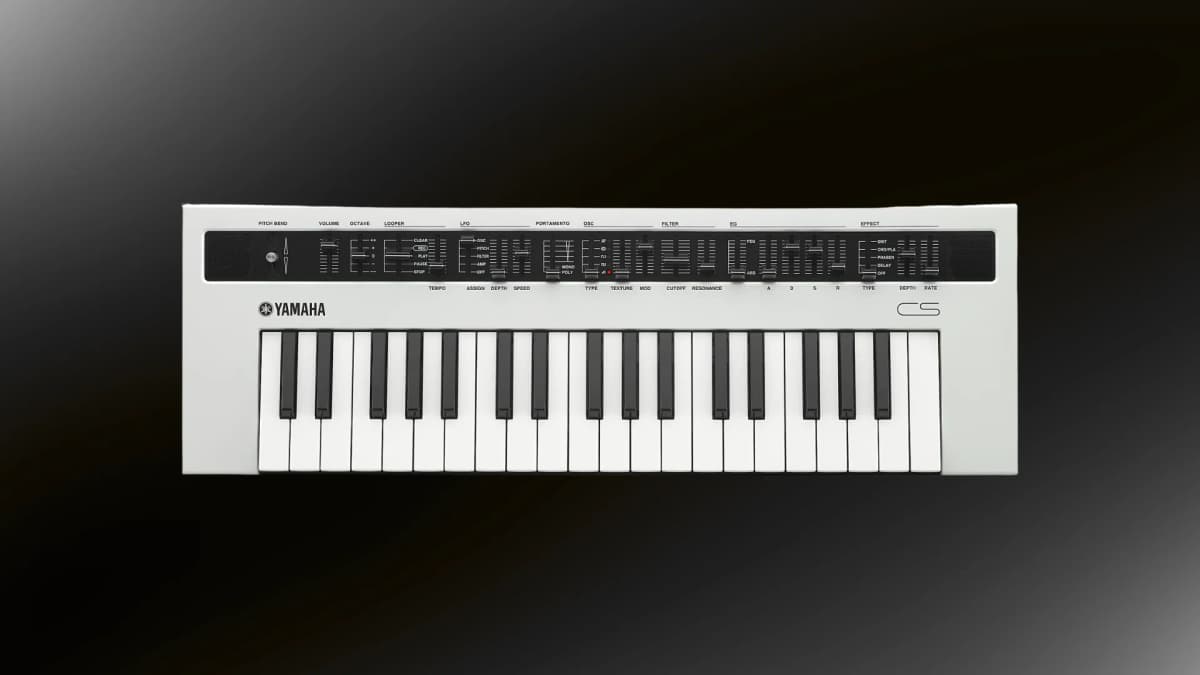
The Yamaha reface CS is a compact virtual analog synthesizer that Yamaha announced at the Summer NAMM show in July 2015 and began shipping that September, alongside three sister models in the reface range: the DX, CP and YC. It runs Yamaha’s AN analog-modeling engine with eight voices, five switchable oscillator types, an 18dB low-pass filter, a single envelope, one LFO, an effects section and a MIDI phrase looper, all controlled from a row of sliders above 37 HQ Mini keys. It has built-in speakers, runs on six AA batteries and stores no patches. What makes it matter at a glance is how much sonic range Yamaha squeezed out of three oscillator sliders, and how it revived the Yamaha reface CS name in a form almost anyone could afford and carry.
Table of Contents
Yamaha reface CS sound and character
The Yamaha reface CS sounds more flexible than its size suggests, and the flexibility comes from its oscillator section. A Type slider chooses between Multi-Saw, Pulse, Oscillator Sync, Ring Mod and FM, and two further sliders, Texture and Mod, change what each type does. In Multi-Saw, Texture adds an octave-down sub-oscillator to a stack of detuned saws; in Pulse it retunes a second square wave and Mod sets the pulse width; in FM, Texture sets modulation depth and Mod changes the modulator’s pitch. MusicRadar’s reviewer described it moving from warm, analog-style tones to harsh, bright, or delicate digital ones with a few slider changes.
The filter is an 18dB-per-octave resonant low-pass that self-oscillates, and reviewers singled it out. MusicRadar found it handled squelchy TB-303-style bass, brass, strings, pads and leads, with a vocal quality to the resonance. Sound On Sound’s Paul Nagle was more reserved: he heard the Multi-Saw as a supersaw-style stack, found the sync mode steppy and slightly pale, picked Ring Mod as the most striking type, and described FM as lo-fi, turning into a glitchy noise source at extreme settings. He also noted that the filter lacks keyboard tracking and that the engine could sound underpowered, with aliasing and odd harmonics at times.
The single ADSR shapes everything, with an EG slider that balances it between filter and amplifier, so contrasting filter and amp shapes are not possible. Release times stretch beyond 40 seconds, and the LFO reaches audio rates and can be aimed at pitch, cutoff, amplitude or the oscillator’s Mod parameter. In mono mode the instrument becomes a single-triggered, low-note priority synth with portamento.
In character it sits between a modern virtual analog and a sketchpad. It is good at basses, fat pads, string-like leads and noisy effects, and less convincing as a full-bodied substitute for a vintage Yamaha reface CS polysynth. The effects section, with distortion, chorus/flanger, phaser and delay (Yamaha models the phaser and chorus/flanger with its VCM circuit-modeling technology), adds a lot of finish, but only one effect runs at a time.
Features and architecture
- Manufacturer: Yamaha Corporation
- Year introduced: 2015; announced July 9, 2015 at Summer NAMM in Nashville and shipping from September 2015
- Production years: 2015 to present in the US, where Yamaha still lists it and major retailers have stock in October 2026; Yamaha’s Mexican site now marks the reface series as discontinued
- Synthesis type: virtual analog (Yamaha AN analog-modeling engine)
- Category: compact battery-powered mini-key synthesizer
- Polyphony: 8 voices; monophonic mode with portamento selected from the portamento slider
- Multitimbrality: none; monotimbral
- Original price: $499.99 street in the US and £289 in the UK according to Sound On Sound; Yamaha’s US launch release listed an MSRP of $799 for each reface model, and other references give $649
- Current market price: about $495 new at Sweetwater in October 2026; Sweetwater has run promotions as low as $299.99
- Oscillators: one oscillator section with five types (Multi-Saw, Pulse, Oscillator Sync, Ring Mod, FM), each shaped by Texture and Mod sliders
- Filter: 18dB/octave resonant low-pass with cutoff and resonance sliders; self-oscillating; no keyboard tracking
- LFO: one LFO with depth and speed, reaching audio rate, assignable to amplitude, filter, pitch or oscillator modulation
- Envelopes: one ADSR with an EG/FEG slider that sends it to the amplifier, the filter or a blend of both
- Modulation system: slider-based; LFO assign slider, EG balance slider, portamento; an external foot controller can control LFO depth
- Sequencer / arpeggiator: MIDI phrase looper controlled by a lever, synced to internal tempo or MIDI clock; no arpeggiator; recorded phrases are lost at power-off
- Effects: one effect at a time, chosen by a type slider with depth and rate controls; reviewers list distortion, chorus/flanger, phaser and delay, while Yamaha’s own literature counts five types
- Memory: no patch memory; sounds can be saved through Yamaha’s Soundmondo web service or the Capture iOS app
- Keyboard: 37 HQ Mini keys; velocity is transmitted over MIDI but not used by the internal engine; no aftertouch; pitch bend lever and an octave slider covering two octaves up or down
- Inputs / outputs: two 1/4-inch line outputs, headphone output, stereo mini-jack auxiliary input, foot controller/sustain input; built-in stereo speakers (2 x 2W)
- MIDI / USB: MIDI In and Out through a supplied adapter cable (no Thru); class-compliant USB MIDI to host
- Display: none
- Dimensions / weight: 530 x 175 x 60 mm; just under 2 kg without batteries
- Power: six AA batteries (Yamaha quotes up to about five hours) or 12V AC adapter
Strengths
- The oscillator design is remarkably efficient. Three sliders reach five quite different synthesis methods, from detuned saw stacks to ring modulation and two-operator FM, so a tiny panel covers more ground than most mini synths.
- Everything is on the surface. With no menus and no display, each parameter has its own slider, which makes the Yamaha reface CS fast to learn and well suited to teaching basic subtractive synthesis.
- It is genuinely portable. Batteries, built-in speakers and a sub-2 kg body make it usable on a sofa, a train or a small stage without other equipment.
- The keyboard is better than the mini-key norm. Yamaha developed the HQ Mini keys specifically for this range, with keys 10 mm longer than its earlier mini keys, and most reviewers found them playable.
- The sliders double as MIDI controllers. MusicRadar counted 21 sliders that send MIDI, which gives the Yamaha reface CS a second life as a compact controller for software.
- The phrase looper adds an unusual performance dimension. Layering a loop and then changing sound over the top turns a small monotimbral synth into a live sketching tool.
Limitations
- There is no patch memory. Every sound has to be rebuilt by hand or saved through an external app or web service, which complicates live use.
- One envelope serves both filter and amplifier, so plucks with sustained filters or slow filter sweeps over sharp amplitude shapes are hard to program.
- The keyboard’s velocity does not reach the sound engine and there is no aftertouch, which is a notable omission on an instrument named after the expressive CS-80.
- Only one effect is active at a time, and switching effect types causes a brief dropout; MusicTech also found that effects can run away into feedback at high settings.
- Switching oscillator types can produce clicks and glitches, and Sound On Sound heard aliasing and occasional thinness in the engine.
- Three octaves of mini keys and a stereo input on a mini jack confirm that it is designed for portability first, not as a main stage keyboard.
- The looper is volatile and its lever-based control is less convenient than the screen-based looper on the reface DX.
Historical context
The reface range began as an after-work project inside Yamaha. According to the company’s own development story, sound designer Koichi Kashiwazaki, producer Yuji Yamada and software engineer Satoshi Morita, all of whom had worked on digital instruments outside the synthesizer line, built a prototype called ES (for “Enjoy Synthesis”) around the idea of a small but serious instrument. Product designer Yoshihiro Katsumata of the Yamaha Design Laboratory joined early. The ES prototype evolved into the Yamaha reface CS, and the team later added FM, electric piano and organ engines to create the DX, CP and YC.
Yamaha announced the four models together at the Summer NAMM show on July 9, 2015, with shipping in September. The Yamaha reface CS was presented as a descendant of the Yamaha reface CS series of Control Synthesizers from the mid-1970s, the line that produced the CS-80 used by Vangelis. In practice its lineage is closer to the battery-powered CS01 of 1982: Sound On Sound’s reviewer called it Yamaha’s most portable Yamaha reface CS since the CS01, while also pointing out that it was not a CS-80 reissue and had no ribbon controller.