

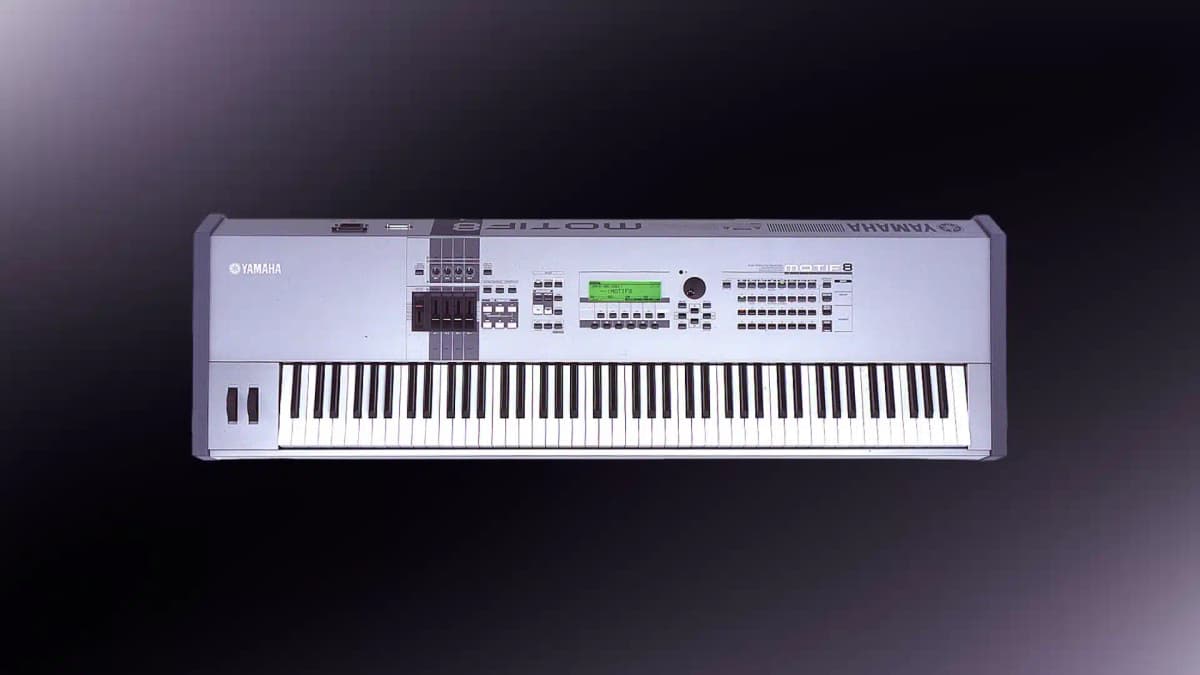
The Yamaha Motif is a sample-based keyboard workstation introduced in 2001 in three sizes: the 61-key Motif 6, the 76-key Motif 7, and the 88-key Motif 8. Built on Yamaha’s AWM2 tone generation with 84MB of waveform ROM, it combined a 16-track sequencer, a pattern-based arpeggiator, user sampling, and three slots for Yamaha’s plug-in synthesis boards. What made it matter was the way those parts were joined: Yamaha called the concept an “Integrated Sampling Sequencer,” and it turned the first Yamaha Motif into the starting point of a workstation line that ran through the ES, XS and XF models for more than a decade.
Table of Contents
Sound and character
The original Motif sounds clean, detailed, and production-oriented. It is not an instrument with a single signature timbre in the way a CS-80 or DX7 has one. Its identity lies in consistency: a broad library of acoustic, electric and synthetic sounds that sit together in a mix with little effort. Yamaha’s own history says development focused on further improving the PCM waveforms it had been refining since the S80.
A user review on Sonic State singled out the acoustic piano, drums, electric pianos and resonant-filter synth sounds as strengths, while finding the brass and some acoustic instruments weaker than competing libraries. The same reviewer preferred the overall Yamaha Motif soundset to Korg’s and Roland’s for its consistency. User reviews on Audiofanzine praised the general sound quality but wished the strings and effects had been better. The picture is consistent: polished rather than dramatic, strongest in keyboards, drums and modern synth programming.
The voice structure explains part of that profile. Each Yamaha Motif voice is built from up to four elements, each drawing on a choice of 1,309 waveforms and running through its own resonant filter, so layered and velocity-switched sounds were central to the design. When Sound On Sound reviewed the Motif 7 in September 2001, it concluded: “Whichever way you slice it, this is a winner of a workstation.” Assignable knobs and sliders on the front panel made the synth patches more interactive than the “preset player” image of many workstations suggests.
Features and architecture
- Manufacturer: Yamaha
- Year introduced: 2001 (unveiled at the Frankfurt Musikmesse in March 2001; Sound On Sound’s April 2001 preview expected units in shops worldwide from July)
- Production years: 2001 to 2003, when the Motif ES superseded the Motif 7 and 8; Yamaha kept the Motif 6 in the line at a reduced price
- Original price: in Japan, ¥230,000 for the Motif 6, ¥255,000 for the Motif 7 and ¥325,000 for the Motif 8; Sound On Sound’s preview estimated UK prices of around £1,500, under £2,000 and under £2,500 respectively
- Synthesis type: AWM2 sample-based synthesis with user sampling, expandable through the Modular Synthesis Plug-in System
- Category: keyboard workstation (Yamaha marketed it as a music production synthesizer)
- Models: Motif 6 (61 keys), Motif 7 (76 keys), Motif 8 (88 keys), with identical tone generation and controls across all three
- Polyphony: 62 notes, shared between the AWM2 engine and the sampler, plus the voices of any installed plug-in boards
- Multitimbrality: 16 parts, plus one part per plug-in board (up to three)
- Waveform ROM: 84MB with 1,309 waveforms (Yamaha’s own history rounds the figure to 85MB)
- Voices: 384 preset voices plus 128 General MIDI voices, 128 user voices; 48 preset drum kits plus a GM kit, 16 user kits; 128 user performances
- Oscillators / elements: up to four AWM2 elements per voice
- Filter: one resonant filter per element, chosen from 18 types according to Sound On Sound (Vintage Synth Explorer counts 21)
- LFOs and envelopes: envelope and LFO modulation within each AWM2 voice
- Modulation system: pitch and modulation wheels, four assignable knobs and four assignable sliders, two foot controller sockets, two footswitch sockets and a breath controller input
- Sequencer / arpeggiator: 16-track sequencer with song and pattern modes, 110,000 notes of capacity and 480 ppqn resolution; 128 preset phrases (all drum patterns) and space for 256 user phrases; 256 preset and 128 user arpeggio patterns
- Sampling: 16-bit, 44.1kHz sampling with 4MB of RAM as standard, expandable to 64MB via two SIMM slots; imports WAV and AIFF files plus Akai and Yamaha sample data
- Integrated Sampling Sequencer: slices audio loops and automatically creates a sequence track that triggers the slices in time, so tempo can change without altering pitch
- Effects: reverb, chorus and variation system effects, insertion effects, and a five-band master EQ
- Expansion: three slots for Yamaha PLG boards (VL, AN, DX, XG, piano, Vocal Harmony); optional boards for mLAN and additional analog outputs
- Memory and storage: internal user memory, SmartMedia card slot, SCSI port
- Keyboard: unweighted synth action on the Motif 6 and 7; weighted hammer action on the Motif 8; velocity and aftertouch on all models
- Inputs / outputs: four audio outputs (a main stereo pair and a sub-output pair), A/D inputs for sampling, optical S/PDIF digital output
- MIDI / USB: MIDI In, Out and Thru; USB port for direct connection to a computer
- Display: backlit monochrome LCD, 240 x 64 dots
- Dimensions / weight: 1,048 x 397 x 135 mm and 15.8 kg for the Motif 6; 1,255 x 397 x 135 mm and 18.1 kg for the Motif 7; 1,458 x 465 x 166 mm and 28 kg for the Motif 8
- Power: AC inlet on the rear panel, with an AC power cord supplied
Strengths
- Sound quality was consistent across categories, which made it easy to build complete arrangements without fighting mismatched timbres.
- The Integrated Sampling Sequencer was a genuine workflow idea, not a checklist feature. Recording a loop, slicing it and controlling it from the sequencer at a new tempo brought a groove-production method into a performance keyboard.
- Expandability was unusually deep. Three plug-in slots meant that a Motif could host VL physical modeling, AN analog modeling or DX-style FM alongside its own AWM2 engine, turning one keyboard into several instruments.
- Connectivity reflected the studio of 2001. SCSI, SmartMedia, a USB port for direct computer connection, optical output and optional mLAN placed the Yamaha Motif between hardware rigs and the computer-based studios that were rapidly taking over.
- The sequencer was strong enough to be a reason to buy. Users described the Motif as a complete song-making instrument, and the pattern mode with an extensive arpeggiator suited loop-based writing.
- The three sizes shared the same functionality, so one platform served producers, stage players and pianists.
Limitations
- 62-note polyphony is restrictive for a workstation, especially because it is shared with sampled material and because a single Yamaha Motif voice can use up to four elements. Sound On Sound calculated that four-element voices cut it to 15 notes, an Audiofanzine owner called the figure “really too low” for song and pattern work, and the Motif ES more than doubled it to 128.
- Standard sample memory was small. Sound On Sound called the 4MB base “skimpy,” so serious sampling required buying SIMM memory up to the 64MB ceiling.
- The operating system could be slow in places. A Sonic State user reported sluggish patch scrolling and mix-parameter loading that could interrupt pattern-mode work.
- The manual and the depth of the system made the learning curve steep. Audiofanzine owners described the manual as overwhelming and sampling and drum-pattern building as difficult for beginners.
- The Motif 8 is heavy at around 28 kg, which matters for a keyboard aimed partly at stage players.
- Extra synthesis engines, mLAN and additional outputs all required optional boards at extra cost.
Historical context
The Yamaha Motif arrived at a turning point for Yamaha’s synthesizer division. According to Yamaha’s own account of its synth history, earlier attempts to follow up the SY and EX workstation lines had not produced major hits, while the S80 had won great praise as a stage keyboard. The Yamaha Motif grew out of an internal workstation project code-named Kangaroo and was developed around three goals: great sound, easy music-making, and integration with computers. Yamaha chose AWM2 as the core engine and moved its more exotic synthesis technologies, such as VL and AN, onto plug-in boards rather than building them into the main instrument.
The timing mattered because the workstation was being redefined. Computers were becoming the center of many studios, and loop-based production, especially in hip-hop and pop, was changing how records were assembled. The Yamaha Motif responded on both fronts. USB MIDI, SCSI, editor software and mLAN connected it to the computer, while the Integrated Sampling Sequencer brought loop slicing and tempo-independent playback into the keyboard itself. Sonic State noted in March 2001 that it shared much of its sequencing and sampling functionality with Yamaha’s forthcoming RS7000 production studio.
In brand terms, the Motif was a flagship statement and a reset: one clear platform, scaled across three keyboard sizes and extended with boards.