

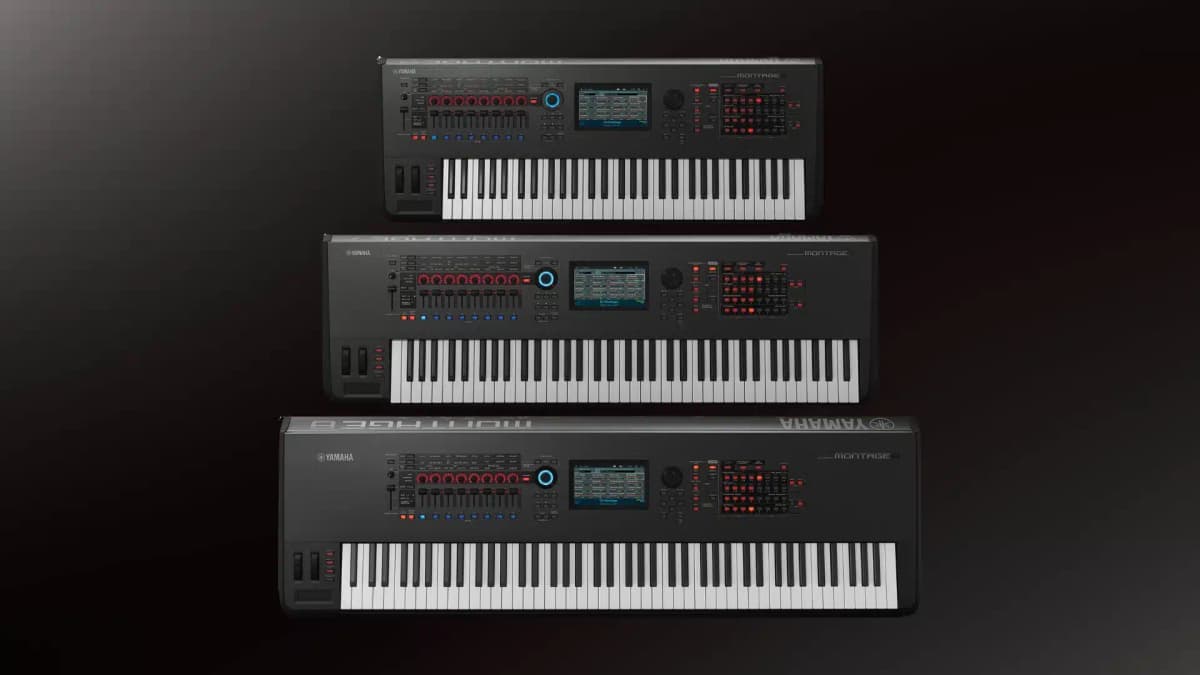
The Yamaha Montage is a flagship digital synthesizer announced at NAMM in January 2016 and shipped from May of that year in three sizes: the 61-key Montage6, the 76-key Montage7 and the 88-key Montage8. It succeeded the Motif line by pairing two engines under one roof, the sample-based AWM2 and a new eight-operator FM engine called FM-X, both governed by a modulation layer Yamaha called Motion Control. What made it matter was a change of emphasis: Yamaha’s top keyboard stopped presenting itself mainly as a production workstation and became an instrument built to be performed in real time.
Table of Contents
Sound and character
The Yamaha Montage sounds clean, wide and expensive. MusicRadar described the sound as wide, clean and precise, while Keyboard magazine found the output smoother and more hi-fi than the Motif XF it replaced, a difference Yamaha attributed to improved converters and analog output circuitry. Its default posture is polished and controlled, which suits pianos, orchestral layers and large stacked patches, and it means character usually comes from programming and modulation rather than from the engine’s own coloration.
The AWM2 side is where that polish is most obvious. The factory library is roughly ten times the size of the Motif XS and XF waveform ROM, and it brought new content that reviewers singled out, including a Yamaha CFX concert grand, a Bösendorfer Imperial and orchestral material recorded with members of the Seattle Symphony. Each AWM2 Part can stack eight Elements, each a full subtractive voice with its own filter, envelopes, LFO and EQ.
FM-X is the more distinctive half. With eight operators, 88 algorithms, per-operator envelopes and a choice of filter types, it covers the electric pianos and brass associated with the DX era, and Yamaha pitched it equally at modern EDM sounds; Keyboard singled out its FM brass. Keyboard compared it to the FS1R “on steroids,” and Howard Jones, reacting at Yamaha’s 2016 UK launch tour, spoke of an “FM renaissance.”
What finally gives the Yamaha Montage its identity, though, is movement. The Super Knob, eight assignable knobs, Motion Sequences and an envelope follower that can be driven by external audio mean that a Performance is rarely a static sound. The Yamaha Montage leans modern and fluid rather than vintage and unstable: its strength is transformation, not imperfection.
Features and architecture
- Manufacturer: Yamaha
- Year introduced: 2016 (announced at NAMM in January, shipping from May)
- Production years: 2016 to 2023; a white-finish edition was added in 2019, and Yamaha announced the discontinuation in July 2023
- Synthesis type: hybrid digital, combining AWM2 sample-based subtractive synthesis and FM-X frequency modulation under the Motion Control Synthesis Engine
- Category: flagship performance synthesizer
- Polyphony: up to 128 notes for AWM2 and up to 128 notes for FM-X
- Original price: US list prices of $3,499 (Montage6), $3,999 (Montage7) and $4,499 (Montage8); UK launch prices of £2,250, £2,625 and £3,000
- Current market signal: see Market value below
- Oscillators: AWM2 with up to 8 Elements per Part drawing on 5.67 GB of preset waveforms (16-bit linear equivalent); FM-X with 8 operators and 88 algorithms per Part; up to 16 Parts per Performance, freely mixing both engines
- Filter: 18 filter types, available to both AWM2 Elements and FM-X Parts
- LFOs: per-Element LFOs in AWM2; LFO speed range extended in OS 3.0
- Envelopes: per-Element envelopes in AWM2; individual envelopes for every FM-X operator plus pitch envelope and filter for FM-X Parts
- Modulation system: Motion Control, combining the Super Knob macro, 8 assignable knobs, 8 sliders, ribbon, Motion Sequencer (up to 9 lanes per Performance) and an envelope follower that can track external audio; 8 Scenes per Performance
- Sequencer / arpeggiator: arpeggiator running up to 8 Parts at once with 10,239 preset types and 256 user types; a basic real-time recorder at launch, expanded in OS 3.0 with a loop-based Pattern Sequencer
- Effects: dual insertion effects per Part (88 types), system reverb and variation, master effect and 5-band master EQ, including Virtual Circuit Modeling processors and a vocoder; OS 3.0 added a wavefolder and a VCM Mini Filter
- Memory: 2,707 preset Performances in the final firmware (around 2,000 at launch); 2,048 user Live Set slots; 1.75 GB of non-volatile user flash for imported samples
- Keyboard: Montage6 and Montage7 use Yamaha’s FSX synth action; Montage8 uses a Balanced Hammer Effect weighted action; all with velocity and aftertouch
- Inputs / outputs: balanced main and assignable stereo outputs, stereo A/D input, headphones, two foot controller and two footswitch inputs
- MIDI / USB: MIDI In, Out and Thru; USB audio/MIDI interface (6 in / 32 out at 44.1 kHz, 6 in / 8 out up to 192 kHz); USB to Device port
- Display: 7-inch color WVGA touchscreen
- Dimensions / weight: Montage6 1,037 × 396 × 131 mm, 15 kg; Montage7 1,244 × 396 × 131 mm, 17 kg; Montage8 1,450 × 460 × 170 mm, 29 kg
- Power: internal supply with AC power cord, 27 W consumption
Strengths
- Two genuinely different engines in one Performance. Layering sampled acoustic sounds with FM-X Parts inside the same 16-Part structure gives a timbral range a sample-only workstation could not reach.
- FM-X is a serious FM instrument rather than a nostalgia feature. Eight operators, 88 algorithms, per-operator envelopes and real filters make it capable of both classic DX-style sounds and modern, heavily modulated textures.
- Motion Control turns sounds into performances. Reviewers singled it out as the defining feature: Keyboard called its modulation “incredibly musical and playable,” and MusicTech’s reviewer named the Motion Sequencer his favourite part of the instrument.
- Seamless Sound Switching suits live use. Held notes are not cut off when changing Performances, and Live Sets organise a show into quick-access pages.
- Long firmware support. OS updates in 2018 and 2019 added Motif XS and XF import, a modulation overview and a Pattern Sequencer.
Limitations
- Depth can become a burden. MusicRadar described the programming as “often overwhelming,” and even sympathetic reviewers warned of a steep learning curve built on Performance, Part and Element layers.
- No direct sampling. Users can import WAV files into the 1.75 GB flash memory, but cannot record samples directly on the instrument.
- No virtual analog or dedicated tonewheel engine. Organs and analog-style sounds come from AWM2 and FM-X programming rather than from purpose-built models, a gap Yamaha later addressed with the AN-X engine in the Montage M.
- A thin sequencer at launch. Early units had only a basic real-time recorder, which disappointed Motif users who relied on song and pattern work; the Pattern Sequencer only arrived with OS 3.0 in 2019.
- Only four analog outputs. MusicTech’s reviewer wanted more, with USB as the only route to multiple separate channels.
- Interface frictions. Reviewers noted lag between screen edits and audible change, and no way to create arpeggio phrases on board.
- Size and price. The Montage8 weighs 29 kg, and US list prices of $3,499 to $4,499 put the range firmly in flagship territory.
Historical context
The Yamaha Montage arrived at the end of a long Motif era. Yamaha’s Motif family had been built around the idea of the sample-playback workstation with an integrated sequencer, and by 2016 that model faced pressure from two directions: software instruments that put large sample libraries within cheaper reach, and rival flagships such as Korg’s Kronos, which reviewers of the Montage still cited as the obvious workstation-oriented alternative.
Yamaha’s response was not to add more of everything, but to change the question. The Yamaha Montage kept Motif compatibility and much larger AWM2 content, yet the marketing and the hardware both pointed at live performance. MusicTech noted that Yamaha did not want it seen as a workstation, and the Motif’s “Music Production Synthesizer” label became simply “Music Synthesizer.”
The return of FM was the most symbolic part of that shift. FM is the synthesis method most associated with Yamaha through the DX7, yet the Motif’s identity rested on AWM2 samples. FM-X put FM back at flagship level, alongside the sample engine rather than instead of it, and MusicRadar noted that a conversion utility was available for original DX sounds.