

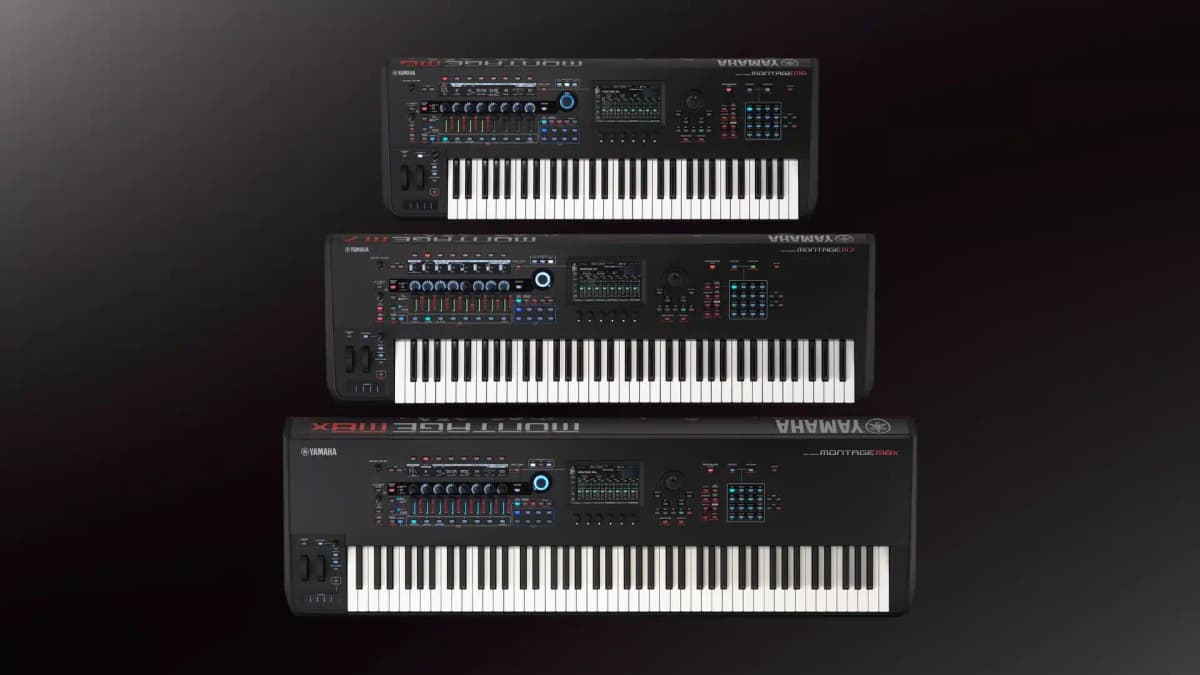
The Yamaha Montage M is a flagship keyboard synthesizer announced in October 2023 as the successor to the original Montage of 2016. It comes in three sizes: the 61-key M6, the 76-key M7 and the 88-key M8x. It combines three sound engines: the sample-based AWM2, the eight-operator FM-X and a newly developed virtual analog engine called AN-X. Together they give up to 400 notes of polyphony. What makes it meaningful is that it gave Yamaha’s flagship a dedicated analog-modeling engine, which the original Montage lacked, and that the M8x is the first Yamaha keyboard with polyphonic aftertouch across 88 keys.
Table of Contents
Sound and character
The Yamaha Montage M sounds like three instruments sharing one control surface, and its character comes from how those layers are combined more than from any single engine. AWM2 supplies the sampled material Yamaha workstations are known for: pianos, electric pianos, orchestral instruments and drums. Yamaha doubled the waveform pool and allowed up to 128 elements per part.
Pianist’s Compass praised the detail of the CFX concert grand and called its low-register decay “as realistic as it gets,” and updates have since added a newly sampled CFX, a CP-80 electric grand from Yamaha’s Synth Space LA, and a new clavinet. FM-X, with eight operators and 88 algorithms, supplies the glassy, metallic and percussive tones that tie the Yamaha Montage M to Yamaha’s FM heritage.
AN-X is what changes the instrument’s personality. It is a three-oscillator virtual analog engine with five waveforms, a noise source, two filters offering ten filter types, sync, pulse-width modulation, ring modulation, FM and a wave shaper. Yamaha also gave it “voltage drift” and “aging” parameters that deliberately introduce the small instabilities of vintage hardware. This gives the Yamaha Montage M a warmer, analog-style vocabulary for pads, brass and leads, and the wave folder added in OS 2.0 (2024) gives AN-X a harder, more harmonically dense edge.
The overall result is polished rather than raw. The Yamaha Montage M is at its best in layered, evolving performances where a sampled piano, an FM bell and an analog-style pad move together under one macro control, not in the narrow, aggressive role of a dedicated analog monosynth.
Features and architecture
- Manufacturer: Yamaha
- Year introduced: 2023 (announced October 2023)
- Production years: 2023 to present; still listed and sold new as of 2026
- Synthesis type: hybrid “Motion Control Synthesis Engine” combining AWM2 sample playback, FM-X frequency modulation and AN-X virtual analog
- Category: flagship synthesizer / performance workstation
- Polyphony: 400 notes in total: AWM2 up to 256 (128 for preset and 128 for user waveform parts at launch), FM-X 128, AN-X 16
- Original price: US pre-order prices of $3,499.99 (M6), $3,999.99 (M7) and $4,499.99 (M8x)
- Current market price: US retailers listed the M6 at $3,649.99 and the M8x at $4,699.99 in 2026
- Oscillators: AWM2 with up to 128 elements per part; FM-X with 8 operators and 88 algorithms; AN-X with 3 oscillators (Saw 1, Saw 2, Triangle, Square, Sine) plus noise, sync, PWM, ring modulation, FM and wave shaper; AN-X wave folder added in OS 2.0
- Filter: 18 filter types listed for the Yamaha Montage M; AN-X adds two filters with 10 types of its own
- LFOs: Part LFO, which can target AN-X and FM-X parameters since OS 3.0; dedicated AN-X LFOs for amplitude and filter
- Envelopes: AN-X amplitude envelope with a drive stage; Envelope Follower available as a modulation source
- Modulation system: Motion Control with the Super Knob, the tempo-syncable Motion Sequencer, the Envelope Follower, a five-segment ribbon controller, and Smart Morph for AN-X (added in OS 2.0)
- Sequencer / arpeggiator: 128 patterns with 16 tracks and 128 songs at 480 ppq; arpeggios on 8 parts at once, with more than 10,900 preset types
- Effects: reverb, variation, two insertion effects per part, master effect and EQs; additions include VCM Rotary Speaker (launch), Shimmer Reverb (OS 2.0), VCM GS1 Ensemble Chorus and CS Ring Modulator (OS 3.0)
- Memory: 11.29 GB preset waveform memory (16-bit linear equivalent) and 3.7 GB user memory in Yamaha’s current specification, compared with 9.97 GB preset and 3.8 GB user memory quoted at launch; 3,487 Performances; library slots raised from 16 to 24 in OS 3.0
- Keyboard: M6 (61 keys) and M7 (76 keys) use the semi-weighted FSX action with channel aftertouch; M8x (88 keys) uses the GEX weighted action with polyphonic aftertouch
- Inputs / outputs: balanced main and assignable outputs (6.3 mm TRS), stereo A/D inputs, headphone output, two foot controller jacks, sustain and assignable foot switch jacks
- MIDI / USB: MIDI In, Out and Thru; USB to Host with a multichannel audio interface (32 outputs and 6 inputs at 44.1 kHz); two USB to Device ports; MIDI 2.0 high-resolution data since OS 2.0
- Display: 7-inch color TFT touchscreen plus a 512 x 64 LCD with six display knobs and a Page Jump function
- Dimensions / weight: M6 1,037 x 396 x 131 mm, 15.3 kg; M7 1,244 x 396 x 131 mm, 17.6 kg; M8x 1,446 x 460 x 170 mm, 28.1 kg
- Power: AC power cord, 36 W consumption
Strengths
- Three engines share one Performance structure, so sampled realism, FM and virtual analog can be layered or split across 16 parts and controlled together.
- AN-X’s drift and aging controls, wave folder and Smart Morph make it a real sound-design engine rather than a token VA layer.
- Polyphonic aftertouch on the M8x makes per-note expression natural for piano-trained players; Pianist’s Compass praised the GEX action’s fast repetition and called the poly aftertouch “fantastic.”
- The dual-display interface speeds up editing. The second LCD and its six encoders give quick access to key parameters without leaving the main touchscreen page, and Pianist’s Compass named the “vastly improved” interface as its favourite thing about the Yamaha Montage M.
- Its headroom is very large. With 400 total voices, 16 parts and a 32-output USB audio interface, it works as a stage rig, a multitimbral module and a DAW-connected production tool.
- Firmware updates have added real features: new sampled instruments, new effects, MIDI 2.0 resolution and a fuller Expanded Softsynth Plugin.
Limitations
- AN-X is limited to 16 voices. For an engine meant to be the new analog heart of the instrument, this restricts large analog-style pads and stacked layers, and it is the only drawback Pianist’s Compass lists.
- Polyphonic aftertouch is exclusive to the M8x. Players who prefer the lighter FSX action of the M6 or M7 for synth and organ work get channel aftertouch only.
- The M8x weighs 28.1 kg. Pianist’s Compass calls it built like a tank, and carrying it is the obvious burden for gigging players.
- Outputs are 6.3 mm jacks only, with no XLR outputs, and audio input is limited to a stereo A/D pair.
- The depth that makes it powerful also makes it demanding, and Pianist’s Compass cautions buyers to make sure they actually need an instrument this vast.
- The price places it at the top of the market, and US street prices rose after launch rather than falling.
Historical context
Yamaha dates its synthesizer history to the SY-1 of 1974, and the line runs through the DX7 and the Motif workstations to the original Montage of 2016, which combined AWM2 and FM-X under the Super Knob and Motion Sequencer. That platform is what the Yamaha Montage M inherited.
The handover was abrupt. In July 2023 Yamaha announced that the original Montage was discontinued because it could no longer develop it further, and promised a next-generation Montage for October. The Yamaha Montage M arrived on schedule as a direct successor.