

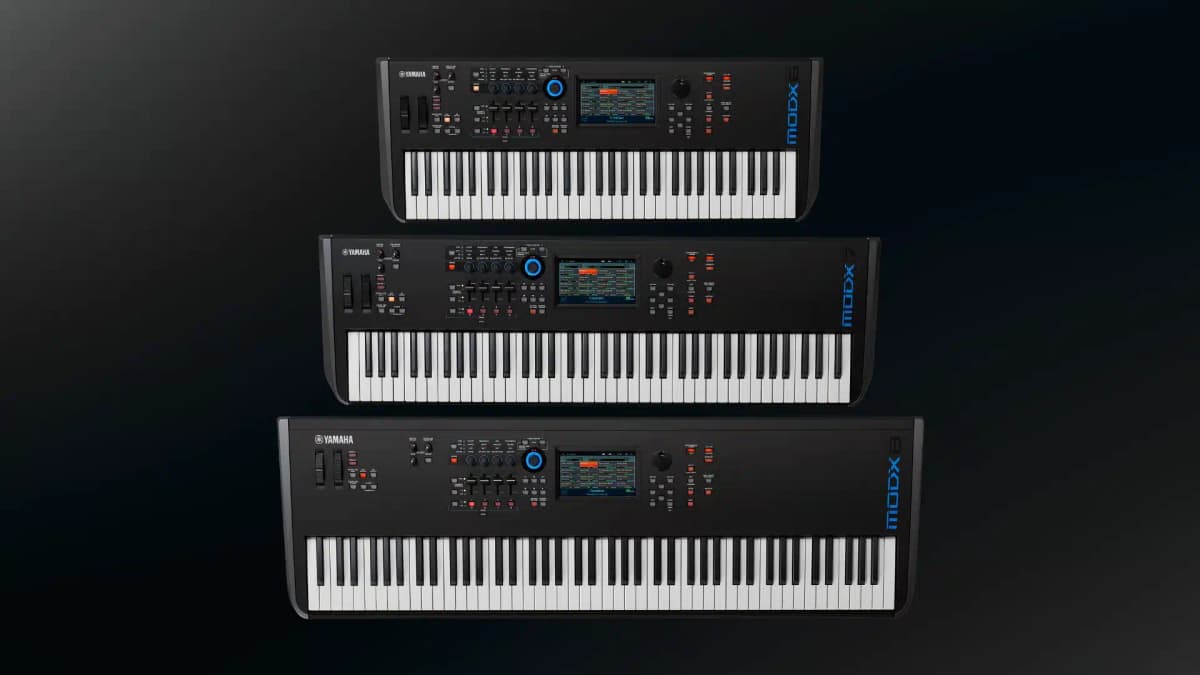
The Yamaha MODX is a range of synthesizers that Yamaha introduced in September 2018 in three sizes: the 61-key MODX6, the 76-key MODX7 and the 88-key MODX8. It uses the same two sound engines as the flagship Montage, the AWM2 sample-based engine and the eight-operator FM-X engine, with 128 notes of AWM2 polyphony, 64 notes of FM-X, 16-part multitimbrality, Motion Control, the Super Knob and a 7-inch touch screen, in a plastic chassis that brought the 61-key model down to 6.6 kg. It matters because it made the Montage sound platform available at roughly half the price, and in a body light enough to carry to every gig.
Table of Contents
Yamaha MODX sound and character
The Yamaha MODX sounds, in most respects, like a Montage. Sound On Sound’s launch report described it as borrowing heavily from the flagship, and the core is identical: AWM2 for sampled instruments and sample-based synthesis, and FM-X for eight-operator FM. MusicTech’s Andy Jones found its acoustic sounds among the most realistic he had heard, singling out the presets built around real instruments, while the factory library includes a sampled Bösendorfer Imperial grand piano as its headline acoustic sound.
Where the Yamaha MODX really earns its character is in movement. Motion Control lets the Super Knob, tempo-synced Motion Sequences and the Envelope Follower (which turns incoming audio into a modulation source) drive many parameters at once, so pads, arpeggios and synth layers evolve rather than sit still. MusicRadar’s Dan Goldman praised this as a deep real-time engine for sound evolution, and MusicTech described synths, pads and strings that swirl more than ever. Some of the leads, by contrast, struck MusicTech as a little obvious.
FM-X is the more distinctive of the two engines. It extends the DX approach with eight operators, 88 algorithms and waveforms beyond the sine, so it can produce classic DX electric pianos and basses as well as dense, moving textures; a free FM converter loads patches from the DX7 and the TX series. On the Yamaha MODX, however, FM-X polyphony is 64 notes, half the Montage’s 128, which matters with layered FM pads or sustained FM pianos.
Overall the Yamaha MODX sits firmly in the modern, polished workstation camp. It is strong at realistic keyboards, orchestral and band sounds, and animated hybrid textures, less so at the raw character of analog or virtual analog instruments, and it has no dedicated organ or virtual analog engine, gaps MusicRadar pointed out.
Features and architecture
- Manufacturer: Yamaha Corporation
- Year introduced: 2018; announced and released on September 14, 2018
- Production years: 2018 to 2022, when the MODX+ superseded it; retailers such as Bax-shop now list the original models as discontinued
- Synthesis type: AWM2 sample-based synthesis plus FM-X eight-operator FM, combined in Yamaha’s Motion Control Synthesis Engine
- Category: mid-priced synthesizer and performance keyboard (often grouped with workstations)
- Polyphony: 128 notes AWM2 plus 64 notes FM-X, 192 in total when engines are layered
- Multitimbrality: 16 parts
- Sample memory: 5.67 GB of preset waveforms (when expanded to 16-bit linear format) and 1 GB of user flash memory for imported samples and libraries, compared with about 1.7 GB on the Montage
- Original price: $1,299 (MODX6), $1,499 (MODX7) and $1,899 (MODX8) in the US; £1,242, £1,420 and £1,642 in the UK
- Current market price: no longer sold new; used MODX6 listings on Reverb UK sat at roughly £690 to £710 in autumn 2026
- Oscillators: AWM2 parts built from sampled waveforms (up to eight elements per part); FM-X parts with eight operators, 88 algorithms and multiple operator waveforms
- Filter: multiple AWM2 filter types per element; FM-X parts also include a filter
- LFOs: per-part and per-element LFOs on AWM2, plus LFOs on FM-X parts
- Envelopes: pitch, filter and amplitude envelopes on AWM2 elements; per-operator envelopes and pitch envelope on FM-X
- Modulation system: Motion Control, comprising the Super Knob, Motion Sequencer, Envelope Follower and a control matrix, plus eight Scenes for snapshot recall
- Sequencer / arpeggiator: arpeggiator with more than 10,000 types; basic 16-track performance recorder, extended by later OS updates
- Effects: up to 13 simultaneous dual insert effects and three master-stage effects, shared with the Montage effects library
- Memory: internal flash user memory; compatible with Montage files and with MOTIF XS/XF and MOXF content
- Keyboard: MODX6 61 semi-weighted keys; MODX7 76 semi-weighted keys; MODX8 88-key GHS (Graded Hammer Standard) weighted action; velocity-sensitive, no aftertouch
- Controllers: Super Knob, four assignable knobs, four faders, two assignable buttons, pitch and modulation wheels, data wheel
- Inputs / outputs: two unbalanced main outputs, headphone output, stereo A/D input, pedal inputs including foot-controller control of the Super Knob
- MIDI / USB: 5-pin MIDI In/Out; USB to host with multichannel audio (10 outputs and 4 inputs) and MIDI
- Display: 7-inch color touch screen
- Dimensions / weight: MODX6 937 x 331 x 134 mm, 6.6 kg; MODX7 7.4 kg; MODX8 1,333 x 404 x 160 mm, 13.8 kg
- Power: external PA-150B AC adapter (16 W)
Strengths
- It delivers the Montage’s sound platform at a much lower price. The same AWM2 and FM-X engines, Motion Control and effects arrived at roughly half the cost of the flagship, which MusicTech highlighted when it named the MODX6 its best hardware instrument of 2018.
- The 61- and 76-key models are genuinely portable. At 6.6 kg and 7.4 kg they are light enough for musicians who carry their own gear, a practical advantage over heavier flagships.
- Motion Control gives presets life. The Super Knob, Motion Sequences and Envelope Follower let a single gesture reshape a whole layered Performance, which suits both live playing and sound design.
- FM-X is a serious FM engine. Eight operators, 88 algorithms and a converter for DX7 and TX patches make it one of the most capable FM implementations at its price.
- It is broadly compatible. Montage files load directly, MOTIF XS/XF and MOXF content can be imported, and a 10-out, 4-in USB audio interface simplifies integration with a computer.
- Yamaha kept developing it. Operating system updates such as version 2.5 in 2020 added Smart Morph for FM-X and DAW Remote control, extending the Yamaha MODX well after launch.
Limitations
- There is no aftertouch on any model, an omission both MusicTech and MusicRadar noted, MusicRadar arguing that aftertouch should never be lost on an instrument built around expressive control.
- FM-X polyphony is limited to 64 notes, half of the Montage’s, which can run out with layered FM sounds.
- Only two unbalanced main outputs are provided, without the Montage’s additional outputs, balanced connections or Pure Analog Circuit.
- The panel has fewer dedicated controls than the Montage, so more work happens through the touch screen and menus, and MusicRadar found controller assignment slower than it would like.
- The plastic case saves weight but feels less robust than the Montage’s metal chassis.
- There is no dedicated organ, virtual analog or direct sampling engine, and the original performance recorder was basic compared with the old MOTIF sequencers.
- The MODX8’s GHS action is a lighter, cheaper hammer action, and MusicRadar found its repetition sluggish for fast passages.
Historical context
Yamaha launched the Montage in May 2016 as the successor to its long-running MOTIF flagship, introducing the FM-X engine and Motion Control alongside the established AWM2 engine. Below the MOTIF, Yamaha had for years sold a lighter, cheaper line under the MO name, most recently the MOXF. The Yamaha MODX revived those two letters, as Sound On Sound noted, and filled the same mid-priced slot, but this time with the flagship’s current engine rather than an older one.
Yamaha announced the Yamaha MODX on September 14, 2018. Its own history of its synthesizers describes it as a compact, lightweight instrument that embraced all of the Montage’s design concepts, and reviewers agreed that the reductions were mostly physical: fewer knobs and buttons, no ribbon or aftertouch, two outputs, plastic instead of metal, and half the FM-X polyphony. Yamaha supported it with regular operating system updates, including version 2.5 in June 2020 with Smart Morph, which builds a morphing map from up to eight FM-X sounds, and DAW Remote.