

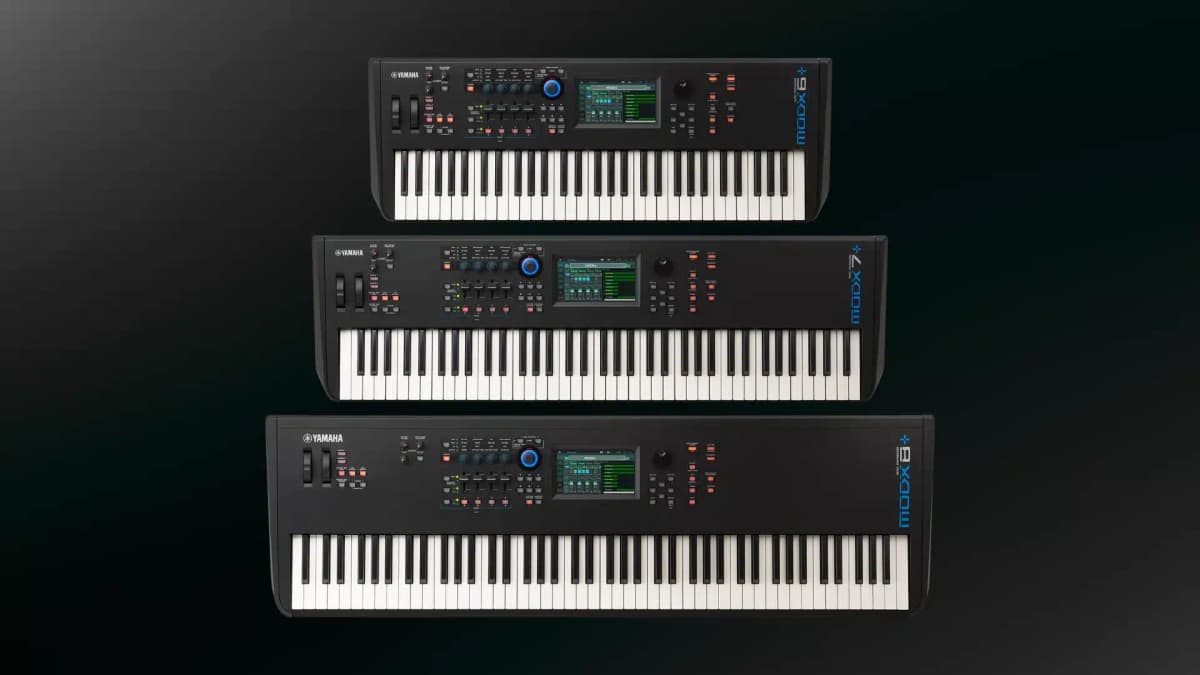
The Yamaha MODX+ is a mid-priced synthesizer workstation that Yamaha announced and shipped on September 1, 2022, in 61-, 76- and 88-key versions called the MODX6+, MODX7+ and MODX8+. It is a revision of the 2018 MODX rather than a new design: the same pairing of AWM2 sample-based synthesis and eight-operator FM-X, the same Motion Control system and Super Knob, and the same light plastic chassis, but with FM-X polyphony raised from 64 to 128 notes, user sample memory raised from 1GB to 1.75GB, more factory Performances and effects, and rubberized wheels. Its importance is practical. For three years it was the cheapest way to get the full sound engine of the first-generation Montage, and the last version of that platform before the MODX M arrived in 2025.
Table of Contents
Yamaha MODX+ sound and character
The Yamaha MODX+ sounds like a Montage because, in terms of engine and content, it largely is one. The AWM2 side draws on a preset wave ROM of about 5.67GB of 16-bit linear samples, including Yamaha’s CFX and Bösendorfer Imperial concert grand pianos and orchestral strings, and its Performances can stack up to eight elements per part with filters, envelopes and effects on top. The result is polished, detailed and mix-ready: pianos, electric pianos, strings, brass and layered pads that drop into a session or a covers set with little work. Bonedo’s December 2022 test described the combination of AWM2 and FM-X as producing lively sounds that respond well to the real-time controls.
FM-X is the more distinctive half. With eight operators, 88 algorithms and several operator waveforms beyond the sine, it goes well past the DX7‘s six operators, and its analog-style filters let FM tones be rounded off in a way the original DX series could not. It covers glassy electric pianos and bells as easily as hard, distorted basses and metallic textures. The practical change on the Yamaha MODX+ is headroom: 128 FM-X voices instead of 64 means dense FM pads, layered keyboard splits and long releases no longer run out of notes so quickly, and since AWM2 keeps its own 128 voices the Yamaha MODX+ offers 256 notes in total.
Where the Yamaha MODX+ really comes alive is movement. The Super Knob, motion sequences, envelope follower and Smart Morph let a single Performance evolve, morph from one layer balance to another, or pulse in time with the tempo, which suits pop, film-style beds and electronic music more than static preset playback. Its character is modern and clean rather than warm or vintage. It does not try to model analog circuitry, and there is no virtual analog engine; Bonedo noted that rumors of a third engine, based on Yamaha’s AN-X trademark, did not materialize on this model.
Features and architecture
- Manufacturer: Yamaha Corporation
- Year introduced: 2022; announced on September 1, 2022 and reported as available immediately
- Production years: 2022 to 2025; it was succeeded by the MODX M in October 2025, and retailers such as zZounds now list it as no longer available, though no formal discontinuation date from Yamaha was found
- Synthesis type: AWM2 sample-based subtractive synthesis plus FM-X eight-operator FM, combined under Yamaha’s Motion Control Synthesis Engine
- Category: mid-range synthesizer workstation and performance keyboard, derived from the first-generation Montage
- Polyphony: 256 notes in total, 128 AWM2 plus 128 FM-X (the original MODX had 64 FM-X voices)
- Multitimbrality: 16 parts per Performance; Seamless Sound Switching between Performances of up to four parts
- Original price: £1,680 (MODX6+), £1,959 (MODX7+) and £2,239 (MODX8+) in the UK at launch; Piano and Synth lists US list prices of $1,699, $1,999 and $2,499, with street prices lower
- Current market price: Sweetwater’s Gear Exchange price guide shows about $936 to $1,386 for a used MODX7+ and $1,144 to $1,694 for a used MODX8+
- Oscillators: AWM2 with a 5.67GB preset wave ROM and up to eight elements per part; FM-X with eight operators, 88 algorithms and multiple operator waveforms
- Filter: multimode filters on AWM2 elements and analog-style filters for FM-X parts
- LFOs: per-element and per-part LFOs, supplemented by motion sequences and the envelope follower as modulation sources
- Envelopes: pitch, filter and amplitude envelopes for AWM2 elements; individual operator envelopes in FM-X
- Modulation system: Motion Control with the Super Knob, motion sequences, envelope follower, Audio Beat Sync and Smart Morph
- Sequencer / arpeggiator: 16-track sequencer with 128 patterns and about 520,000 notes of storage; multitimbral arpeggiator; rhythm patterns and a beat slicer
- Effects: up to 13 dual insert effects plus master and system effects including VCM processing; Piano and Synth’s comparison counts 88 variation types and 26 master effect types, up from 76 and 15 on the MODX
- Memory: about 2,227 preset Performances; 1.75GB of user flash memory for samples, up from 1GB
- Keyboard: 61 or 76 semi-weighted keys, or 88 GHS (Graded Hammer Standard) keys; velocity-sensitive, no aftertouch; rubberized pitch and modulation wheels
- Controllers: Super Knob, four knobs, four sliders, two assignable switches and four scene buttons
- Inputs / outputs: stereo main outputs, stereo A/D input, headphone output, foot controller and footswitch jacks
- MIDI / USB: 5-pin MIDI in and out; USB to host carrying 16 MIDI channels and a 4-in, 10-out audio interface; USB to device for storage
- Display: 7-inch color touchscreen, unchanged from the MODX
- Dimensions / weight: Bonedo weighed the MODX6+ at 6.6kg, while Yamaha’s own overview gives 15.9lb, 17.6lb and 31.7lb for the three models, so published figures vary
- Power: external AC adaptor
Strengths
- It delivers the first-generation Montage engine at a mid-range price. The AWM2 and FM-X engines, the sound content and the Motion Control system are shared, so most Montage Performances and techniques carry over.
- The FM-X polyphony upgrade fixes a real bottleneck. Doubling FM voices to 128 makes FM pads and layered splits far less prone to note stealing than on the original MODX.
- The extra user memory makes custom sample libraries practical. At 1.75GB, it matches the original Montage and leaves room for third-party sound sets alongside the factory content.
- It is light and compact for its capability. The 61- and 76-key models are easy to carry, and the narrow case suits crowded stages and small studios.
- Studio integration is unusually complete for the price. The multichannel USB audio interface, DAW remote functions and Soundmondo patch sharing let it work as both a hardware instrument and a computer peripheral.
- Legacy FM is easy to reach. A patch converter for DX7, DX7II, TX802 and TX816 voices opens up thousands of classic Yamaha sounds.
Limitations
- There is no aftertouch on any model. For a performance-oriented synth with so many expressive tools, the omission limits how much can be controlled from the keys themselves.
- The keybeds are budget actions. Sound On Sound found the original MODX’s semi-weighted keys flimsy and its GHS action unsatisfying for acoustic piano, and the Yamaha MODX+ kept the same mechanisms apart from textured black keys and new wheels.
- Physical control is thin compared with the Montage. Four knobs and four sliders mean much editing happens through the touchscreen.
- Programming is deep and slow. Bonedo noted that sounds cannot be changed quickly or intuitively, and Sound On Sound described FM-X as incomprehensible for most users.
- The update was modest. Reviewers including Bonedo and Piano and Synth described it as a boost rather than a redesign, so owners of an original MODX gained relatively little.
- Rear-panel labels are not visible from the playing position, which Bonedo called flying blind when connecting pedals and cables.
- It has no separate assignable outputs beyond the main stereo pair, so multitrack routing depends on USB audio.
Historical context
The Yamaha MODX+ belongs to the family Yamaha launched with the Montage in 2016, a flagship that combined an evolved AWM2 sample engine from the Motif line with FM-X, a modern eight-operator descendant of the DX7. The Montage has its own article on this site. Two years later, in 2018, Yamaha released the MODX, a cheaper and lighter instrument that kept the same engines and sound library but trimmed controls, polyphony and physical build. Sound On Sound summed it up as a Montage for the masses, and that positioning carried straight into the Yamaha MODX+.
The Yamaha MODX+ was announced on September 1, 2022, with the three models shipping at once. MusicTech reported that Yamaha designed them to lean even closer to the Montage, and the changes followed that brief: FM-X polyphony up to 128 notes, user flash memory up by 75 percent to 1.75GB, a larger factory library of about 2,200 Performances, more effect types, and rubber-coated wheels like the Montage’s. Little else changed. The display, keybeds, panel layout and chassis were carried over, and the absence of a third engine was noted by several reviewers.
Yamaha replaced the Montage with the Montage M in 2023, leaving the Yamaha MODX+ as the remaining member of the original platform for two more years. In October 2025 Yamaha introduced the MODX M, which Synth Anatomy and Japanese retailer Shimamura Music both describe as the Yamaha MODX+’s successor and which brought the newer platform’s AN-X engine, larger sample ROM and more controls to the mid-range. Gearnews referred to the Yamaha MODX+ as the previous model, and by 2026 major US retailers had stopped stocking it.