

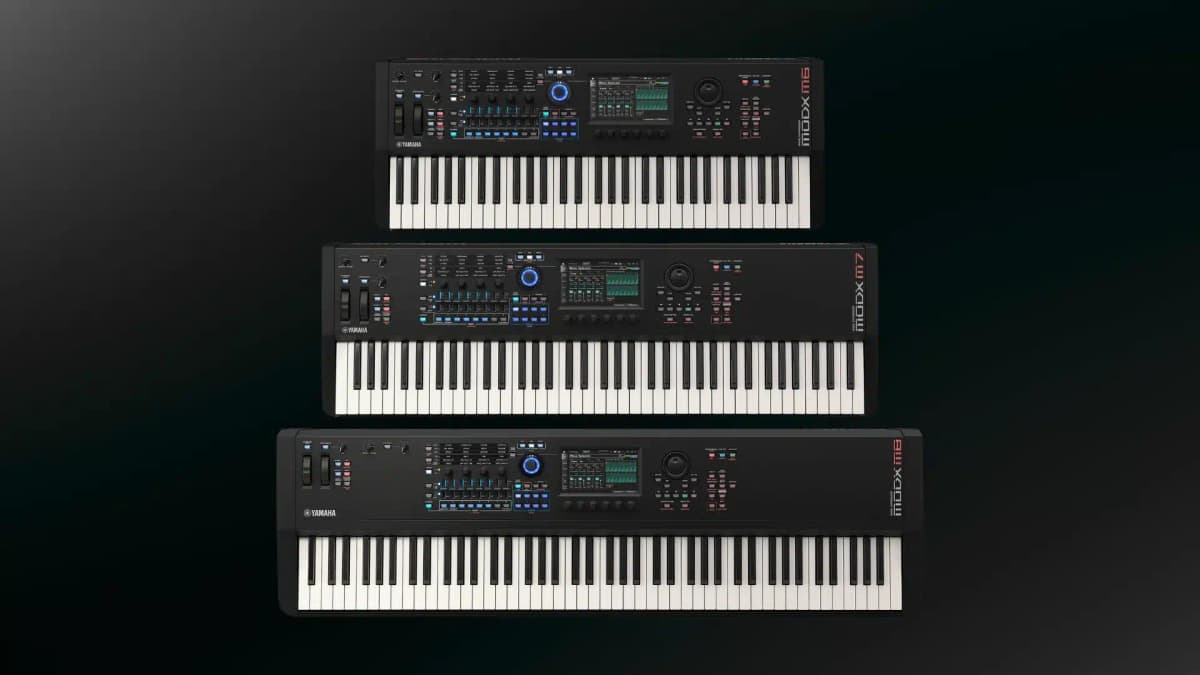
The Yamaha MODX M is a three-engine synthesizer workstation that Yamaha announced in mid-October 2025 as the MODX M6, MODX M7 and MODX M8, with 61, 76 and 88 keys. It replaces the MODX+ and is built on the platform of the Montage M flagship: AWM2 sample-based synthesis with up to 128 elements per part, FM-X eight-operator FM, and the AN-X analog-modeling engine, all under the Motion Control system, with 268 notes of total polyphony and a 10.7GB preset wave ROM. It also gains eight faders, six display knobs and a free plugin version of its engine. At a glance, it matters because it brings almost the full Montage M sound engine to a lighter instrument at around half the price.
Table of Contents
Yamaha MODX M sound and character
The Yamaha MODX M sounds very close to a Montage M, and that is the point of it. Audiofanzine’s reviewer described its engines and modulation as nearly identical to the flagship’s and called the AWM2 library the most homogeneous and musical multisample bank available on a hardware synth. The acoustic pianos, including the CFX concert grand, sit alongside detailed electric pianos, organs, orchestral sections and modern synth layers, and Pianoo’s April 2026 test found the piano content close to dedicated software instruments. Because a single AWM2 part can now hold up to 128 elements instead of eight, complex layered and velocity-switched sounds no longer need to be spread across several parts.
FM-X is unchanged in concept from earlier Montage and MODX models: eight operators, 88 algorithms and 128 voices, capable of DX-style electric pianos, bells and basses but also aggressive, filtered digital textures. AN-X is the genuinely new ingredient for this price range. It offers three oscillators with five waveforms, pulse-width modulation, sync, ring modulation and FM, a noise source, two filters with ten types, a wavefolder and waveshaper, and adjustable drift and aging to imitate analog instability. It gives the Yamaha MODX M fat leads, basses and evolving pads that do not depend on samples.
Character is where reviewers temper their praise. Audiofanzine found AN-X neutral, lacking the personality of some competitors’ vintage analog modeling and lacking dedicated subtractive-style panel controls, and its 12-voice limit keeps it in a supporting role. The overall voice of the Yamaha MODX M is modern, clean and high-fidelity, with improved output quality and stereo width compared with the original MODX according to the same review. Its real strength is combining all three engines in one Performance and moving between layers with the Super Knob and motion sequences, rather than imitating a single vintage instrument.
Features and architecture
- Manufacturer: Yamaha Corporation; Audiofanzine reports that the Yamaha MODX M is manufactured in Indonesia
- Year introduced: 2025; announced on October 14 and 15, 2025 depending on region, with a Japanese release on October 24, 2025
- Production years: 2025 to present; still current in October 2026
- Synthesis type: AWM2 sample-based subtractive synthesis, FM-X eight-operator FM and AN-X analog modeling, combined under the Motion Control Synthesis Engine
- Category: mid-range synthesizer workstation and performance keyboard derived from the Montage M
- Polyphony: 268 notes in total; 128 AWM2, 128 FM-X and 12 AN-X (the Montage M offers more AWM2 and 16 AN-X voices)
- Multitimbrality: 16 parts per Performance, each using AWM2, FM-X or AN-X; Seamless Sound Switching for Performances of up to six parts
- Original price: launch prices of $1,799.99 (M6), $1,999.99 (M7) and about $2,499 (M8) in the US; Gearnews listed £1,190, £1,444 and £1,629 in the UK and €1,349, €1,649 and €1,849 in Europe
- Current market price: Kraft Music lists $1,949.99, $2,149.99 and $2,699.99 in October 2026, matching Sweetwater’s M6 and Yamaha’s US store M8 prices; ePianos quotes £1,190 to £1,680 in the UK
- Oscillators: AWM2 with a 10.7GB preset wave ROM and up to 128 elements per part; FM-X with eight operators and 88 algorithms; AN-X with three oscillators, five waveforms each, PWM, sync, ring modulation, FM and noise
- Filter: AWM2 element filters and FM-X part filters; AN-X has two filters with ten types plus a wavefolder and waveshaper
- LFOs: AN-X offers two LFOs; AWM2 and FM-X have element and part LFOs, and OS 3.0 added AN-X and FM-X parameters as part LFO destinations
- Envelopes: AWM2 pitch, filter and amplitude envelopes per element; FM-X operator envelopes; AN-X has its own amplitude envelope
- Modulation system: Motion Control with the Super Knob (now with left, center and right position buttons), motion sequences, envelope follower, Smart Morph and up to 32 control destinations per part
- Sequencer / arpeggiator: 16-track sequencer with 128 patterns, about 520,000 notes and 480 PPQN, real-time recording only; multitimbral arpeggiator with more than 10,000 preset types and 256 user slots; stereo audio recording to USB
- Effects: 13 insert effect sets (the Montage M has 17), 88 insert algorithms, 13 reverb algorithms including a Shimmer type, 23 master effects and a VCM rotary speaker; OS 3.0 added further VCM effects
- Memory: about 1.9GB of user flash for samples (the MODX+ had 1.75GB, the Montage M about 3.8GB); Montage M Performances and content are compatible
- Keyboard: M6 and M7 use the semi-weighted FSB action; M8 uses GHS (Graded Hammer Standard); velocity-sensitive with no aftertouch transmitted
- Controllers: eight sliders, six display knobs, four knobs, Super Knob, portamento knob, pitch and modulation wheels, two assignable switches, keyboard hold and motion sequence trigger, eight part select and scene buttons, and a Quick Edit system covering up to 24 parameters
- Inputs / outputs: stereo main outputs, stereo A/D input with gain, headphone output, two foot controller jacks, sustain and assignable footswitch jacks, all on 6.3mm jacks
- MIDI / USB: 5-pin MIDI in and out; USB to host with MIDI 2.0 support and a 4-in, 10-out audio interface; USB to device for storage
- Display: 7-inch color wide VGA touchscreen
- Dimensions / weight: 6.6kg (M6), 7.6kg (M7) and 13.6kg (M8) per Audiofanzine; Yamaha gives the M8 as 1,310 by 152 by 391mm
- Power: external PA-300C AC adaptor, 19W
Strengths
- It delivers most of the Montage M engine for roughly half the price. AWM2, FM-X and AN-X are all present, and Montage M Performances load directly, so content and programming skills carry across the family.
- The 128-element AWM2 architecture is a major structural gain. Complex pianos, multilayered pads and velocity-switched instruments fit in a single part instead of consuming several.
- Hands-on control is much improved over the MODX+. Eight faders, six display knobs, Quick Edit and dedicated part, scene, hold and portamento buttons reduce the touchscreen dependence of earlier MODX models.
- AN-X adds a sample-free analog-modeling voice. Three oscillators, dual filters, a wavefolder and drift controls widen the range of basses, leads and pads beyond what the MODX+ could produce.
- The ESP plugin extends the hardware into the DAW. Owners get a software version of the engine that shares sounds with the Yamaha MODX M, while the multichannel USB audio interface handles recording and monitoring.
- It stays portable. The M6 and M7 weigh well under 8kg, and Audiofanzine gave the series its 2025 Best Value award.
Limitations
- There is no aftertouch from the keyboard. The Yamaha MODX M receives polyphonic aftertouch over MIDI but cannot generate it, which limits expression compared with the Montage M.
- The keybeds remain modest. The FSB and GHS actions improve on the MODX+, but Audiofanzine judged them below Yamaha’s higher-end FSX action, and Pianoo noted mechanical key noise and case resonance during vigorous playing.
- AN-X has only 12 voices and, according to Audiofanzine, little sonic personality compared with dedicated analog-modeling synths.
- There are no assignable outputs beyond the main stereo pair, so multitrack routing relies on USB audio.
- The onboard sequencer is basic. It records in real time with no detailed event editing, and drum kits are limited to the AWM2 engine.
- Several flagship features are cut back: Seamless Sound Switching works only up to six parts, there are fewer insert effects and USB channels, and user sample memory is about half the Montage M’s.
- The US price has risen since launch, by roughly $150 to $200 per model at major retailers, narrowing its value advantage over discounted MODX+ stock and used Montage units.
Historical context
The MODX line has always been Yamaha’s lighter, cheaper version of its Montage flagship. The original MODX of 2018 followed the 2016 Montage, and the MODX+ of 2022 updated it with more FM-X polyphony and memory. When Yamaha announced the Montage M in October 2023, adding the AN-X engine, a larger sample ROM, up to 400 notes of polyphony and the ESP plugin concept, the MODX+ was left on the older platform without the new engine. The Montage and Montage M each have their own article on this site.
The Yamaha MODX M closed that gap. Kraft Music published its introduction on October 14, 2025, and the press coverage followed the next day; Shimamura Music lists the Japanese release as October 24, 2025. Synth Anatomy called it a major hands-on upgrade and Gearnews noted how popular its predecessor had been in the mid-range; the headline changes were AN-X, the newer AWM2 content, eight faders and new display knobs. Kraft Music presented it as a lighter, more mobile alternative to the Montage M rather than a cut-down budget model, and the M8 uses a GHS action while the M6 and M7 move to the semi-weighted FSB action.
Development continued after launch. In January 2026 Yamaha released OS 3.0, a free update that moved the Yamaha MODX M to the same operating system generation as the Montage M and added new VCM effects, a newly sampled clavi waveform, about 60 Performances, deeper modulation routing and ESP Control for DAW integration. The ESP plugin itself arrived in early 2026, with download codes supplied to hardware owners. As of October 2026 the Yamaha MODX M remains Yamaha’s current mid-range synthesizer.