

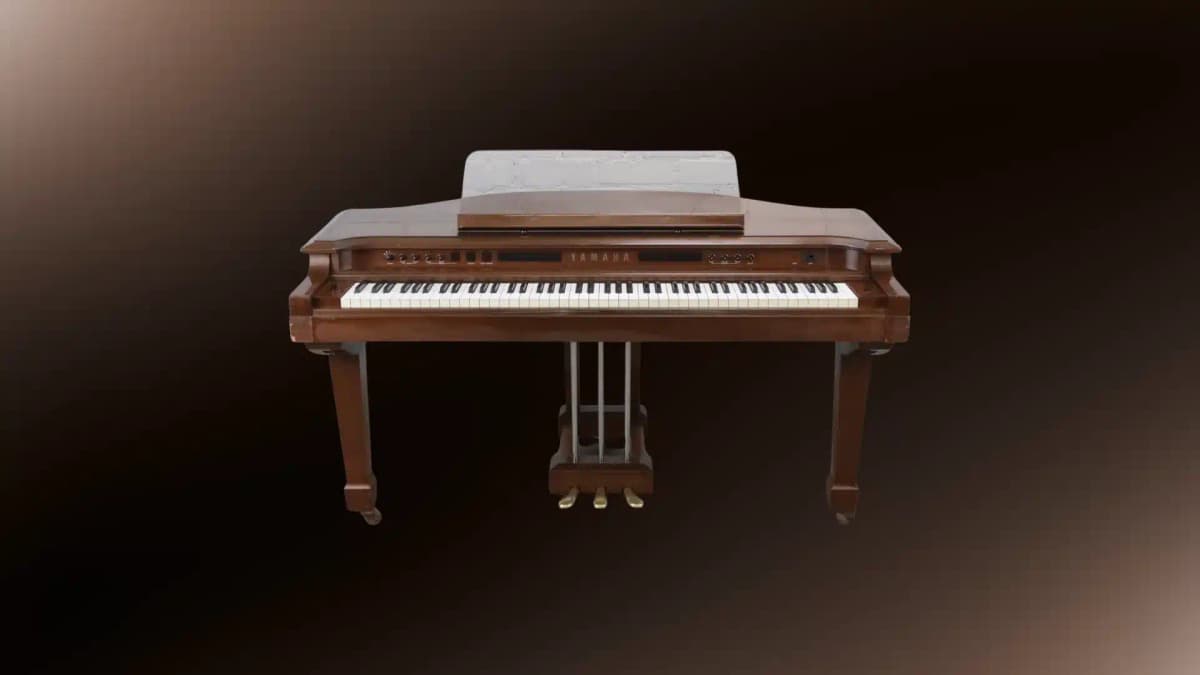
The Yamaha GS1 is a 16-voice digital FM synthesizer that Yamaha released in 1981, about two years before the DX7. Housed in a wooden cabinet shaped like a small grand piano, with 88 weighted keys, three piano pedals and a weight of 90 kg, it looked more like a luxury home instrument than a synthesizer. Inside, each voice used eight FM operators arranged as four modulator and carrier pairs, split into two sections that could be loaded independently from magnetic voice strips. There was no editing on the instrument at all. Priced at 2.6 million yen in Japan and sold in tiny numbers, the Yamaha GS1 matters because it was the first full keyboard synthesizer built on Yamaha’s FM research, and the place where the company tested ideas that later reached the DX series.
Table of Contents
Yamaha GS1 sound and character
The Yamaha GS1 sounds like early FM with the rough edges polished away by heavy hardware and an unusually expressive keyboard. Its tones can be glassy and bright in the way later DX instruments became famous for, yet many of its factory voices are warmer and rounder than the stereotype of 1980s FM. Sound On Sound’s Gordon Reid, who spent time with one for a 2001 Retrozone feature, described it as a remarkable instrument and wrote that its sound could be clear and bright like a digital synth while still warm and deep like an analog one. He also noted that its FM pianos and plucked sounds pointed directly toward the refinements of the DX7.
Part of that character comes from the performance controls wrapped around the FM engine. Polyphonic aftertouch controls both loudness and brightness, so a held chord can swell and open note by note. A detune control offers four modes, shallow and deep static detuning plus shallow and deep random detuning, and Reid singled out the random settings as adding a lot of life. An Ensemble switch routes the output through a genuine analog delay line for a wide, slightly noisy chorus, and a three-band EQ shapes the result.
Like most FM instruments, it excels at sounds with inharmonic or bell-like content. Japanese retailer Sound House, analyzing Toto’s “Africa”, points to the Yamaha GS1’s kalimba and marimba-type voices as typical of what it did best, alongside electric pianos, vibraphone and harpsichord. What it cannot do is offer the hands-on sculpting of an analog synth: there is no filter, no algorithm choice and no editing, so the player works within the voices supplied and shapes them with touch, pedals, detune, ensemble and EQ.
The Yamaha GS1 sits between eras: digital and preset-based like what followed, but with the weight, wooden cabinet and analog chorus of a late-1970s flagship.
Features and architecture
- Manufacturer: Yamaha
- Year introduced: 1981; some references give 1980
- Production years: about 1981 to 1983; the Swedish Museum of Performing Arts dates its example 1981 to 1983, and sources agree that only around 100 GS1s were sold
- Synthesis type: digital FM (frequency modulation)
- Category: preset polyphonic FM keyboard synthesizer in a piano-style cabinet
- Polyphony: 16 voices; two identical synth sections (A and B) are layered within each voice
- Original price: 2.6 million yen in Japan according to Yamaha; Sound On Sound gives £12,000 in the UK in 1981; quoted US figures vary from nearly $10,000 to $25,000
- Current market price: no reliable price guide exists; recent Reverb listings have ranged from $6,495 for an unserviced unit in fair condition to $12,500 for a restored unit with MIDI
- Oscillators: eight FM operators per voice, arranged as four modulator and carrier pairs split across the A and B sections; Yamaha’s own history describes the Yamaha GS1 as a four-operator design, counting a single section
- Filter: none; brightness depends on modulation levels and touch
- LFOs: vibrato and tremolo, each with speed and depth controls
- Envelopes: one envelope generator per operator (eight per voice)
- Modulation system: fixed operator arrangement with no user-selectable algorithms; polyphonic aftertouch to loudness and brightness; pressure-sensitive soft and sostenuto pedals for vibrato and tremolo
- Effects: analog Ensemble chorus using a delay line, three-band EQ (bass, mid, treble), detune with static and random modes
- Memory: 16 voice memories loaded from magnetic voice strips, whose A and B ends can be combined from different voices
- Programming: no onboard editing; voices were created on a dedicated Yamaha programming computer
- Keyboard: 88 weighted keys with velocity and polyphonic aftertouch
- Inputs / outputs: audio outputs and headphone output, three built-in pedals (soft, sostenuto, damper), and an input for an expression pedal
- MIDI / USB: none at launch; Yamaha offered a MIDI retrofit in 1984 that handled only note on, note off and velocity on channels 1 to 3
- Display: none; illuminated voice selection buttons
- Dimensions / weight: 1,500 x 832 x 826 mm and 90 kg according to Yamaha
- Power: internal power supply; Sound On Sound gives a consumption of 95 W
- Variant: GS2, a cheaper version with 73 velocity-sensitive keys and no aftertouch, half the FM structure (it reads only the A side of a voice strip), no random detune; it reads the same voice strips
Strengths
- The keyboard is expressive in a way few early digital synths matched. Weighted keys, velocity and polyphonic aftertouch acting on both loudness and brightness give each note of a chord its own dynamic.
- Its FM voices are unusually warm for the technology. The analog ensemble stage, EQ and random detune soften the clinical edge that later FM instruments were often accused of.
- It is strong at the sounds FM does best. Kalimba, marimba, vibraphone, electric piano and bell tones come out clean and distinct, which is exactly how Toto used it.
- The A and B voice structure allows real layering without programming. Loading halves of different voices from separate strips creates composite sounds, and these combinations can be stored.
- Playing it requires no technical knowledge. Yamaha’s design aimed at musicians rather than programmers, so it behaves like a piano with selectable voices and simple, musical performance controls.
- Its historical position is secure. As the first full keyboard synthesizer built on Yamaha’s FM research, it is a key document of how the DX series came to be.
Limitations
- There is no voice editing on the instrument. Without Yamaha’s rare programming computer, owners can only use, combine and store voices from existing strips.
- It is enormously heavy and large. At 90 kg in a wooden piano cabinet, it is a studio or installation instrument in practice, whatever Yamaha intended for the stage.
- MIDI was never native. The 1984 retrofit is primitive, monotimbral and limited to note and velocity data, and unmodified units have no MIDI at all.
- The magnetic voice strips and their reader are a weak point. Strips get lost or degrade, and sellers of restored units report rebuilding the reader as part of the work.
- Service is specialist work. With so few units built, parts are scarce, and listings regularly describe failing detune, vibrato or output sections on unserviced examples.
- There is no filter and no algorithm choice. Even with the programmer, the Yamaha GS1’s fixed operator arrangement is far less flexible than the 32 algorithms of the later DX instruments.
- Market prices are hard to judge. With no price guide and only occasional listings, values depend heavily on condition, MIDI status and provenance.
Historical context
Yamaha’s work on FM began after it licensed the technique from Stanford University in 1973, a story told in more detail in the site’s article on the DX7. The company’s organ division built an FM monophonic prototype that year and a polyphonic prototype by 1975, but these early machines needed too many integrated circuits to be practical products. Yamaha’s own history describes seven years of development, during which a prototype known as the TRX-100 became the basis for the Yamaha GS1. Meanwhile Yamaha’s synth line still rested on analog flagships such as the GX-1 and CS-80, both covered separately on this site.
FM reached the market first in the F-70 Electone home organ in 1981, followed about a month later by the Yamaha GS1. Yamaha described it as an instrument intended for stage use, though Gordon Reid argued that the size, weight and price made it clear it was really meant for studios. Chick Corea was the featured artist in its Japanese catalog and was photographed testing the Yamaha GS1 and the smaller GS2 at Yamaha before release. The GS2, with 73 keys and a reduced FM structure, was meant to widen the market, but by most accounts it fared little better.