

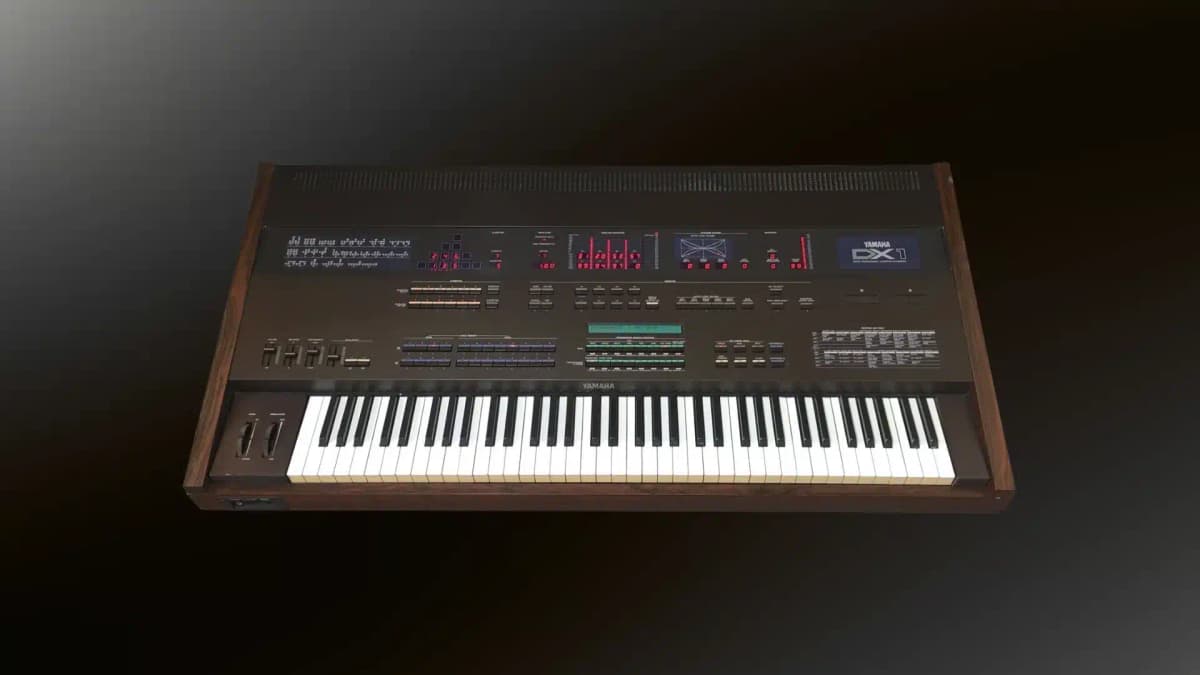
The Yamaha DX1 is the flagship of Yamaha’s original DX series, launched at the end of 1983 and built in a run of only about 140 units. It combines two complete six-operator FM tone generators, each equivalent to a DX7, with a 73-note wooden, weighted keyboard offering velocity and polyphonic aftertouch, all in a cabinet framed by Brazilian rosewood. Where the DX7 hid its parameters behind a single small display, the Yamaha DX1 laid FM out across a wide panel of LED readouts and dedicated buttons, making it far easier to program from the front panel. At $13,900 in the United States it was beyond almost every musician, but it remains the most complete statement of Yamaha’s first FM generation.
Table of Contents
Yamaha DX1 sound and character
At its core the Yamaha DX1 sounds like FM from the DX7 era: crisp electric pianos, metallic bells, bright brass, plucked basses and glassy pads. The difference lies in scale and finish. Two 16-voice engines can be layered in Dual mode, split across the keyboard, or used together for 32-voice polyphony in a single voice, and each engine has its own output. Layering two six-operator voices, often slightly detuned or with different envelopes, produces thicker, more complex tones than a single DX7 patch, and Vintage Synth Explorer describes the result as a fatter DX7.
Sound On Sound’s Gordon Reid observed that, on paper, the Yamaha DX1 should have sounded no better than two DX7s costing a fraction of its price, yet it did. Part of the reason was the conversion stage: Gearnews contributor Rob Puricelli explains that the DX1 used the same BA9221 DAC as the DX7, but with the quietest examples hand-selected, giving a noticeably cleaner and lower-noise output. Owners and dealers repeatedly comment on its basses and bells, and the British dealer Soundgas, while noting its initial skepticism about the DX sound, called them strong.
The keyboard changes the instrument as much as the electronics. Polyphonic aftertouch lets pressure on individual notes alter level, brightness or pitch modulation within a chord, a level of expression otherwise associated with Yamaha’s CS-80 (covered separately on this site), and Reid called the Yamaha DX1 a true successor to that instrument. The weighted wooden action, which Puricelli describes as identical to the CS-80’s, rewards piano technique but makes fast synth lines heavy work.
Its limits are those of the FM generation it belongs to. There is no filter, no onboard effects and only sine-wave operators, so warmth and space usually come from external processing. The Yamaha DX1 sits firmly in the clean, articulate, digital camp, but it is the most refined and expressive version of that 1980s sound.
Features and architecture
- Manufacturer: Yamaha (Nippon Gakki Co., Ltd.), assembled by Yamaha’s piano division according to Gearnews
- Year introduced: 1983; Yamaha Blackboxes gives December 1983, while one database lists 1984
- Production years: about 1983 to 1985; Vintage Synth Explorer gives 1983 to 1986; around 140 units were built
- Synthesis type: digital FM, two six-operator tone generators (sections A and B)
- Category: flagship polyphonic FM synthesizer and performance keyboard
- Polyphony: 32 voices in Single mode; 16 voices in Dual mode; 16 plus 16 in Split mode
- Multitimbrality: two parts (A and B) layered or split, with separately assignable MIDI channels
- Original price: $13,900 in the United States according to most sources; Yamaha’s chronology gives 1,950,000 yen in Japan (other sources quote 1,810,000 yen or more); UK figures range from about £7,000 to somewhat over £10,000 in 1984
- Current market price: no Reverb price guide; past dealer sales of serviced units have been around £7,000, while recent Reverb asking prices have run from about $90,000 to €149,000 for exceptional examples
- Oscillators: six sine-wave operators per voice in each engine, 32 algorithms, operator feedback
- Filter: none
- LFOs: one per engine, with sine, square, triangle, saw up, saw down and random waveforms
- Envelopes: one eight-parameter (four rates, four levels) envelope generator per operator, plus pitch envelope
- Modulation system: velocity and polyphonic aftertouch, mod wheel, foot controller and breath controller routing to pitch, amplitude and EG bias
- Sequencer / arpeggiator: none
- Effects: none
- Memory: 32 internal voices for each engine (64 in total) and 64 Performance memories; two cartridge slots for ROM or RAM voice and performance cartridges
- Keyboard: 73 weighted wooden keys with velocity and polyphonic aftertouch; pitch and modulation wheels
- Inputs / outputs: A, B and mixed outputs, each on balanced XLR and unbalanced quarter-inch jacks; inputs for sustain and portamento footswitches, volume and modulation foot controllers, and a breath controller
- MIDI / USB: MIDI In, Out and Thru; no USB
- Display: 40-character, two-line backlit LCD plus banks of LED and segment displays for algorithm, operator frequency, detune, envelope rates and levels, keyboard scaling and sensitivity
- Chips: two YM21280 operator chips and two YM21290 envelope generator chips, one pair per engine
- Dimensions / weight: 1,255 x 640 x 225 mm and 51 kg according to Yamaha; some sources give heavier figures
- Power: internal power supply using unusual voltages, a known failure point on surviving units
Strengths
- It is the easiest classic DX to program. Dedicated buttons, LEDs on each control and a full display of algorithm and envelope data make FM editing visible rather than buried in menus.
- Two engines give real depth. Dual and Split modes combine two DX7-class voices, producing richer layers or full keyboard splits from one instrument.
- The keyboard is exceptionally expressive. Weighted wooden keys with polyphonic aftertouch let each note of a chord respond to pressure, a rare feature in any era.
- Its output is unusually clean. Hand-selected DACs gave it lower noise than a standard DX7, a difference Sound On Sound and Gearnews both highlight.
- Its connections are studio-grade. Balanced XLR outputs for each section and the mix, plus full pedal and breath controller inputs, made it ready for professional rooms and stages.
- The build quality is exceptional. Rosewood ends, solid buttons and an interior designed for servicing reflect its status as Yamaha’s flagship.
Limitations
- It was, and remains, prohibitively expensive. With around 140 made, prices put it out of reach for nearly all players.
- It is large and heavy. At around 51 kg with a long, deep cabinet, it needs a permanent home rather than regular transport.
- The keyboard is very heavy to play. Reid called it perhaps the heaviest synth action you will encounter, and many players preferred the lighter DX5 for that reason.
- Spares are scarce. The power supply is a common failure, some chips are hard to source and donor machines are almost nonexistent.
- The display has aged. Owners note that the backlight can whine, and replacing it while keeping the original look is a concern for collectors.
- Its sound is still first-generation FM. Without filters or effects, it shares the DX7’s limitations for warm analog-style tones.
- MIDI implementation is of its time. It handles two parts on separate channels, but the later DX5 already improved slightly on its MIDI features, and it lacks the conveniences of later FM synthesizers.
Historical context
Yamaha’s FM program is covered in detail in the site’s DX7 profile; the Yamaha DX1’s own story begins with the CSDX, a range-topping prototype from 1982 that combined FM with a CS-80-style keyboard and a broad control panel. When Yamaha launched the original DX series in 1983, the line ran from the DX9 and DX7 up to the Yamaha DX1. Yamaha’s own history notes that the Yamaha DX1 kept its development code as its product name, which it describes as rare for the company. The DX1 followed the DX7 by some months, with Yamaha Blackboxes dating its release to December 1983, and Gordon Reid first saw one in Osaka in March 1984.
It was aimed at large studios and touring professionals. Each was assembled at Yamaha’s piano division, and production stayed small: the usual figure is about 140 units, and Reid wrote that only around 20 were delivered to the UK. In practice, the Yamaha DX1 also had to compete inside Yamaha’s own range with the TX816, a rack of eight DX7 modules that offered more polyphony and multitimbrality for studio use.