

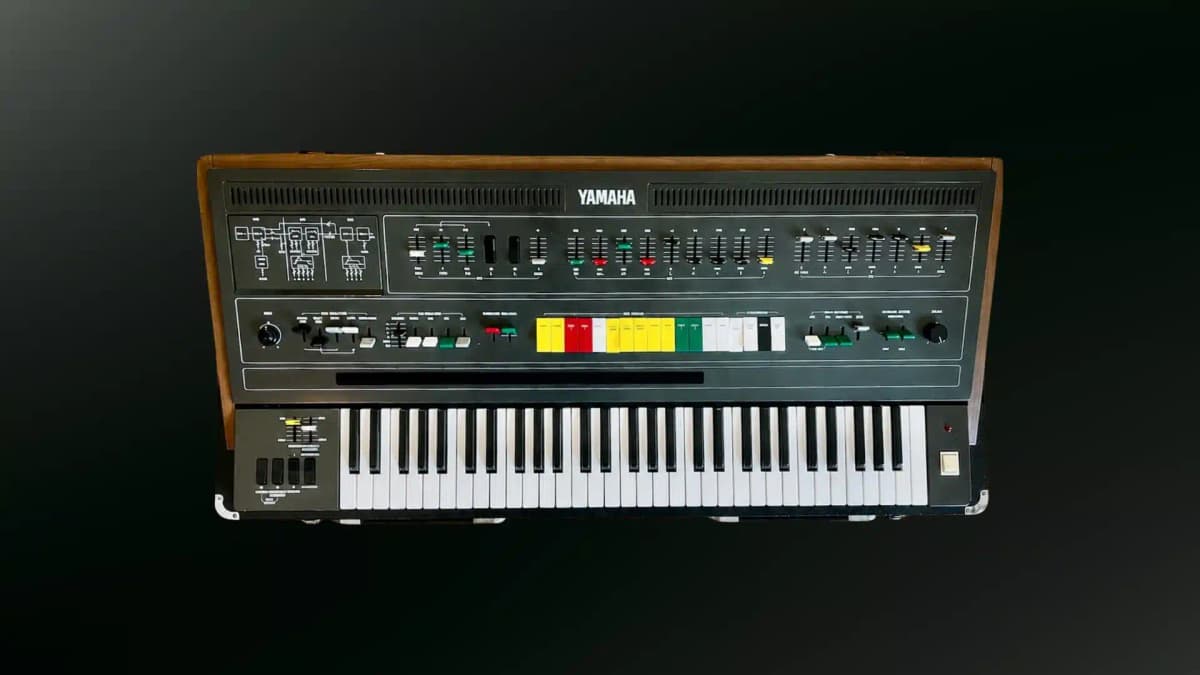
The Yamaha CS-60 is an eight-voice polyphonic analog synthesizer that Yamaha showed at the NAMM show in June 1977 alongside its flagship CS-80. It is essentially one layer of the CS-80’s two-layer voice: each of its eight voices has a single VCO feeding a high-pass and low-pass filter pair and a VCA, played from a 61-key keyboard with aftertouch and a long ribbon controller. It adds 12 factory presets and one user memory to a panel full of lever controls. What makes it matter at a glance is that it offers much of the CS-80’s expressive behavior and tonal character at about half the weight and a much lower price, and it has become one of the most sought-after vintage polysynths in its own right.
Table of Contents
Yamaha CS-60 sound and character
The Yamaha CS-60 sounds bright, lively and elastic, with the slightly unstable, breathing quality that defines Yamaha’s 1970s polysynths. GreatSynthesizers argues that it sounds as lively as the CS-80, crediting part of that character to the absence of auto-tuning: each voice drifts a little on its own, so chords move rather than sit still. With one oscillator per voice it is leaner than the CS-80, and Vintage Synth Explorer’s verdict is that it neither sounds as good nor programs as deeply as the flagship. Players who own both are less categorical, and some owners consider it just as expressive.
The filters shape most of the tone. A high-pass filter runs in series with a low-pass filter, each with its own resonance, so the pair can act as a band-pass and carve hollow, nasal or vocal colors as easily as warm brass. At high resonance they produce the rubbery, unmistakably late-1970s sound GreatSynthesizers associates with the series, and RL Music describes the CS filter resonance as distinctive among polysynths. Pulse and ramp waves can be mixed at the same time, a dedicated LFO handles pulse-width modulation, a sine wave adds weight, and the amplifier can be overdriven.
Its expressive side is what lifts it above many polysynths of the time. Aftertouch can be applied to pitch, filter and amplitude, a brilliance control adds to the touch response, the ribbon gives continuous pitch bends, and the ring modulator moves the sound into bells and metallic textures. Yamaha Synth’s Synthbits feature, built around Mathew Jonson’s own unit, highlights its pads, leads and basses. The overall character is warm, organic and performance-led rather than precise.
Features and architecture
- Manufacturer: Yamaha (Nippon Gakki), Japan
- Year introduced: 1977, shown at the NAMM show in June 1977 alongside the CS-80
- Production years: 1977 to about 1980
- Synthesis type: analog subtractive
- Category: single-layer, eight-voice keyboard polysynth with presets and one user memory
- Polyphony: 8 voices, monotimbral
- Original price: $3,999 in the United States, according to Sound Programming; the CS-80 cost $6,900
- Current market price: serviced European examples have been listed at around €12,500 in 2026, Reverb asking prices have spanned roughly $12,000 to $35,000, and GreatSynthesizers puts typical values at €10,000 to €20,000 and above
- Oscillators: 1 VCO per voice (8 in total) with simultaneous pulse and ramp (sawtooth) waves, dedicated PWM, an added sine wave, and a noise generator
- Filter: series high-pass and low-pass filters per voice, each with cutoff and resonance; ADSR envelope; brilliance control
- LFOs: sub oscillator (Yamaha’s term for the LFO) with multiple waveforms, routable to VCO, VCF and VCA; a separate modulation source for PWM
- Envelopes: separate envelopes for filter and amplifier, with a further envelope for the ring modulator
- Modulation system: ring modulator; touch response routable to pitch, filter and amplitude; ribbon controller for pitch; portamento and glissando
- Sequencer / arpeggiator: none
- Effects: none onboard
- Memory: 12 factory presets built on fixed-resistor tone boards, plus one user memory set with small sliders that mirror the main controls
- Keyboard: 61 keys with monophonic aftertouch; no polyphonic aftertouch; sources disagree on whether it has velocity response (some dealers and owners mention velocity affecting the filters, while GreatSynthesizers attributes velocity only to the CS-80)
- Controllers: long velvet-covered ribbon between the keyboard and the preset switches; foot pedal inputs for volume, sustain and portamento or glissando
- Inputs / outputs: audio output, external input usable for modulation or as a CV input for monophonic lines, and a headphone socket hidden on the underside
- MIDI / USB: none as built; Kenton offers a MIDI retrofit for the CS-50 and Yamaha CS-60
- Display: none
- Dimensions / weight: about 110 cm wide; around 46 kg
- Power: internal power supply; both 110V and 220V market versions are documented in dealer listings
Strengths
- It captures much of the CS-80’s character in a more manageable instrument. Its single-layer voice uses the same family of custom filter and VCA chips, and specialist reviewers describe it as sounding just as lively as the flagship.
- The expressive controls are excellent. Aftertouch, the brilliance control, the ribbon and the foot pedal inputs give a level of real-time control that few polysynths of the 1970s matched.
- The high-pass and low-pass filter pair is unusually versatile, giving band-pass shapes and thin, vocal timbres alongside the expected warm brass and strings.
- Eight voices make it a full polyphonic instrument, unlike the four-voice CS-50, so pads and wide chords are practical.
- The user memory and presets make it usable live. One stored panel sound and 12 factory presets give quick changes without rebuilding every patch.
- The lever-based panel is built for playing, with firm, direct controls that encourage changes during performance.
Limitations
- One user memory is very limited. GreatSynthesizers calls it generous for its day but largely obsolete now, and most sounds still have to be set by hand.
- The presets are of mixed value. Reviewers describe many as charming but only partly usable, and they cannot be edited.
- There is no polyphonic aftertouch and no second layer, the two features most associated with the CS-80’s expressive reputation.
- Tuning stability is a recurring issue, and many surviving units suffer from overheating, drift and worn components.
- It is heavy at around 46 kg, and its size makes it awkward to move or tour.
- Its custom Yamaha chips are hard to replace, so a failed IC can make a repair difficult and expensive.
- Prices have risen sharply, putting a good example well out of reach of most players.
Historical context
The Yamaha CS-60 belongs to the generation of instruments that Yamaha built on technology developed for the GX-1, its three-manual dream machine of the mid-1970s. Perfect Circuit notes that the polyphonic CS models of 1977 all shared that GX-1-derived technology, and Yamaha’s own history explains how the CS series moved its tone generators onto custom integrated circuits, making polyphony far lighter and cheaper. The CS-80 got two complete voice layers, four user memories and polyphonic aftertouch; the CS-60 kept one layer, eight voices and the ribbon, and the CS-50 reduced the idea to four voices.
Yamaha showed the Yamaha CS-60 and CS-80 at NAMM in June 1977, with the Yamaha CS-60 listed at $3,999. It entered a short window in which polyphonic analog synthesizers were becoming practical but programmable memory was still primitive. Yamaha’s presets used tone boards of fixed resistors set to the lever positions, an approach the company’s own history illustrates with a page from the Yamaha CS-60 service manual. A year later Sequential’s Prophet-5 arrived with microprocessor-based memory for every patch, which made the Yamaha CS-60’s single user memory look dated.
Production ended around 1980, as the size, cost and complexity of the CS design shortened the life of the whole family. Yamaha’s next large analog polysynth, the CS-70M of 1981, moved to digital memory, auto-tuning and a built-in sequencer, before FM synthesis took over the company’s line.