

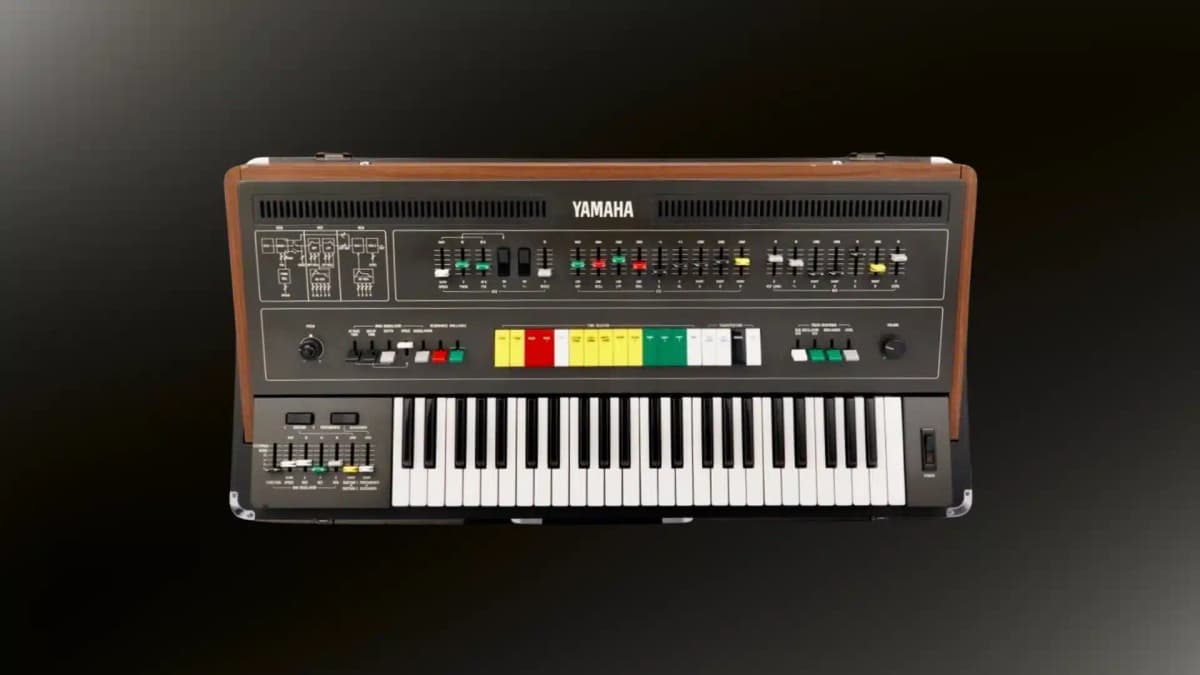
The Yamaha CS-50 is a four-voice polyphonic analog synthesizer that Yamaha introduced in 1977 as the smallest and most affordable polyphonic model in its CS series, below the eight-voice CS-60 and the flagship CS-80. Each voice has a single VCO feeding a resonant high-pass and low-pass filter pair and a VCA, built on the custom Yamaha chips shared across the range, and the 49-key keyboard responds to aftertouch. It offers 13 factory presets alongside a manual panel, but no user memory. What makes it matter at a glance is that it delivers the recognizable tone of Yamaha’s 1970s polysynths in a single-layer, four-voice instrument, which made it the most attainable way to own that sound then and, for a time, on the used market too.
Table of Contents
Yamaha CS-50 sound and character
The Yamaha CS-50 shares the tonal signature of the CS-60 and CS-80: bright, animated and slightly elastic, with a liveliness that GreatSynthesizers attributes partly to the absence of auto-tuning and to each voice running on its own hand-trimmed card. With only one oscillator per voice and gentle 12dB per octave filters, it is thinner than its two-layer flagship, and Vintage Synth Explorer describes its sound as thin for exactly those reasons. Played as an instrument rather than compared on paper, it is strong on leads, plucked tones, brassy swells and resonant, moving pads, and reviewers note that its four independent voice boards give chords an organic, uneven quality.
The filter section is the core of the sound. A high-pass filter feeds a low-pass filter, each with its own cutoff and resonance, so the player can carve a band out of the spectrum or thin the bottom while sweeping the top. Pushed to maximum resonance, the combination produces the rubbery, distinctly late-1970s quality that GreatSynthesizers associates with this generation of CS instruments. The filters do not self-oscillate, but with resonance and Yamaha’s brilliance control at the top of their range, the result tips into grit and distortion, which makes gain staging part of programming it.
A sine wave option adds weight to the bass, and the ring modulator, within easy reach of the playing hand, brings metallic and bell-like colors. The LFO, which Yamaha calls the sub oscillator, can be routed independently to pitch, filter and amplitude and run fast enough to create audio-rate effects. The overall character is vintage and organic rather than clinical, closer to the expressive CS-80 than its specifications suggest.
Features and architecture
- Manufacturer: Yamaha (Nippon Gakki), Japan
- Year introduced: 1977 in most references; GreatSynthesizers, Sonic State and Synthtopia give 1976, and Vintage Synth Explorer notes that it appeared just before the CS-60 and CS-80
- Production years: 1977 to about 1980
- Synthesis type: analog subtractive
- Category: single-layer, four-voice keyboard polysynth; the smallest polyphonic model of the CS series
- Polyphony: 4 voices, monotimbral, no unison mode
- Original price: not reliably documented in English-language sources; the CS-80 cost $6,900 in the United States and the CS-50 sat well below it
- Current market price: Reverb’s price recommendation sits around $4,300, while Reverb asking prices collected by Sound Programming run from about $5,400 to more than $12,000, and a fully serviced UK example was brokered at £8,000
- Oscillators: 1 VCO per voice (4 in total) with sawtooth, square and pulse with PWM, plus a sine wave option; noise generator
- Filter: high-pass and low-pass filters per voice, each 12dB per octave with its own cutoff and resonance; brilliance control; no self-oscillation
- LFOs: 1 sub oscillator (Yamaha’s term for its LFO) with several waveforms, routable by separate levers to VCO, VCF and VCA, capable of audio-rate speeds
- Envelopes: separate envelope generators for the filter and amplifier, with an additional envelope shaping the ring modulator
- Modulation system: ring modulator; monophonic aftertouch routable to filter, pitch and vibrato; portamento; sustain
- Sequencer / arpeggiator: none
- Effects: none onboard
- Memory: 13 factory presets built from fixed-resistor tone boards, plus a manual panel; no user memory
- Keyboard: 49 keys with monophonic, mechanically sensed aftertouch; no velocity; no ribbon controller
- Inputs / outputs: audio and headphone outputs; the full rear-panel complement is not consistently documented in the sources consulted
- MIDI / USB: none as built; aftermarket MIDI kits from Kenton exist for the Yamaha CS-50 and CS-60
- Display: none
- Dimensions / weight: about 99 x 51 x 28 cm (39 x 20 x 11 in) according to a Reverb listing; published weights range from about 76 lb (34 to 36 kg) to 100 lb, in a Tolex-covered wooden case with lid and legs
- Power: internal power supply; voltage depends on the market version
Strengths
- It delivers the CS family sound at a smaller scale. Dealers and reviewers consistently describe it as sharing the tonal character of the CS-60 and CS-80, and some, including GreatSynthesizers, recommend it specifically for that original CS color.
- The dual high-pass and low-pass filters are unusually flexible for a 1970s polysynth, allowing band-pass shapes and thinned-out tones that a single low-pass design cannot produce.
- Aftertouch makes it expressive. Pressure can open the filter, bend pitch or add vibrato, giving leads and swells a responsiveness few four-voice instruments of its time offered.
- The panel is designed for performance. Every function has a dedicated lever or switch, and the LFO and ring modulator controls are placed for real-time playing.
- Its four independent voice cards give it movement. Slight differences between voices make chords breathe in a way that perfectly matched digital voices do not.
- Build quality is high, with a metal faceplate, sturdy levers and a built-in case that protects the instrument.
Limitations
- Four voices and one oscillator per voice limit it. Chords are restricted, the sound can be thin compared with the CS-80, and there is no unison mode to stack voices for leads.
- There is no user memory. Only the 13 presets and the manual panel are available, and sounds must be rebuilt by hand.
- Tuning stability is a known weakness of the CS series, and each voice board carries a dozen or so trimmers that need periodic attention.
- The custom Yamaha chips are the main repair risk; if one fails, replacement parts are scarce and some units become hard to repair.
- It is large and heavy for a four-voice synth, weighing in at roughly 75 to 100 pounds depending on the source.
- Yamaha’s unusual terminology and control layout take time to learn for players used to American synths.
- There is no ribbon controller or polyphonic aftertouch, two features that define the expressive reputation of the larger models.
Historical context
The Yamaha CS-50 grew out of the technology Yamaha developed for the GX-1, its enormous early 1970s dream machine. Perfect Circuit notes that the higher-end polyphonic CS models all shared technology derived from it, and Yamaha’s own history explains that the CS series moved tone generation from transistor circuits to custom integrated circuits, which cut weight and cost enough to bring polyphony to individual musicians. The CS-50 represented the smallest step on that ladder: one layer, four voices and 49 keys.
Its exact debut is reported differently. Several sources, including GreatSynthesizers, place its presentation in 1976 as the first polyphonic CS instrument, while most databases list 1977, the year the CS-60 and CS-80 were shown at the NAMM show in June. Either way, it entered a market where polyphony was rare and expensive. Oberheim’s modular Four Voice was available, and Sequential’s microprocessor-controlled Prophet-5 would arrive in 1978 with user memory, a feature the Yamaha CS-50 lacked.
Yamaha kept the Yamaha CS-50 in production until about 1980. The arrival of programmable, microprocessor-scanned polysynths, along with the size and cost of the CS design, shortened the life of the whole family, and Yamaha shifted to models with patch memory such as the CS-70M, before turning to FM synthesis. The CS-50 had no direct four-voice successor.