

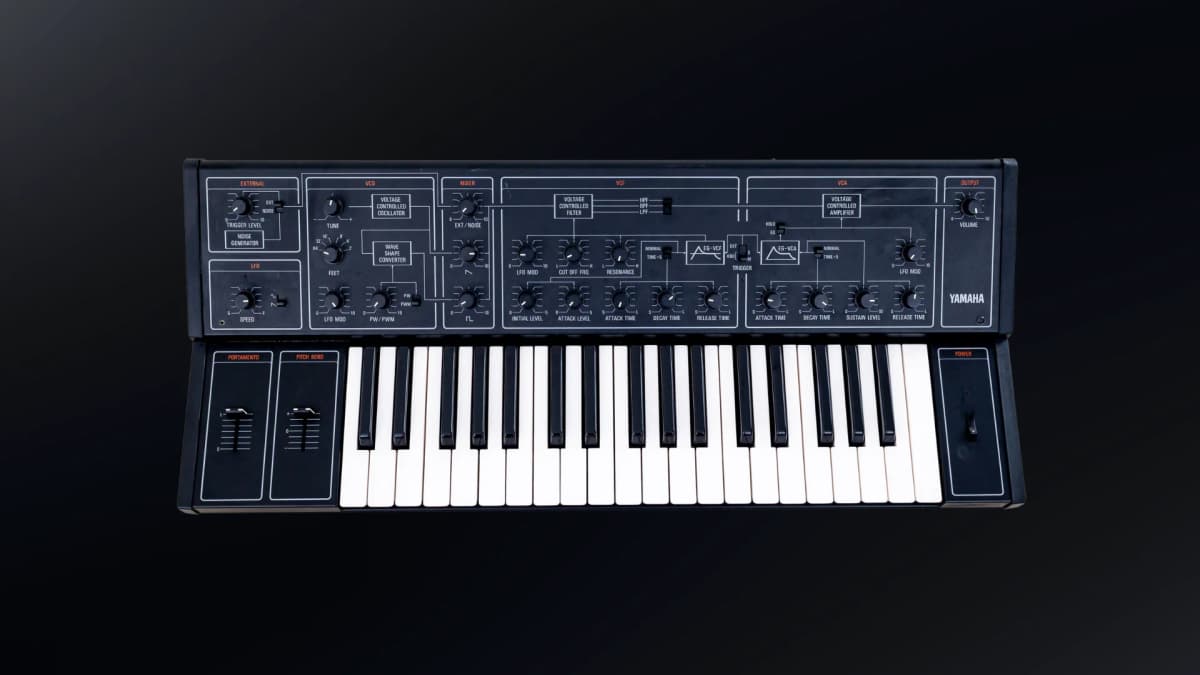
The Yamaha CS-10 is a monophonic analog synthesizer that Yamaha introduced in 1977 as the entry point of its expanding CS series, alongside the two-oscillator CS-30. It has one VCO with sawtooth, variable-width pulse and noise, a resonant multimode filter switchable between low-pass, band-pass and high-pass, two envelopes including Yamaha’s distinctive Initial Level and Attack Level design for the filter, an LFO, a 37-note keyboard and CV and trigger connections. Everything sits on a clearly labeled panel with no presets and no memory. It matters as one of the most widely used low-cost Yamaha analogs: a compact, readable synth that gave many players their first taste of the CS sound.
Table of Contents
Yamaha CS-10 sound and character
The Yamaha CS-10 sounds smooth, slightly hollow and musical rather than aggressive. Sonicstate’s user reviewer calls its sound warm and original, and one Gearspace user compared its messy but musical character to that of the CS-80, which is covered in its own article on this site. With only one oscillator, it cannot produce the thick, detuned stacks of two- and three-oscillator monosynths; instead, its strengths lie in clean basses, plucked sequences, reedy leads and filter-driven effects. Pulse-width control gives the single oscillator more movement than its specification suggests.
The filter is the center of the instrument. It is a gentle 12dB/octave, two-pole design according to dealer specifications, switchable between low-pass, band-pass and high-pass, and its sweeps are smooth rather than cutting. A MATRIXSYNTH demo noted that it does not self-oscillate, so the screaming resonant tones of a Minimoog or MS-20 are not on offer. The band-pass and high-pass modes, unusual on cheap monosynths of the time, make thin, nasal and percussive sounds easy, and the external audio input lets other sources run through the filter.
Its envelopes add a Yamaha-specific nuance. Yamaha’s own history illustrates the Yamaha CS-10 as an example of its IL/AL envelope generator, in which Initial Level and Attack Level controls set the filter’s starting point and peak independently, rather than assuming that the attack begins from zero. This makes brass-like swells, soft plucks and tones that fall rather than rise easier to shape than on a basic ADSR, and a 5x switch changes the envelope time range.
In character the Yamaha CS-10 sits between the smooth Yamaha house sound and the simpler Japanese entry-level monosynths of the late 1970s. Users comparing it with other instruments have described the MS-20 as nastier and the SH-101 as sharper, which is a fair summary of where it fits.
Features and architecture
- Manufacturer: Nippon Gakki (Yamaha), Japan
- Year introduced: 1977 according to Yamaha’s synth chronology and most references; some sources, including Sonicstate, give 1978 or 1979
- Production years: from 1977; a firm end date is not consistently documented, though the CS-15, CS-5 and later CS models effectively superseded it
- Synthesis type: analog subtractive
- Category: compact monophonic keyboard synthesizer
- Polyphony: monophonic
- Original price: not consistently documented; Yamaha describes the CS-10 and CS-30 as giving musicians more control at a lower cost
- Current market price: Reverb listings in 2026 run from about $490 to $850 for working units, with clean cased examples at the top of that range
- Oscillators: one VCO with sawtooth and variable-width pulse waves, plus white noise; footage selector with six positions; pulse-width modulation
- Filter: resonant multimode VCF, switchable low-pass, band-pass and high-pass, described by dealers as 12dB/octave; does not self-oscillate; brilliance control
- LFOs: one LFO with sine and sawtooth waves, routable to pitch, pulse width, filter cutoff and volume
- Envelopes: two; Vintage Synth Explorer and SMEM describe ADSR-type envelopes with one dedicated to the VCA, while Yamaha uses the Yamaha CS-10 to illustrate its IL/AL (Initial Level, Attack Level) filter envelope; a 5x switch changes the time range
- Modulation system: LFO to VCO, VCF and VCA; envelope to filter with IL/AL levels; portamento slider spanning up to one octave of glide according to several references
- Sequencer / arpeggiator: none
- Effects: none onboard
- Memory: none; a patch chart shared with the CS-30 circulates among owners
- Keyboard: 37 keys (three octaves), no velocity or aftertouch
- Controllers: pitch bend slider with a one-octave range that stays where it is left rather than springing back; portamento slider
- Inputs / outputs: mono 1/4″ audio output, external audio input to the filter, Key Volt (CV) in and out, Trigger in and out
- MIDI / USB: none; CV uses Yamaha’s Hz/V scaling and the trigger input uses S-trig, so standard V/oct gear needs a converter; Kenton offers a MIDI retrofit kit
- Display: none
- Dimensions / weight: published figures are not consistently documented; owners describe it as larger than its features suggest
- Power: internal supply with a voltage selector for 110, 130, 220 and 240V according to Sonicstate
Strengths
- The multimode filter is unusually flexible for a budget monosynth. Low-pass, band-pass and high-pass modes give it thin, nasal and percussive tones that many single-mode competitors could not produce.
- The IL/AL filter envelope offers more shaping than its size suggests. Setting the start and peak levels independently makes falling, swelling and brass-like contours straightforward.
- The panel is completely hands-on. Sonicstate counts 22 knobs and eight switches, every parameter has its own control, and the left-to-right layout makes it a clear teaching instrument.
- The external input turns it into a filter and envelope processor for drum machines, other synths or recorded audio.
- CV and trigger connections, in and out, let it be sequenced, slaved to other instruments or retrofitted with MIDI, keeping it usable in modern setups.
- Its sound is warm and musical, with a family resemblance to larger Yamaha instruments at a far lower price.
Limitations
- One oscillator limits its range. It cannot produce detuned, multi-oscillator tones or oscillator sync effects.
- The filter does not self-oscillate and its two-pole slope is gentle, so it lacks the bite of four-pole designs for aggressive bass and acid lines.
- Yamaha’s Hz/V and S-trig control standard is incompatible with V/oct gear without a converter, and Sonicstate’s reviewer notes that the portamento and pitch bend sliders do nothing when it is played over CV.
- The pitch bend slider does not return to center, which makes expressive bends awkward compared with a wheel or spring-loaded lever.
- There is no memory and no velocity or aftertouch, so it suits studio patching more than fast live changes.
- It is physically bulky for a one-oscillator synth, and its age means sliders, pots and keyboard contacts often need cleaning or servicing.
Historical context
By the mid-1970s Yamaha had moved from organs into synthesizers through the SY-1 and SY-2, and in 1975 the CS combo synths became the first non-Electone products to use that technology, with integrated circuits replacing the earlier transistor assemblies. In 1977 the company expanded the line from the polyphonic CS-50, CS-60 and CS-80 down to inexpensive monophonic instruments. Yamaha’s own history says that in the latter half of the decade it broadened the CS series with low-priced monosynths, and its 1970s timeline presents the Yamaha CS-10 and two-oscillator CS-30 as updated designs giving musicians more control at a lower cost.
The Yamaha CS-10 arrived into a market crowded with affordable Japanese and American monosynths, from Roland’s SH series and Korg’s MS line to ARP and Moog models. Its distinguishing points were the multimode filter, the IL/AL envelope and a clean, all-knobs panel. The CS-30, launched alongside it, added a second oscillator, and a CS-30L variant appeared the same year.