

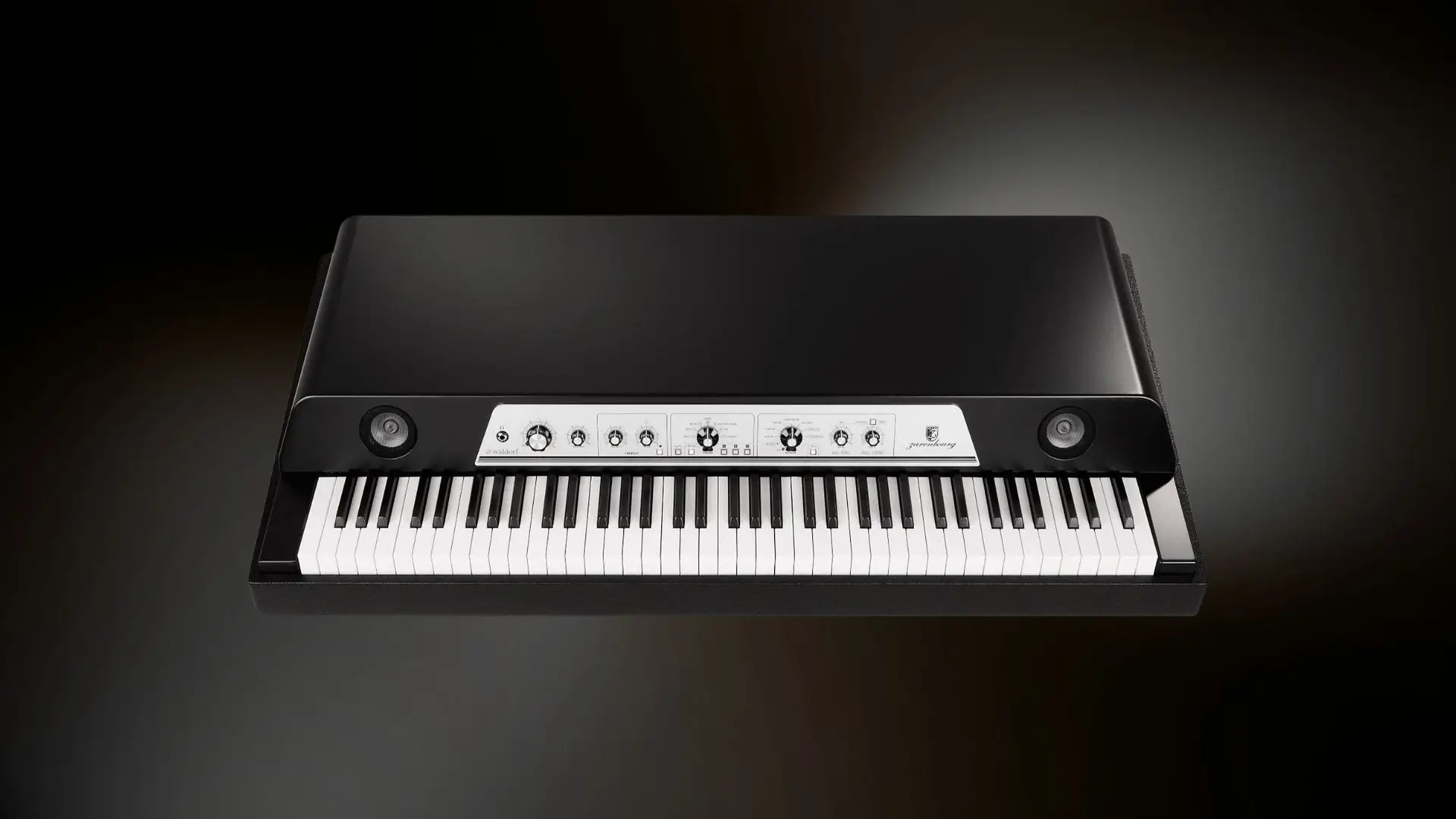
The Waldorf Zarenbourg is a 76-key digital electric piano introduced by Waldorf in the mid-2000s and commercially associated with the early 2010s, built around physical modeling, sample playback, FM synthesis, integrated effects, and a built-in 2.1 speaker system. It was not a typical workstation, not a Rhodes clone in the strict electromechanical sense, and not a standard stage piano designed only for portability. It was Waldorf’s attempt to make a modern electric piano feel like a complete object: a playable instrument, a small sound system, a visual statement, and a platform on which another synth or laptop could literally sit.
Table of Contents
Waldorf Zarenbourg sound and character
The Waldorf Zarenbourg’s sound identity is centered on electric piano behavior rather than broad synthesizer architecture. Its most important voices are modeled electro-mechanical keyboard sounds: tine-like electric pianos, reed-style electric pianos, electric grand territory, clavinet-style articulation, and FM piano colors. The acoustic grand component is sample-based, while the electric-piano side relies on modeling to reproduce the interactive behavior of hammers, tone sources, pickups, and performance dynamics.
In practice, the Waldorf Zarenbourg is at its strongest when treated as a tactile electric piano rather than as a general-purpose digital piano. The modeled tones are clean, polished, and controlled, but they are designed to respond like performance instruments: tremolo gives movement, auto-wah adds funk vocabulary, overdrive roughens the attack, and chorus or phaser places the sound immediately in the language of 1970s and 1980s keyboard recording. It does not have the unruly mechanical noise of a poorly maintained vintage Rhodes or Wurlitzer, and that matters. The Waldorf Zarenbourg is less about historical instability and more about a curated version of vintage feel.
Its character also comes from the speaker system. The built-in EMES 2.1 design means the instrument is not merely producing a line-level signal; it is projecting itself into the room. That makes the Waldorf Zarenbourg closer in spirit to a suitcase electric piano than to a thin, portable stage keyboard. The player hears the instrument as an object in space, not just as a preset through headphones or PA. This gives it a domestic and performative quality that most digital pianos avoid.
The absence of an LCD is equally important. Waldorf deliberately made the instrument feel immediate, with knobs, selectors, and a minimal front panel. That choice narrows the Waldorf Zarenbourg’s personality: it is not a deep menu machine for endless patch navigation. It wants to be switched on, touched, and played.
Features and architecture
- Manufacturer: Waldorf Music GmbH.
- Year: Introduced by Waldorf in 2006; production-era documentation and market listings place the instrument mainly in the early 2010s.
- Production years: Market references commonly list 2012–2020, though this should be read as a marketplace/catalog window rather than a factory-confirmed production statement.
- Synthesis type: Digital physical modeling, sample playback, and FM synthesis.
- Category: Digital electric piano / stage piano with built-in speaker system.
- Polyphony: Up to 100 voices.
- Original price and current market price: Early reporting placed the proposed MSRP around $5,000; later U.S. retail listings showed prices around $3,999.99 to $4,299.99. Recent used-market signals are closer to the $2,000 range, but availability is thin.
- Oscillators: No conventional subtractive oscillator section; tone generation is based on modeled electric-piano engines, sample playback, and FM synthesis.
- Filter: No general synthesizer filter architecture is specified; filter-like movement is available through effects such as auto-wah.
- LFOs: No general-purpose LFO system is specified; tremolo provides periodic amplitude modulation with mono or stereo operation.
- Envelopes: No conventional user-facing ADSR envelope section is specified in the verified hardware documentation.
- Modulation system: Performance-oriented control through tremolo, effects parameters, sustain pedal behavior, expression pedal control, and software editing.
- Sequencer / arpeggiator: No built-in sequencer or arpeggiator is specified.
- Effects: Tremolo, chorus, flanger, phaser, reverb, echo, auto-wah, equalizer, and overdrive.
- Memory: 4 GB direct streaming sample memory; 7 preset sounds and 21 user locations.
- Keyboard: 76 weighted hammer-action keys; Waldorf identifies the keybed as a Fatar TP/40.
- Inputs / outputs: Stereo headphone output, stereo line output, stereo line input, sustain pedal input, expression pedal input, S/PDIF digital output, SDHC card slot, and power connection.
- MIDI / USB: MIDI In, MIDI Thru, MIDI Out, and USB MIDI.
- Display: LCD-free interface.
- Dimensions / weight: 120 cm wide, 62 cm deep, 83 cm high; 38 kg.
- Power: 100–230 V AC input; maximum power consumption 75 W; standby listed as 0.0 W.
- Speaker system: 2 × 20 W wide-band loudspeakers plus 1 × 20 W subwoofer with digital crossover network.
- Finish and construction: Aluminum hood, birch multiplex chassis, low-vibration MDF speaker enclosures, aluminum front panel, chrome-plated legs, and off-white standard finish with optional color variants.
Strengths
- It treats the electric piano as a complete instrument rather than a category of presets. The combination of hammer action, built-in speakers, tremolo, effects, and furniture-like chassis makes the playing experience more integrated than on a typical stage board.
- The physical modeling engine gives the main electric-piano sounds a performance-oriented logic, especially for tine, reed, and clavinet-style sounds where response and articulation matter more than static sample realism.
- The EMES speaker system is central to the concept. It makes the Waldorf Zarenbourg usable as a self-contained practice, studio, or small-room performance instrument, while also reinforcing the suitcase-piano analogy.
- The LCD-free interface is a serious design decision. It reduces visual distraction and makes the instrument feel closer to older electro-mechanical keyboards, even though the underlying engine is digital.
- The stereo input is unusually practical. A laptop, synth module, or another keyboard can be routed through the Waldorf Zarenbourg’s internal speakers, turning it into a small integrated keyboard hub.
- The chassis design gives the instrument visual authority. It is not portable in the modern gigging sense, but it has the physical confidence of an object meant to stay in a room, studio, or performance space.
- The effects section is musically appropriate rather than generic. Chorus, phaser, auto-wah, overdrive, echo, and tremolo all belong naturally to the electric-piano vocabulary.
Limitations
- At 38 kg, the Waldorf Zarenbourg is heavy for a digital instrument. Its built-in speakers and furniture-like design are part of its appeal, but they also make it far less convenient than most modern stage pianos.
- It is not a general Waldorf synthesizer in the Microwave, Q, Blofeld, Iridium, or Quantum sense. Buyers looking for wavetable synthesis, deep modulation, filters, and multi-engine sound design may find it too specialized.
- The memory structure is limited by modern standards, with only 7 preset sounds and 21 user locations.
- The lack of a screen helps the performance concept but restricts onboard editing feedback. Deeper editing depends on software rather than an extensive hardware interface.
- Its acoustic piano role is secondary to its electric-piano identity. The instrument is more convincing as a characterful electric piano system than as a replacement for a dedicated modern digital grand piano.
- Current availability is inconsistent. Because it is discontinued and relatively uncommon, buyers cannot rely on a steady used market.
- The integrated-speaker concept is less attractive for players who always use in-ear monitors, a PA, or studio monitors. In those contexts, part of the Waldorf Zarenbourg’s physical argument becomes redundant.
- Its size and shape are elegant in a room but awkward for musicians who need compact transport, quick setup, or lightweight touring gear.
Historical context
The Waldorf Zarenbourg occupies an unusual place in Waldorf history. Waldorf is best known for wavetable synthesis, beginning with the Microwave lineage and continuing through instruments such as the Wave, Q series, Blofeld, Iridium, and Quantum. Against that background, the Waldorf Zarenbourg looks like a deliberate detour: a digital electric piano from a company associated with synthetic sound design rather than piano emulation.
That detour is precisely what makes it interesting. When Waldorf first presented the Zarenbourg, the market was already full of digital stage pianos, workstation keyboards, software instruments, and increasingly capable laptop-based rigs. The obvious route would have been to make a portable board competing with Nord, Yamaha, Roland, or Korg. Waldorf chose a stranger route: a premium, retro-modern electric piano with integrated amplification and a strong visual identity.
The timing also matters. In the 2000s and early 2010s, many companies were trying to repackage vintage keyboard culture for modern players. Some pursued authentic electromechanical revival; others leaned into sample libraries and stage keyboards. The Waldorf Zarenbourg sat between those poles. It did not bring back tines, reeds, pickups, and mechanical maintenance. Instead, it tried to recreate the cultural role of the vintage electric piano as an object with presence.
It also arrived after Waldorf’s corporate turbulence and rebirth. Waldorf’s later identity would again be dominated by synthesizers, but the Waldorf Zarenbourg showed that the revived company was willing to make eccentric, design-heavy instruments rather than only safe, compact synth products.