

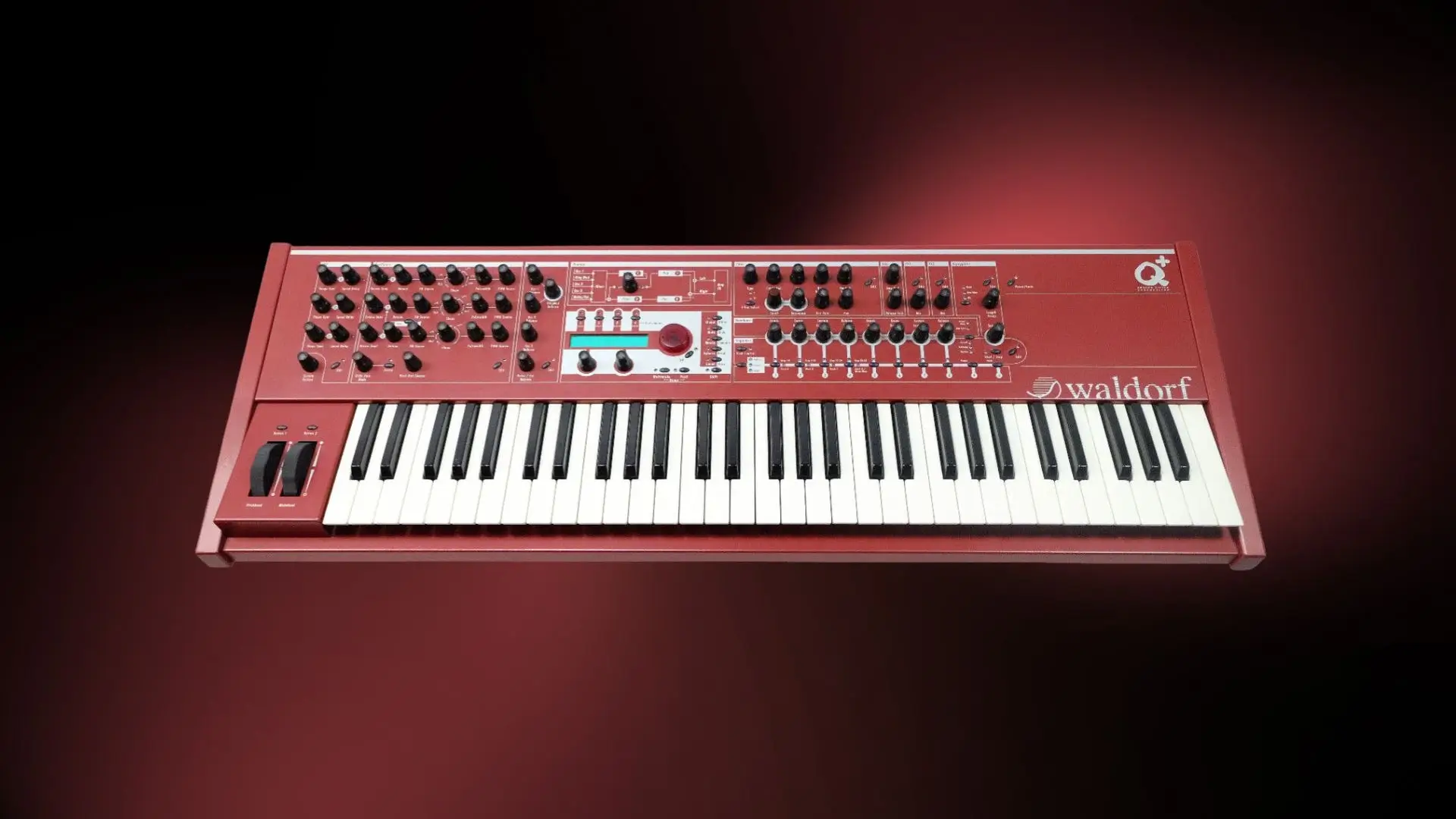
The Waldorf Q+ is a hybrid keyboard synthesizer introduced around the early 2000s, with Musikmesse 2002 standing as the clearest documented public emergence of the Waldorf Q+. It took the architecture of the Waldorf Q series (a deep, knob-heavy virtual-analog synthesizer) and added 16 real analog low-pass filters, creating one of Waldorf’s most unusual attempts to reconcile digital control, high polyphony, wavetable inheritance, and analog filtering in a single flagship keyboard. It matters because it was not simply a more expensive Q; it was Waldorf revisiting the hybrid logic that had shaped its earlier identity, but in the language of the virtual-analog era.
Table of Contents
Waldorf Q+ sound and character
The Waldorf Q+ sounds like a machine built at the point where late-1990s digital confidence met an older German fascination with hybrid synthesis. Its foundation is clean, precise, and highly programmable rather than loosely vintage. The oscillators, modulation system, routing options, comb filters, wavetable elements, and effects give it a sharp architectural quality: it is a synthesizer that often sounds designed rather than merely played.
Its most characteristic territory is large animated pads, metallic digital textures, complex rhythmic patches, aggressive leads, synthetic basses, evolving arpeggios, and sounds that sit somewhere between subtractive synthesis and digital sound design. It can produce conventional analog-style patches, but reducing it to “analog warmth” misses the point. The Q+ is more interesting when it exploits contrast: digital oscillators into analog filters, comb filtering against low-pass smoothing, sharp modulation against broad polyphonic movement.
The 16 analog filters give the Waldorf Q+ a specific claim that the regular Q does not have. They do not turn the Q+ into a vintage polysynth in the Prophet or Jupiter sense. Instead, they provide an alternate filtering path inside a digital architecture. That distinction is important. The Waldorf Q+ keeps the clarity, complexity, and sometimes icy precision associated with Waldorf’s digital side, but it can route selected voices through analog low-pass circuitry, including configurations where two analog filters are used together for steeper filtering. The result is not a nostalgic analog replica; it is a controlled hybrid system with a distinctly Waldorf personality.
Features and architecture
- Manufacturer: Waldorf Music / Waldorf-Music AG era.
- Year: Publicly associated with the early 2000s; Musikmesse 2002 is the strongest documented appearance.
- Production years: Not cleanly documented in reliable public sources. The ruby-red Q+ appeared in the early 2000s, and a Phoenix Edition appeared later, with 2008 repeatedly cited for that edition.
- Synthesis type: Hybrid virtual-analog / digital subtractive synthesis with wavetable elements and 16 analog low-pass filters.
- Category: Professional keyboard synthesizer; flagship Q-series variant.
- Polyphony: Up to 100 voices when using the digital architecture; up to 16 voices can be routed through the analog low-pass filters.
- Original price: Not confidently verified from primary launch documentation. A later documented Phoenix Edition street price was listed at €2,699 in March 2008.
- Current market price: No stable current price can be stated with confidence. Reverb currently shows no active Q+ listings and no available estimated value.
- Oscillators: Up to five oscillators per voice according to Waldorf’s legacy specification, including pulse with pulse-width modulation, sawtooth, triangle, sine, two 128-wave wavetables, sub-oscillator options tied to alternate waves, noise, ring modulation, FM, and oscillator sync.
- Filter: Two independent multimode digital filters per voice, including low-pass, band-pass, high-pass, notch, comb, and PPG-style filter options; Q+ adds 16 analog filters with resonance and analog distortion.
- Analog filter routing: Up to 16 voices can be routed through analog low-pass filters; two analog filters can be used simultaneously per voice for a maximum 48 dB slope.
- LFOs: Three LFOs capable of reaching audio-rate speeds above 2500 Hz.
- Envelopes: Four enhanced ADSR-style envelopes with loop and one-shot behavior.
- Modulation system: Sixteen-slot modulation matrix, pre-routed modulation destinations, selectable modulation sources, and modulation update rates in the audio range.
- Sequencer / arpeggiator: Programmable arpeggiator with user patterns, accents, timing, swing, glide, chords, and related performance controls; 32-step polyphonic step sequencer; 100 step-sequencer patterns.
- Effects: Two effects per sound, including reverb, surround delay, tap delay, chorus, flanger, phaser, distortion, delay, multi-FX, and a 25-band vocoder.
- Memory: 300 single programs, 100 multi programs, and 20 drum maps.
- Keyboard: Five-octave, 61-key keyboard with velocity and aftertouch.
- Controls: 58 endless dials, 39 editing buttons, pitch-bend wheel, modulation wheel, and two assignable control buttons.
- Inputs / outputs: Six analog outputs arranged as three stereo outs, two analog inputs as one stereo input, coaxial S/PDIF digital output, two switch inputs, and two CV inputs.
- MIDI / USB: MIDI In, Out, and Thru. No USB port is listed in the official legacy specification.
- Display: 2 x 20 character display.
- Dimensions / weight: 995 mm wide, 135 mm high, 360 mm deep. A confidently verified Q+ weight was not found in the sources checked.
- Power: Built-in universal-voltage power supply.
Strengths
- A rare hybrid concept with a real architectural purpose: The Q+ was not merely a Q with a new color. The addition of 16 analog filters changed the Waldorf Q+’s signal-path possibilities and made it one of the most ambitious hybrid keyboards of its period.
- Deep synthesis without abandoning hands-on control: The 58 endless rotaries and large front-panel layout give the Q+ a programming experience closer to an instrument than a menu workstation, even though the synthesis engine is unusually deep.
- Strong identity for evolving and animated sounds: The combination of multiple oscillators, wavetable elements, comb filters, audio-rate modulation, a modulation matrix, arpeggiator, and step sequencer makes the Q+ especially strong for moving pads, rhythmic textures, and complex electronic timbres.
- High polyphony in digital mode: Up to 100 voices gave the Q+ a scale that many analog and virtual-analog instruments of its era could not match, especially for layered pads and multitimbral work.
- Analog filters used as color rather than nostalgia: The analog filters are most compelling when treated as a selective tone-shaping resource inside a digital system, not as an attempt to make the Waldorf Q+ behave like a 1970s polysynth.
- A serious studio instrument: Multiple outputs, external audio input, S/PDIF, MIDI, CV inputs, multitimbrality, and deep patch memory make it more than a performance keyboard; it was designed for complex studio integration.
Limitations
- Analog-filter polyphony is limited: The headline 100-voice capability applies to the broader digital architecture. When analog filters are used, the relevant analog-filter path is limited to 16 voices, and using two analog filters per voice reduces the practical allocation further.
- The analog filters do not automatically make it “more analog” in every patch: The Q+ remains fundamentally a digitally controlled, digital-oscillator instrument with optional analog filtering. Anyone expecting it to replace a classic VCO polysynth may misunderstand its character.
- Scarcity makes it hard to evaluate and buy rationally: The Q+ appears infrequently on the used market, and the lack of stable price data makes valuation difficult.
- Service and long-term maintenance are real concerns: It is a complex discontinued hybrid instrument from the early 2000s, with digital control, analog filter boards, custom hardware, and operating-system considerations.
- No modern USB workflow: MIDI remains the core connection method. That is historically normal for the Waldorf Q+, but it makes integration less immediate than on contemporary synths.
- Interface depth can still become dense: The panel is generous, but the Waldorf Q+’s synthesis engine is deep enough that serious programming still demands time, menu navigation, and understanding of Waldorf’s architecture.
Historical context
The Q+ belongs to a very specific moment in synthesizer history. The late 1990s and early 2000s were the high period of hardware virtual analog: Clavia, Access, Novation, Roland, Yamaha, Korg, and Waldorf were all exploring how digital signal processing could imitate, extend, or reorganize subtractive synthesis. Waldorf entered that field with the Q in 1999, a bright, assertive, professional virtual-analog instrument with unusually extensive hands-on control.
The Q+ arrived after the Q had already established the platform. Its significance lies in what Waldorf chose to add. Rather than simply expand presets, add a cheaper version, or chase workstation conventions, Waldorf built a hybrid extension with real analog filtering. This connected the Q+ backward to Waldorf’s earlier hybrid lineage, especially the company’s association with PPG-derived wavetable thinking and instruments that combined digital tone generation with analog signal treatment.
The timing also matters because the Q+ appeared shortly before Waldorf’s mid-2000s corporate difficulties and before the later rebirth of the brand under Waldorf Music GmbH. In that sense, the Q+ stands near the end of one chapter and the beginning of another. It carries the ambition of the original Waldorf era: technically dense, visually distinctive, expensive, and somewhat uncompromising.
The later Phoenix Edition adds another layer to the story. Its very name suggested return and survival, and it appeared in a period when Waldorf’s legacy instruments were being reconsidered by musicians who had lived through the software-synth explosion but still valued dedicated hardware. The Q+ therefore occupies both an original-era position and a later cult-object position.