

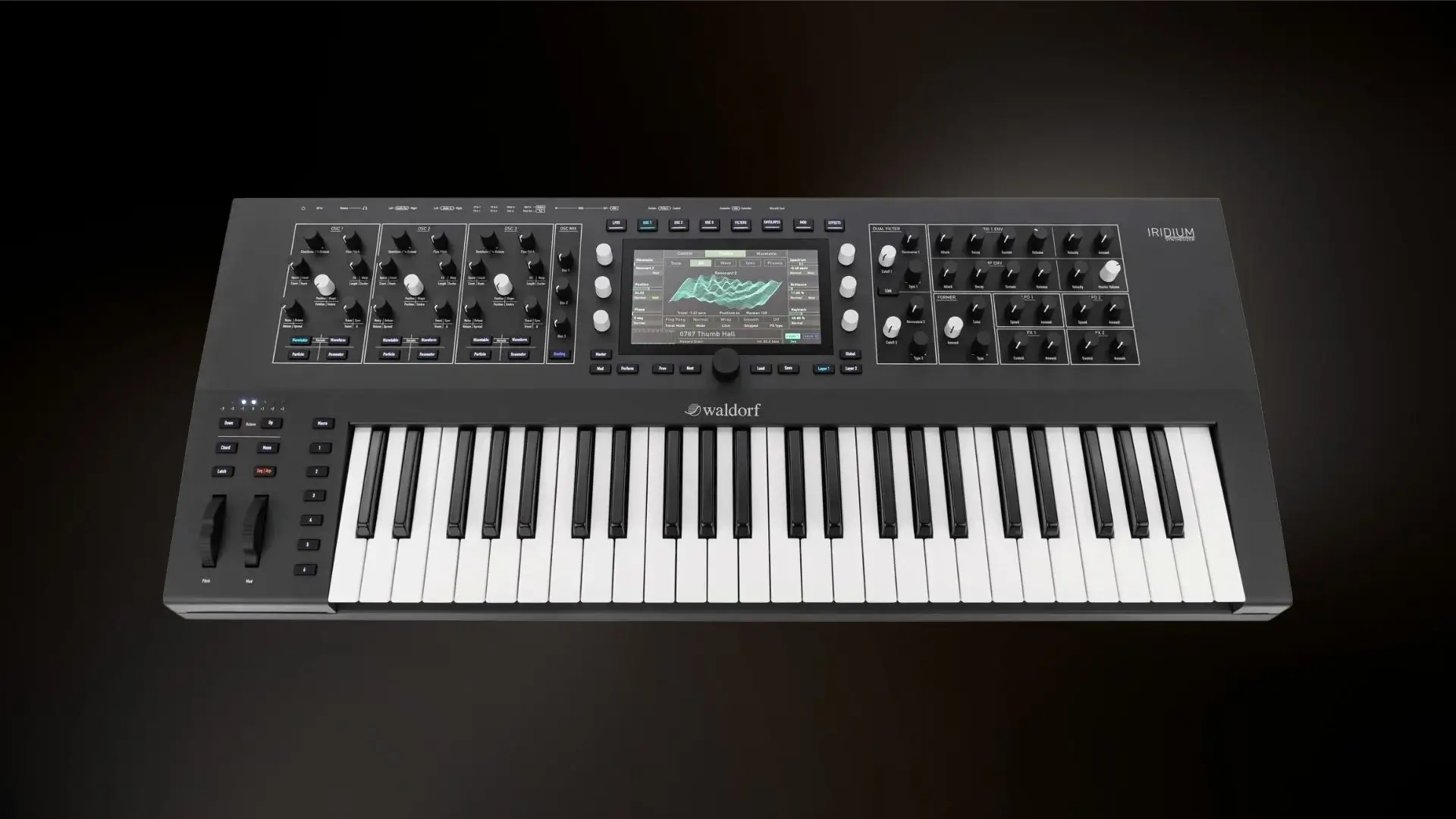
The Waldorf Iridium Keyboard is a 16-voice digital polysynth introduced in 2022 as the keyboard version of Waldorf’s Iridium platform, itself derived from the Quantum synthesis engine. Built around three digital oscillators per voice, multiple synthesis methods, a polyphonic-aftertouch Fatar keybed, and a more performance-oriented control surface than the earlier desktop unit, it matters because it translates an unusually deep sound-design architecture into an instrument that can actually be played, shaped, and performed in real time rather than merely programmed.
Table of Contents
Waldorf Iridium sound and character
In practice, the Iridium Keyboard sounds expansive, precise, and deliberately modern. It is capable of huge evolving pads, spectral drones, granular textures, hard-edged digital basses, metallic FM-like motion, and unusually animated stereo timbres that feel more like constructed environments than conventional patches. This is not a synthesizer whose personality comes from one sweet spot. Its identity comes from range.
That range is tied directly to the architecture. Waldorf’s wavetable legacy is still present, but here it sits beside virtual-analog waveforms, sampling and granular processing, resonator-based sound generation, and the Kernel engine, which turns one oscillator into a small FM network. The result is a synthesizer that can move from recognizably Waldorf glass, sweep, and bite into stranger terrain without changing instruments or abandoning a coherent interface.
What keeps the Iridium Keyboard from becoming merely clinical is the way its digital engine is organized around movement. The true stereo signal path, deep modulation system, multi-engine oscillators, and polyphonic aftertouch make it especially strong at sounds that bloom, shift, and respond under the fingers. It can absolutely do static tones, but it feels most convincing when the patch is in motion.
It does not lean naturally toward the loose, pre-shaped warmth associated with classic VCO polysynths. If the Waldorf Iridium has a bias, it is toward articulation, control, and sculpted detail. That makes it especially attractive to players working in ambient, soundtrack, experimental electronic, IDM, modern prog, and any production context where timbral development matters as much as harmonic content.
Features and architecture
- Manufacturer: Waldorf Music
- Year: 2022
- Production years: 2022 to present
- Synthesis type: Digital multi-engine synthesis combining wavetable, virtual analog waveform synthesis, sampling and granular processing, resonator synthesis, and Kernel-based FM-style synthesis
- Category: Flagship digital performance polysynth
- Polyphony: 16 voices, duo-timbral
- Original price and current market price: Introduced at €2,989; currently listed by Waldorf at €2,699, with current dealer pricing varying by region and U.S. retail often sitting notably higher
- Oscillators: 3 digital oscillators per voice, each with five core synthesis modes
- Filter: Two main stereo digital filters plus an additional digital Former stage, with multiple Waldorf filter models and flexible routing
- LFOs: 6
- Envelopes: 6
- Modulation system: 40-slot modulation matrix plus Komplex Modulator and macro controls
- Sequencer / arpeggiator: Arpeggiator and step sequencer with up to 32 steps for notes and parameters
- Effects: Five-slot master effects rack, master compressor, plus onboard shaping tools such as drive, bitcrusher, comb, and ring modulation in the broader signal path
- Memory: 1,680 sounds at launch, 7,000 patch slots, and 2 GB user sample flash memory
- Keyboard: 49-key Fatar TP/8SK semi-weighted keybed with velocity and polyphonic aftertouch
- Inputs / outputs: Two audio inputs, two audio outputs, headphone output with gain control, sustain and control pedal inputs, microSD slot, plus CV, gate, trigger, and clock connectivity
- MIDI / USB: DIN MIDI In/Out/Thru, USB Type B for computer connection, USB Type A host for storage and MIDI devices, and MPE support
- Display: Industrial-grade touchscreen interface
- Dimensions / weight: 851 x 355 x 110 mm; 14 kg
- Power: External power supply, wide-range 110 to 240 V operation, not USB powered
Strengths
- It turns a very deep synthesis system into a genuinely playable instrument. The keyboard version is not just an Waldorf Iridium with keys attached; the expanded panel, macro buttons, wheels, and polyphonic aftertouch make the engine feel physically performable.
- Its sonic range is unusually broad without becoming incoherent. Many multi-engine synths feel like bundles of disconnected methods, but the Iridium Keyboard keeps wavetable, granular, resonator, virtual analog, and Kernel synthesis inside one integrated workflow.
- Polyphonic aftertouch is central, not decorative. On this instrument, expressive control is part of the architecture, not a bonus feature buried behind MIDI implementation charts.
- It excels at motion-rich sound design. Pads, drones, evolving textures, cinematic layers, and complex hybrid patches are where it becomes especially persuasive.
- The interface balances modern touchscreen editing with enough hardware access to avoid feeling trapped in menus. That matters on a synth this deep.
- Waldorf’s long wavetable lineage is present, but not limiting. The Waldorf Iridium can sound unmistakably Waldorf, yet it is not boxed into nostalgia or historical reenactment.
Limitations
- It remains an expensive instrument, and regional pricing can make it feel dramatically more expensive in some markets than in others.
- Its sound is not automatically “vintage” in the easy, immediate sense some players expect from analog polysynths. It rewards programming and intention more than instant retro gratification.
- Duo-timbrality is useful, but the output structure is still less elaborate than some players may want for complex live or studio routing.
- The architecture is approachable by flagship standards, but it is still deep enough to intimidate casual users or anyone looking for a simpler preset-first instrument.
- At 14 kg, it is portable for a flagship, but not lightweight in the casual gigging sense.
- Its 2 GB user sample memory is practical, though no longer especially generous by the standards of more sample-heavy contemporary flagships.
Historical context
The Iridium Keyboard arrived in March 2022, two years after the desktop Waldorf Iridium and four years after the Quantum established Waldorf’s modern flagship synthesis platform. That timing mattered. The Quantum had reasserted Waldorf as a serious high-end manufacturer, but it did so with a large, expensive hybrid instrument that remained somewhat aspirational. The 2020 Waldorf Iridium desktop brought much of that engine into a smaller and more affordable format, but it also traded away the traditional keyboard-centered identity of a flagship synth.
The keyboard version answered that gap directly. It kept the Waldorf Iridium’s all-digital architecture and 16-voice count while restoring a performance format, adding a new polyphonic-aftertouch keybed and a more immediate control surface. In other words, it was not a nostalgic reissue and not merely a repackaging exercise. It was Waldorf refining what its flagship digital platform should feel like in human hands.
It also arrived during a broader period in which high-end hardware synthesis was splitting into two directions: faithful analog revivalism on one side and increasingly sophisticated digital-hybrid design on the other. The Iridium Keyboard belongs firmly to the second camp. It does not try to pretend the last twenty years of software-based synthesis never happened. Instead, it turns that complexity into a dedicated hardware instrument.