

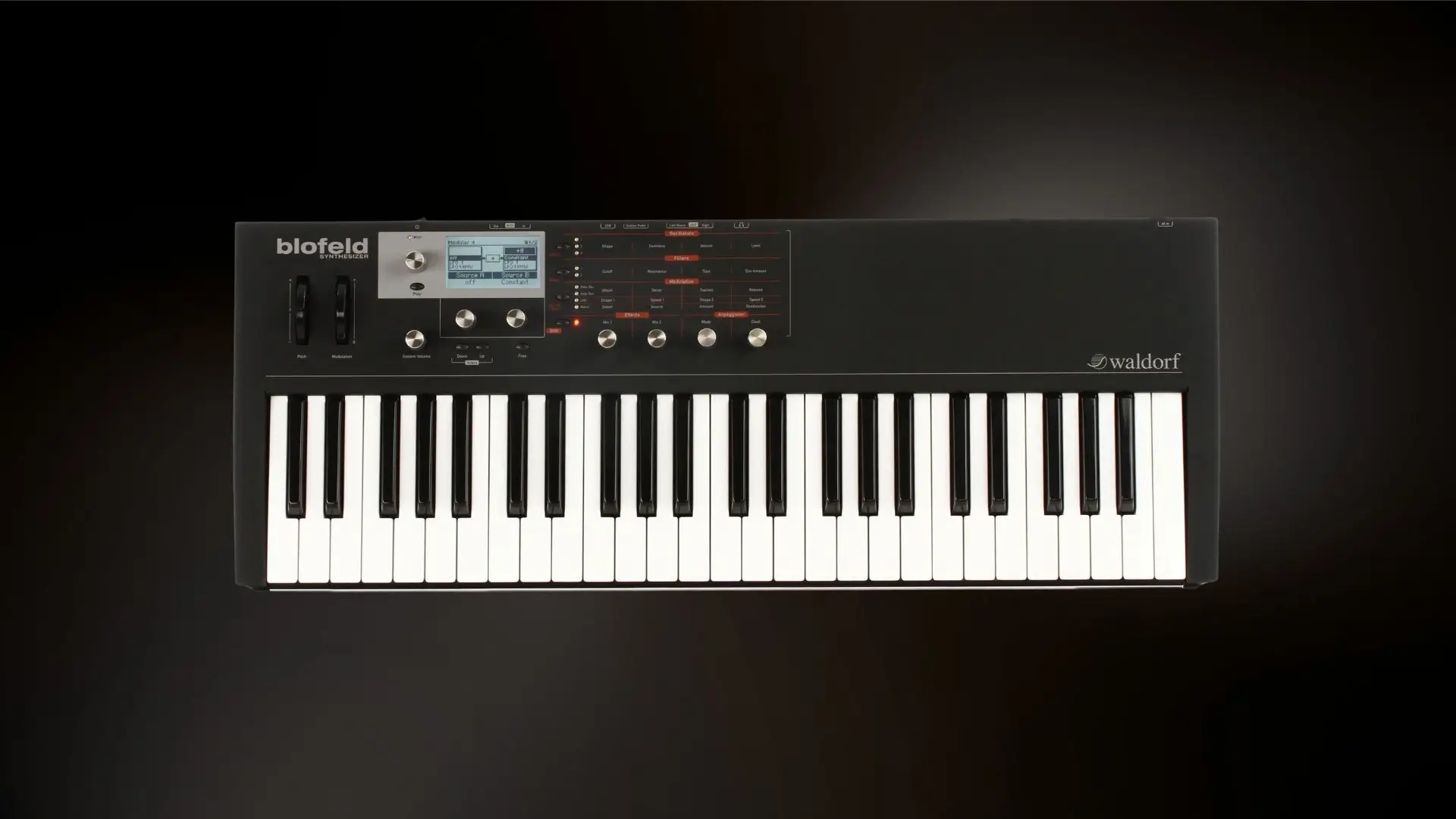
The Waldorf Blofeld is a digital synthesizer platform that began as a desktop module in 2007 and expanded into a 49-key keyboard version in 2009. It combines virtual-analog synthesis, wavetable synthesis, and FM within a compact instrument that offers up to 25 voices and 16-part multitimbrality. What made it matter immediately was not just its specification sheet, but the way it condensed a large part of Waldorf’s sonic identity into a much cheaper and smaller machine than many expected after the company’s troubled mid-2000s period.
Table of Contents
Waldorf Blofeld sound and character
The Waldorf Blofeld sounds unmistakably Waldorf: taut, glossy, slightly severe when pushed, but also more flexible than that stereotype suggests. Contemporary reviews noted that it could sound distinctly Waldorfian while also reaching smoother, lusher territory, including convincing analog-style tones alongside brighter wavetable movement and bell-like digital attacks. That tension between hardness and polish is central to its appeal.
In practice, the Waldorf Blofeld excels at evolving pads, metallic percussion, glassy keys, animated basses, digital choirs, and the sort of restless motion that wavetable synthesis does better than straightforward subtractive instruments. Much of that character comes from the combination of three oscillators per voice, legacy Waldorf wavetable content, oscillator FM, dual multimode filters, filter FM, drive stages, and a deep modulation structure. It can imitate analog vocabulary when asked, but it is more convincing when it leans into its own slightly futuristic sheen rather than pretending to be a vintage monosynth in disguise.
Features and architecture
- Manufacturer: Waldorf Music, Germany.
- Year: Desktop version released in 2007; keyboard version followed in 2009.
- Production years: Both versions are still being sold new by Waldorf and major retailers.
- Synthesis type: Virtual-analog, wavetable, and FM synthesis.
- Category: Digital desktop synthesizer module or digital keyboard synthesizer, depending on version.
- Polyphony: Up to 25 voices.
- Original price and current market price: Early coverage listed the desktop Blofeld at about £370; Waldorf currently lists the desktop at €589 and the keyboard at €899.
- Oscillators: 3 oscillators per voice, with frequency modulation between oscillators; the engine includes Waldorf Q oscillator models and Microwave II/XT/XTk wavetables.
- Filter: 2 independent multimode filters per voice, plus filter FM and per-voice drive stages.
- LFOs: 3 fast LFOs per voice.
- Envelopes: 4 fast envelopes per voice.
- Modulation system: 16 modulation slots with source, destination, and amount, plus modifier functions for mathematical operations on modulation sources.
- Sequencer / arpeggiator: Freely programmable arpeggiator pattern with up to 16 steps per sound.
- Effects: Chorus, flanger, phaser, overdrive, delay, clocked delay, and reverb.
- Memory: More than 1000 sounds; extensive multimode with 128 memory slots. Keyboard version includes sample playback capability out of the box; desktop requires the separate License SL to unlock sample memory.
- Keyboard: Desktop has no keyboard; keyboard version has 49 keys and responds to velocity and aftertouch.
- Inputs / outputs: Stereo out, headphone out, and MIDI/USB connections; desktop version has MIDI In, while the keyboard version has MIDI In and Out plus pedal input.
- MIDI / USB: USB MIDI is supported.
- Display: 128 x 64 monochrome graphic display with white backlight.
- Dimensions / weight: Desktop: 304 × 132 × 54 mm and 1.3 kg. Keyboard: 740 × 275 × 100 mm and 8.0 kg.
- Power: 12V DC for the desktop; keyboard uses internal power supply.
Strengths
- Huge sonic range for the size: Three oscillators, wavetable content inherited from earlier Waldorf lines, FM, dual filters, drive stages, and a deep modulation matrix let the Waldorf Blofeld cover far more ground than its small enclosure suggests.
- A genuinely distinctive digital voice: The instrument produces a recognizably Waldorf blend of edge, shimmer, and density that remains different from generic VA synths.
- Strong multitimbral value: Up to 25 voices and 16-part multimode made it unusually capable for sequencing, layering, and compact studio setups at its price level.
- Serious sound design depth: The 16-slot modulation matrix, modifier functions, flexible arpeggiator structure, and sample option push it beyond preset browsing into true programming territory.
- Long support life: Official soundsets, a Blofeld plugin, and an iPad version show that Waldorf still treats the Blofeld architecture as an active ecosystem.
Limitations
- The interface is deep rather than immediate: The Waldorf Blofeld can involve substantial menu navigation, especially for new users or anyone expecting a knob-per-function workflow.
- Desktop connectivity is sparse: The desktop lacks DIN MIDI Out and offers only one stereo output and no audio input.
- Sample playback is split awkwardly across versions: The keyboard includes sample capability, but desktop owners need the extra License SL purchase.
- It is affordable by Waldorf standards, but no longer ultra-cheap new: Current prices remain reasonable for the depth on offer, yet sit above the bargain aura that helped define the Waldorf Blofeld in early coverage.
Historical context
The Waldorf Blofeld arrived at a very particular moment. It emerged after a difficult phase for Waldorf and functioned as a compact statement that the company could return to hardware without abandoning the wavetable-and-digital complexity that had made the brand important in the first place.
Historically, it sat at the intersection of several Waldorf lineages. It descends from the Q, Micro Q, and Microwave II family, themselves connected to the older PPG Wave tradition. That means the Waldorf Blofeld was never just a budget synth. It was a compact distillation of Waldorf’s established design logic.
Its timing also mattered economically. The Waldorf Blofeld entered the market as a way of bringing high-density digital synthesis back into reach for musicians who could not justify a flagship instrument.