

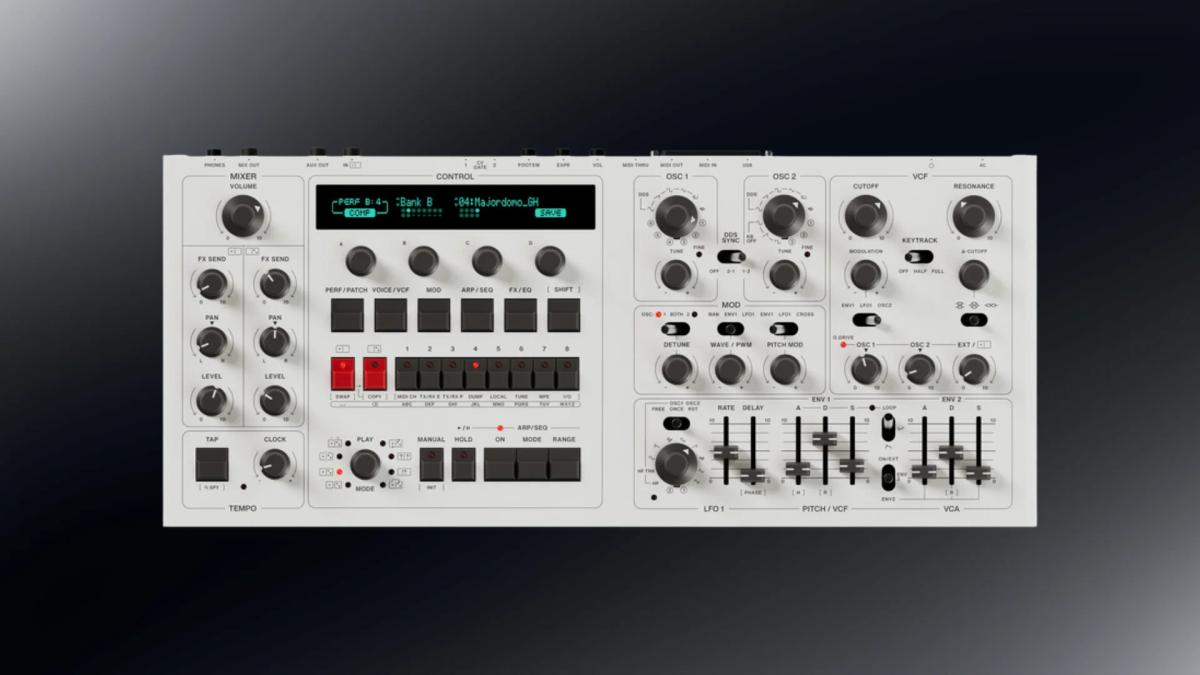
The UDO DMNO ON is a desktop hybrid polyphonic synthesizer from UDO Audio, the Bristol-based company behind the Super 6 and Super Gemini, announced on October 6, 2026. It takes the full engine of the UDO Audio DMNO keyboard and places it in a compact case: eight voices split into two independent four-voice engines, each built around FPGA digital oscillators and UDO’s Dynamic Multi-Core Stereo VCF, with eight Play Modes that decide how the two engines interact. The main change is the control surface. Where the keyboard has two identical synth panels, the desktop unit has one, and a second panel becomes an optional expander called the ONM-1, the first module of what UDO calls the ON System. Launch pricing is $2,850 in the US and £2,099 in the UK, well below the keyboard’s $3,500, and as of October 2026 the instrument is on pre-order.
Table of Contents
UDO DMNO ON sound and character
The UDO DMNO ON is presented by UDO and by every launch report as the same synthesizer as the keyboard DMNO, so its sound can be described through the reviews of the larger instrument. No independent review of the desktop unit had been published by late October 2026. Each of the two engines, labeled DMNO 1 and DMNO 2, has two FPGA-based oscillators per voice running at a very high sample rate, with six “sister” oscillators that build detuned super-waveforms. Vincent Joseph of MusicTech described standard waves plus six assignable single-cycle shapes and 32 user slots, with a Wave/PWM control that morphs between neighboring waveforms.
The oscillators feed an analog filter that is the core of the instrument’s character. Rory Dow of Sound On Sound described it as a dual-core OTA design per voice that can run in stereo, parallel or series, with low-pass, high-pass, band-pass, all-pass and a four-pole phase shifter, adding up to roughly 20 combinations. He singled out the phase shifter, and he also noted what is missing: there is no squelchy SEM-style filter, so the DMNO does not sound like an Oberheim despite its looks. Dow called the instrument a chameleon that often does not behave like a typical polysynth.
Stereo width comes from the binaural signal path UDO first developed for the UDO Super 6. In Binaural mode each channel gets its own full voice, so the eight standard voices become four “super” voices. Andy Jones of MusicRadar heard a large, layered sound with considerable stereo girth and compared the DMNO to an unruly relative of the Super Gemini. His main reservation was polyphony: with four voices per engine, the instrument is not built for lush, many-note pads. Joseph of MusicTech added that some modes limit the voice count to four.
The Play Modes shape the playing experience more than any single parameter. Retailer specifications list eight: Single, Dual, Split, One-Two, Cycle, Random, Chaos and Series. The engines can be layered, split, alternated note by note, triggered at random or chained so that one processes the other. Joseph’s favorite was Chaos, which adds random pitch jumps in fifths or octaves with adjustable probability. Dow found the routing impressive but warned that it can make simple sounds, such as a basic bass patch, feel complicated to set up.
What changes on the UDO DMNO ON is how those two engines are reached. According to MusicRadar, the desktop unit has a single synth control panel that serves both engines, while the keyboard gives each engine its own complete set of controls. Gearnews stressed that the full engine, all eight voices and both parts, remains accessible in the base configuration. Adding the ONM-1 restores the dual-panel layout, so both engines can be adjusted at the same time, which is closer to how the keyboard DMNO is played.
The effects stage is shared with the keyboard: a 32-bit DSP chain with drive, chorus and 3-band EQ as per-engine inserts, plus delay and reverb on send buses. Dow judged the effects good-sounding but basic, and criticized pre-fader sends and the lack of series routing. On both DMNO versions the effect parameters live in menus, which is the gap the planned ONM-2 module is meant to close. Alongside the launch, Sonicstate reported an OS update for both models that adds a Super6 oscillator mode, faster patch loading and more memory.
Features and architecture
- Manufacturer: UDO Audio (Bristol, UK)
- Year introduced: 2026 (announced October 6, 2026)
- Production years: 2026 to present (pre-order as of October 2026)
- Synthesis type: Hybrid; FPGA digital oscillators into an analog filter and signal path
- Category: Desktop polyphonic hybrid synthesizer, expandable with ONM control modules
- Polyphony: 8 voices (two engines of four); 4 “super” voices in Binaural mode
- Multitimbrality: 2 parts (DMNO 1 and DMNO 2), with eight Play Modes: Single, Dual, Split, One-Two, Cycle, Random, Chaos, Series
- Original price: $2,850 (US), £2,099 (UK), €2,449 (EU, per Gearnews); ONM-1 module £659, $875 at Kraft Music
- Current market price: Pre-order only; €2,399 at Thomann Belgium and £2,095 at Scan UK in October 2026
- Oscillators: Two FPGA-based multi-wave oscillators per voice with six sister oscillators for super-waveforms, plus noise and alternative single-cycle waveforms; sync and cross-modulation; Super6 oscillator mode added by OS update
- Filter: Dynamic Multi-Core Stereo analog VCF per voice in parallel, series or stereo configurations; low-pass, high-pass, band-pass, all-pass and phaser types
- LFO: Two LFOs according to Scan; Thomann lists ten LFO waveforms
- Envelopes: Three envelopes
- Modulation system: Programmable modulation matrix; audio input gate detector and envelope follower available as sources
- Sequencer / arpeggiator: 64-step sequencer; multi-mode arpeggiator with Smart Hold; MIDI sync
- Effects: 32-bit DSP chain with delay, reverb, chorus, overdrive/distortion and 3-band EQ
- Memory: 128 patch slots and 128 performance slots (Thomann); Sonicstate reports the new OS adds more memory
- Keyboard: None (desktop unit)
- Inputs / outputs: Stereo main out, stereo aux out (assignable to DMNO 1/2, USB audio or the effects send bus), headphone out, stereo audio input with variable-gain preamp, two CV and two gate/clock outputs on 3.5 mm jacks, sustain, volume and expression pedal inputs, D-Sub expander port for ONM modules
- MIDI / USB: 5-pin MIDI In and Out (Thomann also lists Thru); USB with 2-in/2-out 24-bit audio interface
- Display: Electroluminescent VFD (vacuum fluorescent display)
- Dimensions / weight: 487 x 220 x 107 mm; 4.5 kg; VESA mounting points
- Power: Not specified by the manufacturer in the sources consulted; ONM modules draw power through the D-Sub cable
Strengths
- The UDO DMNO ON keeps the complete DMNO engine. Both engines, all eight voices, the eight Play Modes and the effects are present in the base unit, so the desktop version is not a reduced model.
- It lowers the entry price. At $2,850 and £2,099 the UDO DMNO ON costs roughly $650 and £500 less than the keyboard DMNO at its listed prices.
- Control can be added in stages. Owners can start with one panel and later add the ONM-1 for dual-engine control or the planned ONM-2 for effects, using up to two modules at a time.
- The expanders need no extra power supply. A screw-locking D-Sub cable carries both the connection and the power, which keeps a multi-unit setup tidy.
- Studio integration is strong. The 24-bit USB audio interface, assignable aux output, external input with envelope follower and CV/gate outputs carry over from the keyboard.
- It suits racks and mounts. VESA points on all units and planned joining plates allow the base unit and its modules to be fixed together or mounted on stands.
Limitations
- The UDO DMNO ON base unit has only one synth panel. Both engines share one set of controls, so adjusting DMNO 1 and DMNO 2 at the same time requires the ONM-1.
- The full system costs more than the keyboard. At Kraft Music the DMNO ON with ONM-1 and cables is $3,725, above the keyboard DMNO’s $3,500 list price, which already includes two panels and a keybed.
- Polyphony is modest. Four voices per engine, and four in total in Binaural mode, limit wide chords when the two engines play different parts.
- Effects editing remains menu-based. Hands-on effects control depends on the ONM-2, which had no price or release date at launch and whose layout UDO said may change.
- There are no independent reviews yet. Assessments of the sound come from reviews of the keyboard DMNO; the desktop control layout has not been tested in print.
- Availability and pricing are unsettled. Retailers list the unit as a pre-order with estimates of several weeks, and published US and EU prices differ between outlets.
Historical context
UDO Audio’s instruments are designed by George Hearn, whose earlier career, according to a MusicTech interview, included surgical, industrial and aerospace design and work for a Formula One team. The company’s first instrument, the Super 6 of 2021, combined FPGA digital oscillators with an analog filter and a binaural stereo signal path. The UDO Super Gemini followed with a design that referenced the Yamaha CS-80 and topped MusicRadar’s 2023 gear-of-the-year list. Hearn describes the company’s philosophy as limitation-driven, summed up in his line “just because you can, doesn’t mean you should.”