

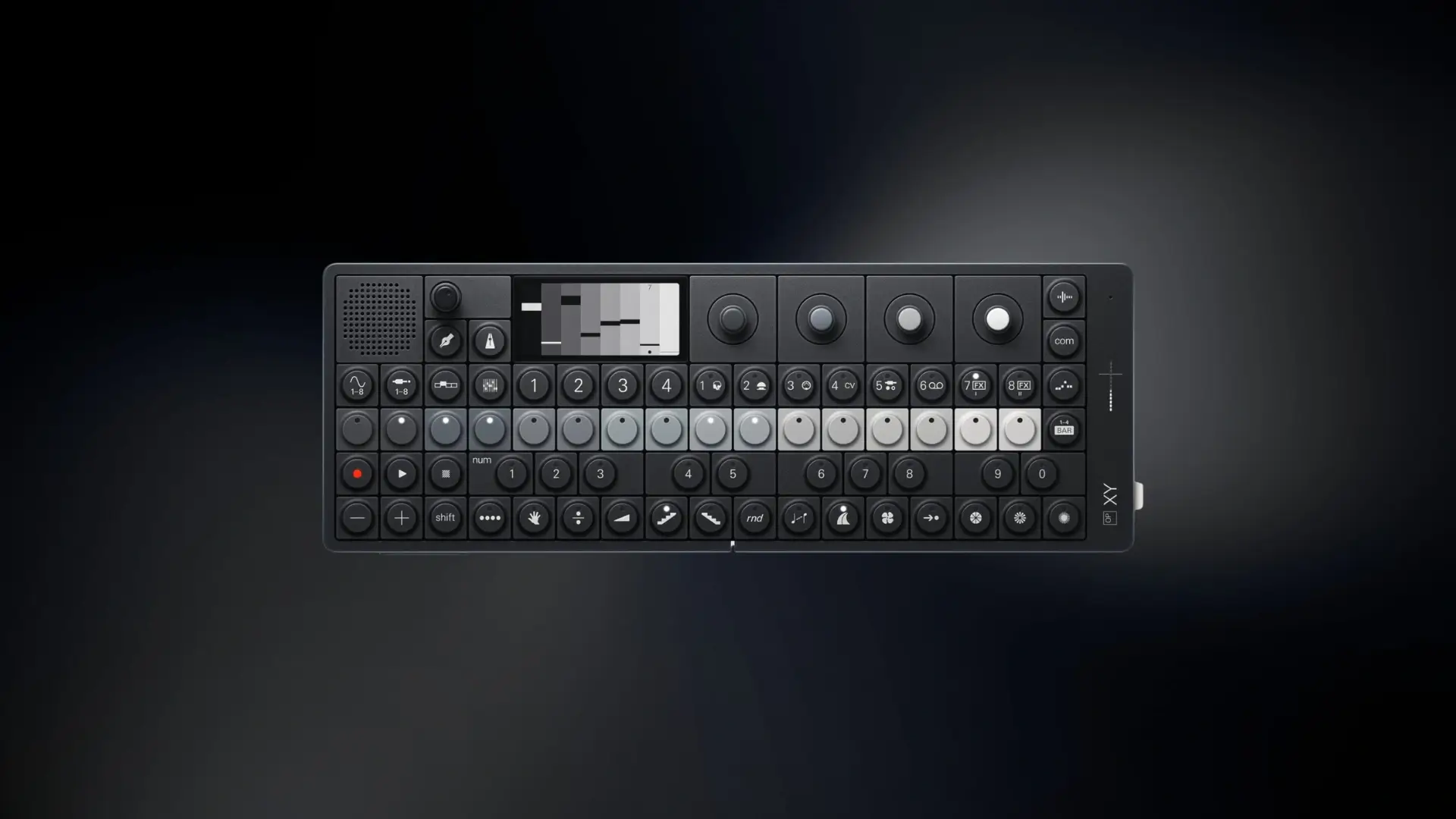
The Teenage Engineering OP-XY is a portable digital synthesizer, sampler and sequencer introduced in late 2024. It combines the sequence-first philosophy of the OP-Z with the physical scale and integrated display of the OP–1 Field, adding eight internal instrument tracks, eight auxiliary tracks, 24-voice multitimbral synthesis, sampling, CV, MIDI and USB audio. Its importance lies less in any individual sound engine than in the attempt to turn Teenage Engineering’s compact sequencing language into a self-contained composition and performance instrument.

Table of Contents
Teenage Engineering OP-XY sound and character
The Teenage Engineering OP-XY is not a disguised analog polysynth. Its sound is deliberately digital, model-based and practical: a collection of compact engines designed for fast decisions rather than exhaustive oscillator-by-oscillator construction. Axis covers FM-derived strings and harmonically shifting tones; Dissolve brings tonal noise, detune and abrasive movement; EPiano handles electric-piano colors, bright leads and basses; Hardsync supplies more forceful stabs and low-end material; Organ covers transistor and church-inspired tones; Prism, Simple and Wavetable complete the palette.
That architecture gives the Teenage Engineering OP-XY a broad but curated character. It can move from clear electronic basses and percussive leads to noisy pads, layered sampled instruments and melodic electro textures without presenting itself as a neutral laboratory. The internal engines are built around immediately useful controls, so the instrument encourages selection, variation and sequencing more than microscopic synthesis.
Its identity becomes clearer once the sequencer is involved. A patch that might feel modest when played statically can become animated through parameter locks, step components, probability-like behavior, ratchets, pitch variation, timing changes and performance effects. The Teenage Engineering OP-XY’s strongest sounds are therefore often not isolated presets but repeating structures that slowly mutate.
Sampling is essential to this identity. The drum sampler, multisampler and synth sampler allow the machine to absorb external sound sources rather than remain confined to its own engines. That makes it especially convincing as a central sketching instrument for artists who want electronic sequencing but do not want every arrangement to share the same factory palette.
Features and architecture
- Manufacturer: Teenage Engineering, Stockholm, Sweden.
- Introduction and production: Introduced in November 2024; still a current product in Teenage Engineering’s catalog as of June 2026.
- Synthesis type: Digital multitimbral synthesis, combined with drum sampling, multisampling and synth sampling.
- Category: Portable synthesizer, sampler, sequencer and live-performance instrument.
- Polyphony: 24-voice multitimbral synthesis.
- Instrument and auxiliary tracks: Eight internal instrument tracks and eight auxiliary tracks for sequencing external devices, effects and performance functions.
- Synth engines: Eight internal engines: Axis, Dissolve, EPiano, Hardsync, Organ, Prism, Simple and Wavetable.
- Oscillator architecture: Engine-specific rather than based on one universal oscillator design. Axis uses FM-oriented controls, Prism includes oscillator ratio, detune and stereo spread, while Simple provides waveform and pulse-width control.
- Sampling: Drum sampler, multisampler and synth sampler, with internal microphone, stereo line input and USB audio available as sound sources.
- Filter: Four selectable filter types, with cutoff, resonance, envelope amount and keyboard tracking controls.
- Envelopes: Two ADSR envelopes per track: one amplitude envelope and one filter envelope.
- Modulation: Per-track modulation through envelopes, LFO functions, gyro and microphone interaction, parameter locks, pressure-sensitive pitch bend and performance-oriented controls.
- Sequencer: Sixteen-track, 64-step sequencer spread across four pages, with up to 64 bars per pattern, nine patterns per track, 99 scenes, song mode and independently scaled track lengths and speeds.
- Step components: Fourteen step components, with the ability to apply multiple components to a single step for repetitions, holds, pitch changes, randomization and rhythmic variation.
- Players and composition tools: Per-track Players for arpeggios and chord behavior, Brain intelligent transposition, microtonal tuning and groove options.
- Effects: Reverb, delay, chorus, distortion, lo-fi and phaser effects, organized through two sequenceable send-effect slots.
- Performance processing: Twenty-four Punch-In FX, Tape Looper, master EQ, master saturation, master compressor and limiter.
- Memory: 8 GB of user storage, with support for thousands of projects and version history.
- Keyboard and controls: Two-octave, 24-key musical keyboard; 68 low-profile mechanical buttons; four encoders; pressure-sensitive pitch bend; built-in speaker.
- Display: Integrated color IPS TFT display.
- Inputs and outputs: Stereo line output, stereo line input, 3.5 mm MIDI input, built-in microphone and multi-output port.
- External control: Multi-output can be configured for MIDI, CV plus gate, Sync8, Sync16, Sync24 or audio.
- USB and wireless: USB-C audio and MIDI host/device operation, plus Bluetooth LE MIDI.
- Dimensions and weight: 288 × 102 × 29 mm; 900 g.
- Power: Rechargeable USB-C battery rated for up to 16 hours of use.
- Price: Introduced at US$2,299; Teenage Engineering’s direct US store still listed the Teenage Engineering OP-XY at US$2,299 in June 2026.
Strengths
- A genuinely deep portable sequencer: The Teenage Engineering OP-XY’s core achievement is its ability to make a 64-step grid behave less like a static loop and more like a changing composition. Step components, parameter locks and independent track behavior allow patterns to develop without requiring constant manual rewriting.
- A stronger physical realization of the OP-Z concept: The built-in screen, larger controls and conventional layout solve some of the OP-Z’s most persistent usability problems. The Teenage Engineering OP-XY is still compact, but it is far less dependent on visual memory or an external companion device.
- Sampling prevents sonic repetition: The built-in engines are useful but limited by design. The three sampling modes make the OP-XY more durable as a long-term instrument because external material can become part of its musical vocabulary.
- External integration is unusually serious for the format: CV, gate, MIDI, sync, USB audio and auxiliary tracks make the Teenage Engineering OP-XY viable as a control center for hardware rather than merely a self-contained groovebox.
- Performance functions are integrated rather than decorative: Punch-In FX, Tape Looper, Brain transposition, mute behavior and effect sequencing make the instrument suitable for reshaping a composition in real time instead of simply pressing play on completed patterns.
- The compact form factor has practical value: Its 16-hour battery, internal speaker, two-octave keyboard and 900 g weight make it easier to carry and use away from a studio than most instruments with comparable sequencing depth.
Limitations
- The price remains difficult to justify on features alone: At US$2,299, the Teenage Engineering OP-XY competes with combinations of dedicated grooveboxes, samplers, synthesizers and controllers. Its value depends heavily on whether the buyer specifically wants its integrated workflow and compact design.
- It is not a deep conventional programming synth: The engines are effective, but the Teenage Engineering OP-XY is fundamentally a preset-and-macro instrument. It is better at selecting, shaping and sequencing sounds than building a highly specific patch from first principles.
- The interface is clearer than the OP-Z’s, but still layered: Four main modes, four module pages, shift functions and specialized terminology create a real learning curve. The machine rewards repeated use but does not provide the immediate transparency of a traditional keyboard synthesizer.
- The two-octave keyboard is a compositional tool, not a full performance keyboard: It is useful for entering ideas, recording phrases and playing compact parts, but serious pianistic playing or expressive two-handed performance will usually require an external controller.
- Eight internal instrument tracks impose arrangement discipline: The auxiliary tracks greatly expand external control, but they do not increase the number of internal synth or sample voices available as separate instrument parts.
- The design can become a constraint: The Teenage Engineering OP-XY’s small encoders, dense control layout and compact display are inseparable from its portability. Musicians who prefer large knobs, immediate modulation matrices and permanent visual feedback may find the experience unnecessarily compressed.
Historical context
The Teenage Engineering OP-XY arrived at an important point in Teenage Engineering’s history. The original OP–1, introduced in 2011, established the company as a maker of portable instruments that treated interface design as part of musical expression. The OP-Z, released years later, pushed the other side of that idea: a remarkably capable step sequencer that intentionally omitted a built-in display.
That decision made the OP-Z compact and conceptually bold, but it also created friction. Its icon-heavy interface required memorization or dependence on a companion device. The Teenage Engineering OP-XY responds directly to that problem. It preserves the sequence-first structure of the OP-Z while giving the user a display, a larger chassis, stronger connectivity and a more legible control surface.
The result is not simply an OP–1 in black. The OP–1 and OP–1 Field are centered on tape-style recording and playful all-in-one composition. The Teenage Engineering OP-XY is more disciplined, pattern-based and performance-oriented. It is closer to a modern sequencing workstation compressed into a portable form than to a conventional synthesizer with an added sequencer.