

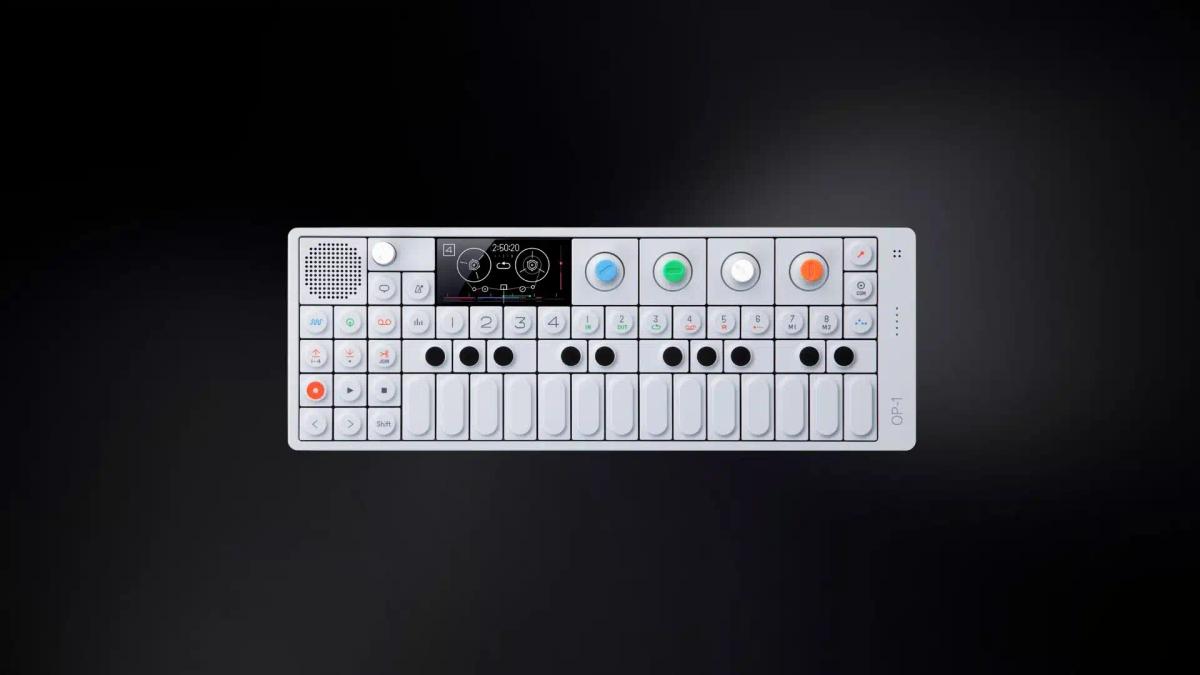
The original Teenage Engineering OP-1 arrived in 2011 as a battery-powered digital instrument combining synthesizer engines, sampling, drum programming, USB control, radio, motion sensing, and a four-track tape-style recorder. It was also Teenage Engineering’s first product. Its importance was never simply that it placed many functions in a compact aluminium body. The Teenage Engineering OP-1 proposed a different working method: create a sound, capture it quickly, alter it through tape-style operations, and commit to the result.
Table of Contents
Teenage Engineering OP-1 sound and character
The Teenage Engineering OP-1 does not have one fixed sonic identity in the manner of a Minimoog, Juno-60, or DX7. Its character comes from contrast. The instrument moves between layered digital oscillator clusters, four-operator FM, phase distortion, waveguide string modelling, pulse-based synthesis, frequency-domain processing, sampled material, and drum synthesis. That range makes it less like a traditional single-architecture synthesizer and more like a compact sound laboratory with a deliberately limited physical interface.
Cluster and Pulse can create dense, animated electronic tones; FM, Phase, and Digital engines can produce sharper or more synthetic material; String emphasizes resonant, plucked behaviour; and the sampling engines allow the instrument to absorb external sound rather than remain inside a preset library. The OP-1’s sound is therefore often defined less by raw oscillators than by transformation: sample something, pitch it across the keyboard, send it through an effect, and record it to tape.
Its effects are also unusually central to its musical identity. Grid, Spring, CWO, Phone, Punch, Nitro, and Delay are not presented as invisible studio utilities. They are part of the sound-design language. Phone can reduce material to a deliberately narrow, damaged signal; Grid can build feedback-based spatial movement; CWO combines delay and pitch shifting; and Punch or Nitro can radically reshape frequency content. The result can be polished, but the Teenage Engineering OP-1 is at its most distinctive when it allows digital precision, lo-fi artefact, playful resampling, and tape-like instability to coexist.
Features and architecture
- Manufacturer: Teenage Engineering.
- Year introduced: 2011.
- Production years: 2011–2022 for the original model, before the OP-1 Field became the current successor.
- Synthesis type: Digital multi-engine synthesis, sampling, drum synthesis, and tape-based audio recording.
- Category: Portable synthesizer, sampler, sequencer, four-track recorder, USB MIDI controller, and USB audio device.
- Polyphony: Published sources are inconsistent. A six-voice specification appears in published product data, while later editorial coverage refers to eight voices in practice. The original Teenage Engineering OP-1 is therefore better understood as an engine-dependent compact instrument rather than one to buy for a guaranteed high voice count.
- Sound engines: Thirteen engines/modules are documented across synthesizer, sampler, and drum functions, including Cluster, Digital, String, Pulse, FM, Phase, Dr. Wave, DSynth, Voltage, DNA, D-Box, Synth Sampler, and Drum Sampler.
- Oscillators and tone generation: The Teenage Engineering OP-1 uses distinct digital sound-generation approaches rather than one common oscillator-and-filter architecture. Cluster can layer multiple waves, Pulse uses dual pulsetrain oscillators, FM uses four operators, and String uses waveguide modelling.
- Filter approach: There is no single shared analogue-style voltage-controlled filter. Filtering is engine-specific and supplemented by effects including Punch, a low-pass filter effect, and Nitro, a dual resonant filter.
- Envelopes: ADSR envelope section for shaping amplitude and other assigned destinations.
- LFOs and modulation: Routable LFO and control sources can target the engine, envelope, or effect. Available modulation tools include Value, Tremolo, Random, Element, MIDI, Bend, and Crank modes.
- Motion and external modulation: The built-in G-force sensor, microphone, line input, radio, and internal signal sources can influence modulation through the Element LFO.
- Sequencer and arpeggiator: Seven documented sequencing modes, including Pattern, Endless, Tombola, Finger, Sketch, and arpeggiator functions.
- Tape recorder: Four-track virtual tape recorder with six minutes of recording time at normal speed, real-time speed changes, reverse recording, overdubbing, lifting, dropping, splitting, looping, and track manipulation.
- Effects: Seven effects: Delay, Grid, Nitro, Phone, Punch, Spring, and CWO.
- Memory: 512 MB NAND flash memory, with presets, samples, snapshots, tape recordings, and file transfer through disk mode.
- Keyboard: Compact low-profile scissor-switch keyboard with fixed velocity and no aftertouch.
- Inputs and outputs: Built-in microphone, speaker, FM radio receiver, 3.5 mm line input, 3.5 mm line output, and Mini USB.
- MIDI and USB: USB MIDI, disk mode, controller functionality, and stereo USB audio streaming added through the OS 243 update.
- Display: 320 × 160 colour AMOLED display with a vector-based graphical interface.
- Dimensions and weight: Approximately 282 × 102 × 27 mm and 0.58 kg.
- Power: Rechargeable 1,800 mAh lithium-ion battery, with a quoted operating time of up to 16 hours.
- Original price: Announced at US$799 / €799 in 2011.
Strengths
- A complete musical workflow in one instrument: The Teenage Engineering OP-1 can move from synthesis or sampling to sequencing, recording, bouncing, and arrangement without requiring a computer. Its four-track tape is not an accessory; it is the center of its compositional logic.
- Genuinely varied sound generation: The different engines are not cosmetic variations of one subtractive architecture. FM, phase distortion, waveguide modelling, pulse synthesis, spectral processing, sampling, and drum tools make the instrument useful for contrasting tonal roles.
- An interface built around decisions rather than menus: The colour-coded encoders and animated display reduce the distance between a parameter and its consequence. The interface can be unconventional, but it encourages direct experimentation instead of deep menu navigation.
- Sampling as composition rather than storage: The microphone, radio, line input, and internal sampler make found sound part of the instrument’s vocabulary. A phrase from the radio, a vocal fragment, or a room sound can become keyboard material within the same device.
- A long-lived platform: Teenage Engineering continued to update the original unit for a decade. The OS 243 update, which added USB stereo audio streaming, materially extended the Teenage Engineering OP-1’s role in modern computer and mobile workflows.
- Portability without becoming a toy: Its battery operation, built-in speaker, compact keyboard, and durable metal chassis encouraged sketching away from a studio, while the tape recorder and export functions allowed those sketches to become finished ideas.
Limitations
- The keyboard is musically restrictive: The original Teenage Engineering OP-1 has no velocity sensitivity or aftertouch. That is a serious limitation for players who depend on keyboard dynamics, expressive pads, or conventional performance technique.
- The tape workflow demands commitment: The recorder allows powerful operations such as lift, drop, reverse, and speed manipulation, but it does not behave like a modern non-destructive DAW. Erasing tape is irreversible, and the original model has no broad undo-and-redo safety net.
- Sampling time is limited: The original synth sampler and drum sampler are short-form tools, not substitutes for a dedicated long-sample workstation. The instrument is strongest when sampling is used creatively and economically.
- The interface is brilliant but idiosyncratic: A user accustomed to conventional synthesizers may find the colour system, mode structure, and tape-centric workflow initially opaque. The OP-1 rewards familiarity rather than immediate technical transparency.
- Its connectivity reflects its era: Mini USB and 3.5 mm audio connections are compact, but the original model lacks the broader physical MIDI and audio connectivity expected from a studio-centered keyboard instrument.
- Its market value can exceed its technical specification: The Teenage Engineering OP-1’s cultural status has often made it more expensive than instruments with greater polyphony, larger keyboards, deeper sequencing, or more conventional production features.
Historical context
The Teenage Engineering OP-1 entered the market in 2011, when Teenage Engineering was a new company and the instrument was its first commercial statement. It did not arrive as a recreation of an older analogue classic, nor as a conventional workstation competing through keyboard size, multitimbrality, or specification density. Instead, it established an object-centered approach to electronic music equipment: compact, visually coherent, portable, and designed around an unusual creative ritual.
The original US$799 launch price placed it in a serious but not unreachable category. Its later history complicated that position. Production was interrupted during the late 2010s, the instrument returned at a higher price, and its reputation expanded beyond its original technical specifications. By the time the OP-1 Field appeared in 2022, the original had already become a reference point for a generation of compact music hardware.
The timing mattered because the Teenage Engineering OP-1 argued that portability did not need to mean simplification. It compressed synthesizer, sampler, sequencer, recorder, controller, radio, and speaker into an instrument that could be used away from the studio, but it did not treat mobility as a novelty. The central four-track tape recorder forced a process of arrangement and commitment that stood apart from the unlimited-track logic of software production.