Home›Articles›What is the sound of a synthesizer? The classic synth s…
Articles

What is the sound of a synthesizer? The classic synth sound families explained

A synthesizer has no single sound. Learn the classic families, from fat analog bass and pads to FM bells and acid squelch, with famous records for each.

Bernardo de Azevedo
Bernardo de Azevedo
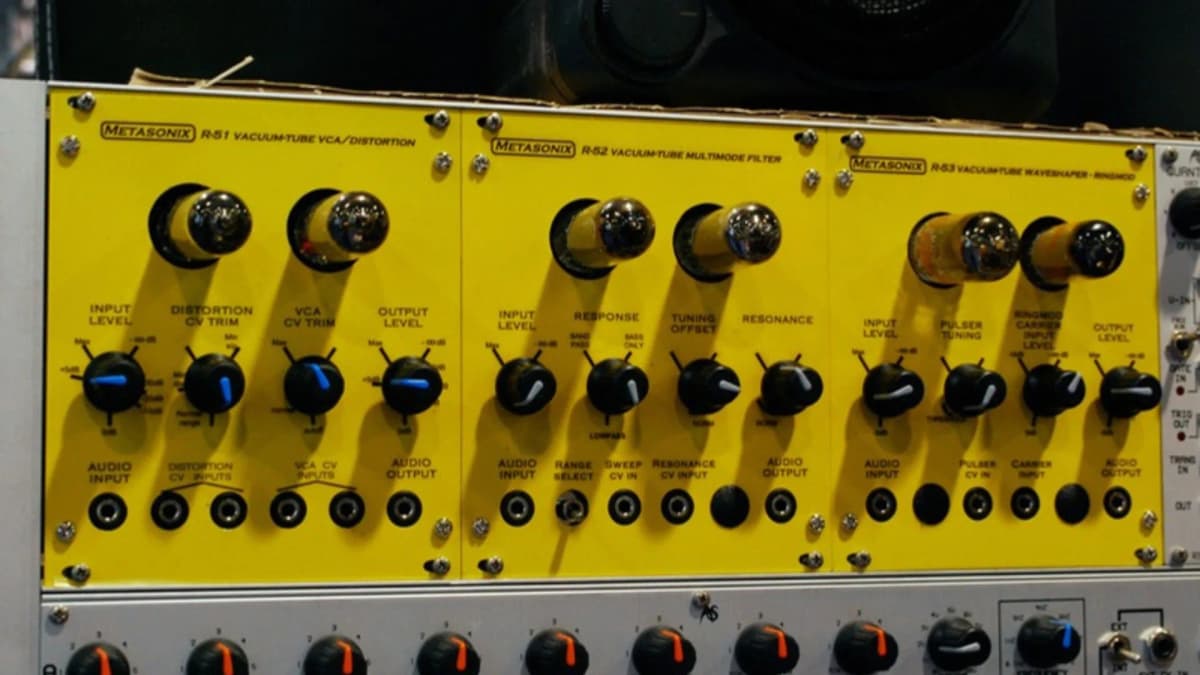
Metasonix Eurorack modules, a hands-on look at how a synth sound is shaped

The sound of a synthesizer is not one single sound. It is an instrument that generates tones electronically and lets you shape them, so the same synth can produce a deep bass, a soaring lead, a soft pad, a bell or a drum. What people usually mean by “the synth sound” is a handful of classic families: fat analog bass, bright sawtooth leads and chords, slow evolving pads, glassy FM bells and electric pianos, and squelchy resonant basses like the Roland TB-303. They sound “synthetic” because they start from simple, mathematically regular waveforms, are shaped by filters and envelopes, and are set in motion by modulation rather than by a bow, breath or hammer.

This guide explains where those sounds come from, gives a famous recording for each family and offers some vocabulary for describing synth timbre.

Why synths sound “synthetic”

Acoustic instruments produce messy, constantly shifting overtones. A synth starts from something much simpler and builds up from there. Four building blocks explain most of what you hear.

Oscillators and waveforms shape the synth sound

The oscillator makes the raw tone. Each basic waveform has a recognisable character:

  • Sine: a pure tone with no overtones; soft, round, flute-like or sub-bass.
  • Triangle: a few weak overtones; mellow and hollow.
  • Square and pulse: odd harmonics only; hollow, woody or reedy, like a clarinet. Changing the pulse width over time (pulse-width modulation) gives a shimmering, chorused movement.
  • Sawtooth: every harmonic; bright, buzzy and brassy. It is the raw material for most classic leads, brass and string sounds.
  • Noise: random energy across the spectrum; used for wind, breath, cymbals and snare drums.

Filters shape the synth sound

In subtractive synthesis, the oldest and most common approach, a filter removes overtones from that raw waveform. A low-pass filter darkens the sound as you lower its cutoff. Turning up resonance boosts the frequencies around the cutoff, producing the whistling, vocal “wah” that sweeps through so many synth records. Subtractive synthesis is often described as rich and warm.

Envelopes shape the synth sound

An envelope shapes how a sound changes over time, usually in four stages: attack, decay, sustain and release (ADSR). A fast attack and short decay give a pluck; a slow attack gives a swelling pad. Envelopes often control the filter as well as the volume, which is why synth notes can “open up” as they start.

Modulation

Low-frequency oscillators (LFOs) and other modulators move parameters automatically: vibrato on pitch, tremolo on volume, rhythmic wobbles on the filter. Much of a synth’s personality comes from how things move, not from the starting waveform.

Analog warmth versus digital clarity

Analog synths are often called warm. Tom Oberheim has compared the difference to vinyl versus CD, and some of that warmth is mild distortion when analog circuits are pushed, plus small imperfections that make analog sound less sterile. Digital methods such as FM and wavetable reach timbres analog circuits struggle with: FM is usually described as glassy, bright or metallic. Neither is better; they are different palettes.

The sound of a synthesizer: the classic sound families

Sound family What it sounds like Typical synthesis Famous example
Fat analog bass Deep, round, punchy Subtractive, saw or square through a low-pass filter Parliament, “Flash Light” (Minimoog)
Sequenced bass Pulsing, hypnotic repeated notes Subtractive mono synth driven by a sequencer Donna Summer, “I Feel Love” (Moog)
Acid bass Squelchy, chirping, liquid Subtractive with resonant filter and accents Phuture, “Acid Tracks” (TB-303)
Leads Bright, cutting, often gliding Subtractive mono, saw or square Gary Numan, “Are ‘Friends’ Electric?” (Minimoog, Polymoog)
Brass and big chords Bold, blaring stabs Polyphonic subtractive, sawtooth Michael Jackson, “Thriller” opening (Jupiter-8)
Pads and strings Slow, wide, atmospheric Polyphonic subtractive with chorus; wavetable Vangelis, Blade Runner (Yamaha CS-80, Prophets)
Arpeggios Rapid, cascading note patterns Any synth plus an arpeggiator Duran Duran, “Rio” (Jupiter-4)
Plucks Short, percussive, string-like Fast envelopes; sample plus synthesis Enya, “Orinoco Flow” (D-50 “Pizzagogo”)
Bells and electric piano Glassy, chiming, metallic FM synthesis Yamaha DX7 “E Piano 1” on 1980s ballads
FM bass Tight, slappy, percussive FM synthesis a-ha, “Take On Me” (DX7 “Bass 1”)
Evolving and growling textures Morphing, moving, aggressive Wavetable synthesis PPG Wave and modern wavetable synths
Drums and noise Booming kicks, clicky percussion Analog drum synthesis Marvin Gaye, “Sexual Healing” (TR-808)
Robot voices Speech with synthetic pitch Vocoder Kraftwerk, Autobahn; Daft Punk

Bass in the synth sound palette

The Minimoog made synth bass a staple of funk, disco and pop in the 1970s, and its low end is still the reference point for “fat”. Giorgio Moroder’s sequenced Moog line on “I Feel Love” showed what a repeating synth bass could do on a dance floor; our I Feel Love story tells how it was made. The TB-303 came later with a different flavour: when Phuture tweaked one live in 1987, the resonant filter produced the squelching, liquid sound that became acid house. If you want that classic mono sound today, see our Minimoog Model D and Roland TB-03 pages.

Leads, brass and chords in the synth sound palette

Sawtooth waves through a partly open filter give the classic lead and brass sound. Polyphonic synths such as the Prophet-5 and Jupiter-8 turned that into chords and stabs, heard on the opening of “Thriller” and across early-1980s pop. Our Prophet-5 story explains the polysynth breakthrough.

Pads and strings in the synth sound palette

Slow attacks, long releases, detuned oscillators and chorus produce the wide, cinematic pads associated with Vangelis. String synthesizers, pioneered by Ken Freeman, were designed specifically to imitate string sections. Wavetable synthesis is especially good at evolving pads because the waveform itself can change as the note sustains. Read about Vangelis’s instrument in our CS-80 and Blade Runner article.

FM bells, electric pianos and basses in the synth sound palette

Frequency modulation, developed by John Chowning at Stanford and licensed to Yamaha, produces bright, glassy and bell-like spectra. The DX7 (1983) made it ubiquitous: its “E Piano 1” preset became the sound of the 1980s power ballad, and its bass presets appear on “Take On Me” and Berlin’s “Take My Breath Away”. For a hands-on modern take, see our Korg opsix page.

Wavetable textures in the synth sound palette

Wolfgang Palm’s PPG synths of the late 1970s and early 1980s introduced wavetable sweeping, moving through a series of stored waveforms to create motion. Modern wavetable synths use the same idea for everything from shimmering pads to the aggressive, growling basses of contemporary electronic music. Our ASM Hydrasynth and Korg modwave pages show how far that has gone.

Drums and the vocoder in the synth sound palette

Synths can make percussion too. The Roland TR-808’s bass drum is essentially a sine oscillator with a long decay, and critics have described its sounds as clicky, robotic and futuristic. The vocoder imposes the shape of a voice onto a synth tone: Kraftwerk used a custom one on Autobahn, Wendy Carlos used one on A Clockwork Orange, and Daft Punk made it a trademark.

How to describe synth timbre

Musicians use a loose but useful vocabulary. These words map fairly well onto the controls:

  • Bright or dark: how many high overtones get through, mostly the filter cutoff.
  • Fat or thin: how much low end and detuning there is; several slightly detuned oscillators sound fatter.
  • Warm or cold: soft saturation and gentle drift versus clean, precise digital tones.
  • Squelchy or resonant: high filter resonance with a moving cutoff.
  • Glassy or metallic: inharmonic or high overtones, typical of FM.
  • Plucky or swelling: fast versus slow attack and decay.
  • Moving or static: how much LFO or envelope modulation keeps the sound evolving.

Describing a sound with two or three of these terms, plus the waveform and synthesis type, is usually enough for another player to get close.

FAQ

Does a synthesizer sound like a piano?

It can imitate one, especially sample-based and FM synths, but a synth’s own character comes from its oscillators, filters and envelopes. Classic synth sounds are usually not trying to be acoustic instruments.

Why do synths sound like the 1980s?

Because affordable polysynths and the DX7 dominated 1980s pop, their presets (brass stabs, FM electric pianos, gated drums) became shorthand for the decade. Synths can sound like any era.

What is the difference between analog and digital synth sound?

Analog synths are often described as warm thanks to circuit saturation and slight instability; digital synths can be cleaner and reach glassy FM or morphing wavetable sounds that analog circuits find difficult.

What makes the classic “synth bass” sound?

Usually a sawtooth or square wave from a mono synth, through a low-pass filter with a quick envelope, often with some resonance. The Minimoog is the archetype.

Related articles

Sources

Image credits: Metasonix Eurorack modules photo by Brandon Daniel, Wikimedia Commons, CC BY-SA 2.0. The photo was cropped to fit the featured image.


Bernardo de Azevedo
Written by
Bernardo de AzevedoFounder & Editor

His connection with music began at age 6, in the 1980s, when his father introduced him to Jean-Michel Jarre's Rendez-Vous on vinyl. He works professionally in the legal field, while synthesizers became his space for abstraction and creative exploration. Founder of The Synth Source.